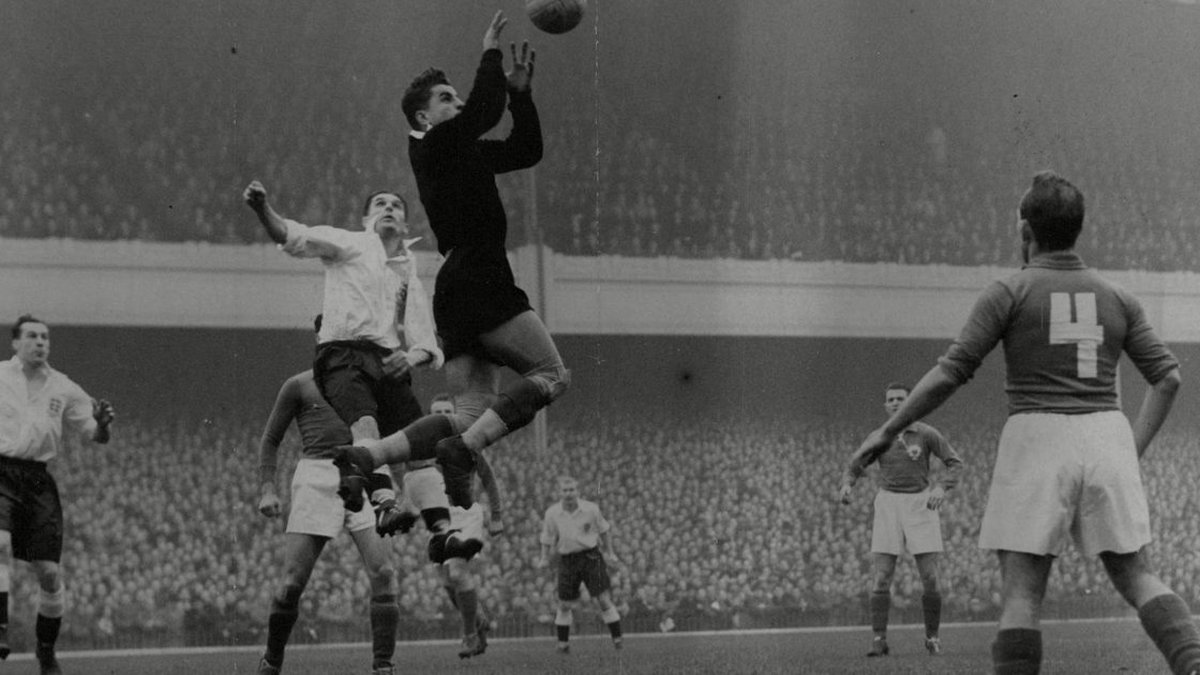
As the 2026 World Cup gets under way, Tony Shaw and Alan McDougall revisit eight football matches played during the Cold War that turned the beautiful game into a battleground of ideology, identity and state power
1. The fog of war at White Hart Lane
A chaotic 1945 friendly between Arsenal and Dynamo Moscow saw wartime alliance splintered by Cold War rivalry
It’s not often that football friendlies spark conflict – especially between allies. The match between Arsenal and Dynamo Moscow, part of a tour of Britain by the Soviet Union’s top team in November 1945, was intended to celebrate the Allies’ recent victory over Nazism. But things went badly wrong – on and off the pitch.
Playing at Tottenham Hotspur’s White Hart Lane stadium – Arsenal’s ground at Highbury was unavailable – the British team bent the rules by fielding ringers such as England’s ‘Wizard of Dribble’, Stanley Matthews. And the Soviet referee, perhaps with half a mind on the gulags, tested neutrality to the limits.
Thick London fog, a real pea-souper, added confusion – and controversy. Visibility was so limited that players could barely distinguish teammates from opponents. Arsenal claimed that Dynamo cheated by sometimes fielding more than 11 men, slipping on substitutes unnoticed. Dynamo accused Arsenal of trying to maim its players. Soviet officials later alleged that Arsenal’s “capitalist” manager, George Allison, had tried to get the game called off once his team had fallen behind because he’d gambled a fortune on a home victory.
The match in the mist revealed a striking contrast in styles. Dynamo played a fast, fluid collective game built on discipline, short passing and constant movement. Players interchanged positions, drifting across the pitch to create space. For British spectators accustomed to more direct football, the effect was startling. Perhaps it offered proof of the vitality of communism – and a glimpse of the future of football.
After Dynamo’s thrilling 4-3 victory, both sides accused each other of bringing the game into disrepute. Writing the next month, George Orwell decried the “orgies of hatred” in such encounters, famously observing that international sport was “war minus the shooting”. The encounter suggested that ideological rivalry between east and west had reached the football pitch.
2. The 'miracle' that remade a nation
With its shock 1954 World Cup win over Hungary, West Germany emerged from the shadow of Nazism
It’s hard to believe now, but Germans were once football underdogs. On Sunday 4 July 1954, in a rainswept Wankdorf Stadium in Bern, Switzerland, the biggest match of the early Cold War saw the world’s best team – the ‘golden squad’ of communist Hungary – pitted against capitalist West Germany in the World Cup final. The ‘Magical Magyars’, featuring the brilliant forward Ferenc Puskás, were hot favourites. The only question was how many goals they would put past the Germans.
At first, the match went to script, and Hungary raced into a 2-0 lead. But West Germany had drawn level by the 18th minute, and it was still 2-2 in the 84th. Then Helmut Rahn rifled a shot past Gyula Grosics. “Germany lead 3-2!” exclaimed commentator Herbert Zimmermann. “Call me mad! Call me crazy!”
Controversy erupted late on as linesman Mervyn Griffiths disallowed a Puskás equaliser for offside. Then the final whistle blew. West Germany were world champions for the first time.
They called it “the miracle of Bern”. That was an exaggeration: the West Germans had top players, a wily coach in Sepp Herberger, and screw-in studs on their Adidas boots – a huge advantage in muddy conditions.
Miracle or not, victory in 1954 helped Germany emerge from the shadow of Nazism. Budapest, though, rioted after their national team’s loss. Two years later, a popular uprising almost toppled communist rule. Grosics hid arms for the rebels. Puskás, like many of Hungary’s golden generation, went west to continue a glittering career at Real Madrid.
Hungary’s brief time as a football superpower was over. Germany’s was just beginning.
3. Church vs communism
A “bewitching” Yugoslav team got the better of Ireland’s footballers – and incensed its religious authorities
“Football is like a religion to me,” Pelé once confessed. “I worship the ball and treat it like a god.” In October 1955, at the height of the Cold War, football and faith clashed head-on as the Catholic Republic of Ireland played communist Yugoslavia in Dublin – and God lost.
For much of the Cold War, Yugoslavia dominated eastern European football. In the 1950s it boasted one of the world’s best goalkeepers, Vladimir Beara, along with prolific striker Miloš Milutinović. When the team’s visit to Dublin was announced in the summer of 1955, Irish sports fans licked their lips at the prospect of seeing these stars in the flesh.
Enter John Charles McQuaid, Catholic archbishop of Dublin and one of the most dominant figures in the history of the Irish Republic. He hated Yugoslavia’s atheistic dictator, Josip Broz Tito, who’d infamously imprisoned Catholic priests. McQuaid had successfully lobbied against a planned 1952 fixture between these teams, and now heaped immense pressure on Ireland’s football authorities to cancel the 1955 game.
The result was an almighty public row. Clergy accused football officials of betraying church and country by arranging the match. Officials argued that vetoing Tito’s team would irreparably damage Irish football. The Yugoslavs cheekily responded by reminding Catholics of Pope Pius XII’s view that politics should not interfere with sports.
This time, McQuaid suffered a rare defeat – and the match went ahead in front of 22,000 spectators at Dalymount Park. The Yugoslavs demonstrated another communist team’s technical brilliance, their slick passing and inventive attacking play repeatedly exposing the Irish defence. Milutinović bagged a hat-trick, and Tito’s team ran out 4-1 winners. Irish newspapers claimed that the visitors’ footballing “science” had “bewitched and bewildered” their opponents.
Ireland lost on the pitch. But many later claimed that football dented the authority of the Catholic church in 1955 – so perhaps the country won something more important.
4. Franco, Khrushchev and the ultimate grudge match
Francoism and communism clashed on the pitch in the final of the 1964 European Nations’ Cup – a game that neither team dared lose
Madrid’s Bernabéu Stadium is always a cauldron. When Spain played the Soviet Union there in the final of the European Nations’ Cup, it was Francoism versus communism in the ultimate Cold War grudge match. “Not just a battle – it was a war,” recalled Barcelona’s Chus Pereda.
Spanish dictator Francisco Franco was among the crowd on 21 June 1964. A Real Madrid fan, he liked football – but not as much as he hated communism. When Spain were drawn against the Soviet Union in the 1960 Euros, they forfeited the tie rather than send the team to Moscow.
Four years later, with Spain hosting the Euros, Franco’s advisors ensured that the 1960 boycott wasn’t repeated. The country was on the path to economic liberalisation, and the Cold War tensions of the early sixties had receded. Semi-final wins for Spain and the Soviets set up the final both sides dreaded.
Pre-match tensions were high. The president of the Spanish Football Federation even considered having the Soviet team poisoned. But all of this was forgotten when the game started. Pereda gave Spain an early lead but the Soviets quickly equalised, with Galimzyan Khusainov’s shot squirming under keeper José Ángel Iribar’s body.
Extra time looked inevitable – until, with 6 minutes remaining, Marcelino powered a remarkable header past Soviet stopper Lev Yashin to give Spain a 2–1 victory.
The Spanish press was cock-a-hoop. Celebrations were widespread, even in the outlawed Communist Party. But the feel-good factor didn’t last. It would be 44 years before Spain won another international trophy.
In Moscow, Nikita Khrushchev was furious – both with the result and with images of a smiling Franco on TV sets across the Soviet Union. Two days after the final, coach Konstantin Beskov was sacked. Khrushchev soon followed. Leonid Brezhnev, a bigger football fan, replaced him as party leader in October 1964.
5. The 'hermit nation' steals British hearts
North Korea’s players were the darlings of the 1966 World Cup finals, but they met their match in the men of an anti-communist dictatorship
The 1966 World Cup quarter-final between North Korea and Portugal produced one of the most dramatic matches in football history – one shaped by the wider tensions of the Cold War.
By that stage of the competition, the communist Asian team had already shocked Italy, but its performance at Goodison Park in Liverpool on 23 July 1966 was still more impressive: fast, direct and fearless. Within 25 minutes North Korea led 3-0, exploiting defensive gaps with sharp passing and clinical finishing. The crowd watched in astonishment as a team from Kim Il-Sung’s ‘hermit nation’ was overwhelming one of Europe’s elite sides.
The Koreans had become unlikely favourites with British fans, especially in Middlesbrough, where their earlier victory over Italy had forged a lasting connection still remembered today. New fans chanted the names of players from the east, and waved improvised North Korean flags.
Portugal, however, represented a different Cold War story. Under António de Oliveira Salazar, the Iberian country was a staunchly anti-communist dictatorship. Its team reflected imperial ambitions: several key players, including Eusébio, were born in African colonies, embodying the regime’s claim of a unified, multiracial state.
The quarter-final match turned on endurance and quality. Portugal regrouped, slowing the tempo and asserting control. Eusébio became the decisive figure, combining strength, pace and finishing to devastating effect, scoring four goals as Portugal mounted a relentless comeback. At the final whistle they had won 5-3.
The game was a classic of shifting momentum: early shock, mounting pressure and eventual domination. Yet it also carried symbolic weight. North Korea’s performance offered a rare humanising sight of a closed communist state, while Portugal’s victory allowed Salazar’s regime to celebrate both footballing excellence and imperial identity.
6. When a regime's dream turned sour
Zaire’s appearance at the 1974 World Cup was meant to rubber-stamp its status as a rising power. That bubble was burst in 90 humiliating minutes
When Zaire (now the Democratic Republic of the Congo) qualified for the 1974 World Cup finals in Germany, President Mobutu Sese Seko saw an opportunity to advertise his regime to the world. His nation had become the first from sub-Saharan Africa to reach the finals, and he intended to turn that success into a political triumph.
Mobutu was a master of Cold War diplomacy. While presenting himself as a staunch anti-communist ally of the US he cultivated relations with China and other socialist states, skilfully playing rival powers off against one another to secure aid and influence. Footballing success, he believed, would reinforce Zaire’s image as a rising African power.
Ironically, as it transpired, the team reflected Yugoslavia’s growing influence across the developing world. Zaire was managed by Blagoje Vidinić, a former Yugoslav international goalkeeper who’d previously coached in Morocco. (Yugoslavia frequently sent sporting experts abroad as informal ambassadors, in an attempt to strengthen diplomatic links through football.)
When Zaire faced Yugoslavia in their Group 2 clash in Gelsenkirchen, it proved an embarrassing mismatch. The communist team’s experienced side dominated, exploiting defensive errors and scoring repeatedly. The final score of 9-0 remains one of the heaviest defeats in World Cup history.
The humiliation had frightening consequences. Before Zaire’s next match against Brazil, rumours spread among the players that Mobutu had threatened punishments if they suffered another embarrassment. Several later said they feared for their lives.
That fear produced one of football’s most famous moments. Before a Brazilian free kick, defender Mwepu Ilunga burst from the defensive wall and blasted the ball upfield. To spectators, he seemed confused about the rules. In reality, it was a desperate attempt to disrupt play and avoid further shame.
The episode revealed the darker side of Cold War sport, in which political pride could transform a football match into something far more dangerous.
7. The derby of a doomed dictatorship
A bitter cup final contested by Bucharest neighbours exposed cracks that augured revolution
Did football ever help overthrow communism? Well, maybe. Take Romania under the tyrannical rule of Nicolae Ceauşescu (1965–89). For much of his dictatorship, Romanian football wasn’t very good. But that changed in the 1980s.
Leading the way were Romania’s most powerful clubs, Steaua Bucharest and Dinamo Bucharest. This was army versus secret police: the team run by Ceauşescu’s son, Valentin, against the team of the hated Securitate. There was no love lost in the ‘eternal derby’.
Dinamo won three league titles between 1981 and 1984, then Steaua took control, taking five straight championships and, sensationally, the Eastern Bloc’s first European Cup – an upset win over Barcelona in 1986.
Tensions peaked at the 1988 Romanian cup final in Bucharest. It was 1-1 in the 90th minute when Steaua sub Gabi Balint’s winning goal was contentiously ruled offside. The furious Steaua team stormed off the pitch. Dinamo’s bemused players eventually lifted the cup in front of their delirious fans.
The bad blood continued. After Steaua’s 2-1 win in a vital league game in March 1989, Dinamo’s players turned their anger on the authorities. Legend has it that defender Ioan Andone walked towards the VIP box, dropped his shorts and flashed Valentin Ceauşescu. More likely, he raised his middle finger at the dictator’s son – a defiant gesture that earned Andone a three-month ban from playing.
Before 1989 ended, so did communism in Romania. Nicolae Ceauşescu was executed on Christmas Day. His regime’s downfall had more to do with political repression and economic misery than football, of course, but the combustible Steaua-Dinamo rivalry showed that the state wasn’t always in control. Or even on the same page. Football was a canary in the coal mine, signalling explosive change ahead.
8. A new world order
China’s victory in the opening match of the 1991 Women’s World Cup signalled the rise of a superpower
By late 1991, the Cold War was thawing and communism had collapsed in eastern Europe. Francis Fukuyama had predicted the universal victory of liberal democracy, and it seemed that a new world was coming, shaped by American power. But there was room, too, for smaller players – and a communist superpower. This was the backdrop to the 1991 Women’s World Cup.
Away from the Olympics, women’s sport had been largely ignored during the Cold War, and women’s football survived with little support from the game’s powers. The wind of change, though, eventually blew into Zurich where Fifa, hardly a feminist bastion, recognised the PR value of women’s football. As did Fifa’s biggest untapped market, the People’s Republic of China. Fifa awarded it the first Women’s World Cup, to be held in November 1991.
It was a controversial choice. In June 1989, Deng Xiaoping’s government had crushed pro-democracy protests in Beijing’s Tiananmen Square, killing hundreds or possibly thousands. Hosting a major sports event was part of China’s international rehabilitation. Today we’d call it sportswashing.
On 16 November 1991, at the Tianhe Stadium in Guangzhou, China played Norway in the first Women’s World Cup game. Some 65,000 spectators watched the hosts win 4-0. Liu Ailing starred, scoring two goals, the second a 30-yard screamer.
Though China went out in the quarter-finals, Norway reached the final, losing 2-1 to the USA. These three countries led the women’s game in the 1990s, a crucial decade of growth. More than 90,000 people watched the USA beat China on penalties in the 1999 World Cup final in California. Bill Clinton received the winners at the White House, saying: “It’s going to have a bigger impact than people ever realise.”
A quarter of a century later, women’s football is no longer relegated to the margins of international sport. Nor is China, which has hosted two Olympics, plus another Women’s World Cup in 2007. The Cold War might be over – but sport remains a potent weapon in tussles for soft power.
Tony Shaw and Alan McDougall are the co-authors of Cold War Football: A History in Ten Matches (Cambridge University Press, 2026)
This article was first published in the July 2026 issue of HistoryExtra Magazine