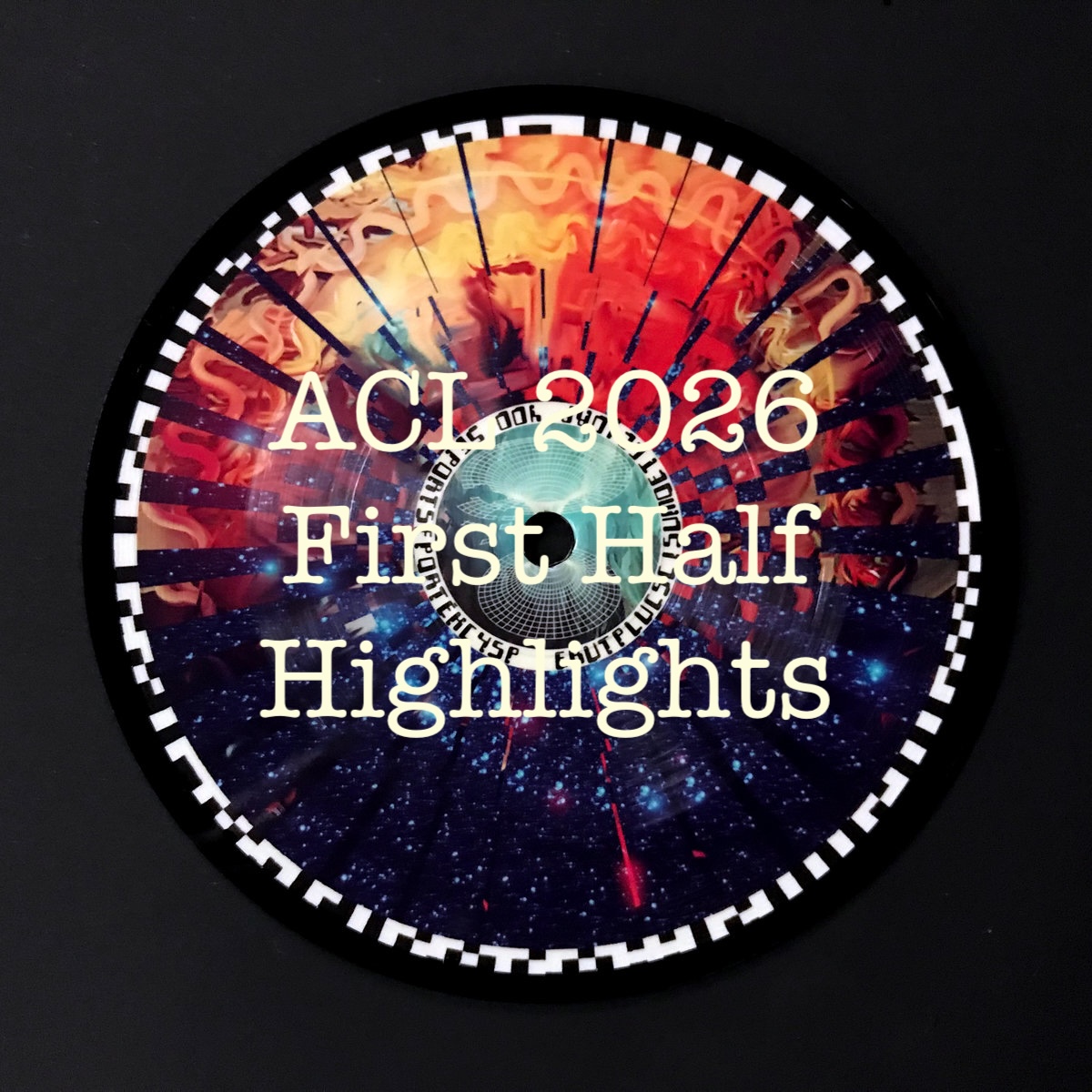
Every year we corral our reviewers for a halftime interview, as we ask their opinions on how the first half went. Six months from now, we’ll choose the top twenty albums of 2026, but for now this is the perfect time for readers to catch up on music they may have missed. There’s a special quirk to this year’s halftime listing, as no album was nominated by more than one reviewer. This leaves the field wide open, and we’re excited about what the second half might bring!
We hope you’ll enjoy our genre breakdown of first half highlights, and for those sweating it out in the summer heat wave, we wish you hot music and cool breezes! Happy summer ~ may you find your next favorite album right here!
Our cover image is taken from Sculpture’s 5″ zoetrope disc Projected Music (Psyché Tropes, 2019).
Ambient
Upon its release in January, Mary Lattimore & Julianna Barwick‘s Tragic Magic became an instant contender for collaboration of the year: a springlike set redolent of a walk in the woods, replete with a surprising cover of a Bladerunner track. Also released in January was a solo work from Kayla Painter, whom our regular readers know as a member of the Jilk collective. Tectonic Particles moves smoothly between the fields of ambient and electronic. Four months later, the quiet details imprint celebrated its 50th release!
Drone
Despite being the least covered genre on our site so far this year (with fewer submissions than any genre save for Field Recording & Soundscape), three drone albums still managed to make the mid-year list. Kreng‘s Wormhole (Miasmah) is the first album in quite some time from the composer, a cinematic work that deserves to be heard as a whole. Site favorite Aho Ssan continues to go from strength to strength with The Sun Turned Back, an incredibly personal effort on Subtext. And Ian Wellman provides a scene report of the California wildfires on the often harrowing Particularly Dangerous Situation (Elevator Bath), capturing the sound of the Santa Ana winds.
Electronic
A trio of very different releases highlight the breadth of electronic music. Drum & Lace‘s Terra Terra is a beat-driven tribute to the elements, highlighting our responsibility to the earth. Craven Faults‘ Sidings (The Leaf Label) offers long, undulating pieces that produce a cumulative, trancelike effect. And on Kinshasa in Action, Congolese collective KINACT transforms metallic debris into a wild mix of street protest and cultural celebration (Nyege Nyege Tapes).
Experimental
Alessandro Brivio recorded 2.25 (Senufo Editions) as “a tribute to a lost friend,” a theme all-too common in the current climate. The electro-acoustic set is lonely and forlorn, laden with memory. In like manner, Metastasis‘ Dineba (Bassiani) is “beyond the conventional frame,” an exercise in disjointed hauntology. With covers of songs from Boards of Canada and The Shaggs, among others, Alarm Will Sound celebrates its silver anniversary. Colorful and occasionally raucous, Lift exudes a contagious energy. The first three episodes of radio host Kvitoslava’s Кияночка series are now collected under the kyïvite moniker on broadcast (staalplaat), excavating the traditional music of Ukraine and re-presenting it in a modern format. The expansive Land 3, as curated by Tunefork Studios & Beirut Synth Center, tackles the Lebanese crisis while raising funds for the displaced.
Field Recording & Soundscape
Where would you like to go this summer? Our Field Recording & Soundscape picks offer a wealth of choices. Verónica Cerrotta leaves Brazil to visit Valparaíso (Chile) and to travel across Europe, preserving these experiences on Álbum de Viaje (LINE), while CM von Hausswolff and Chandra Shukla continue to collaborate on Travelogue [Thailiand], an expressive collection on Touch. The Field Recording & Soundscape category is our most competitive this year, as everything we have reviewed is of comparable high quality; only a fine line separates one release from the next!
Modern Composition
Kyle Preston‘s Music for Disappearing Coastlines uses climate change as a metaphor for all loss, whether ecological, sociological and personal. The music is gentle, careful not to injure a heart already broken. It’s also one of the blue albums, in tone and hue, that dominated the early year. Natalia Tsupryk collects her most personal works about Ukraine on Vil’na, with many more to come; she has emerged as one of the nation’s top contemporary composers. Virtual supergroup Whitney Johnson, Lia Kohl and Macie Stewart merge forces for BODY SOUND (International Anthem), disciplines blending to create an intricate, improvisational experience.
Rock, Post-Rock, Folk & Jazz
Post-rock was once our bread and butter, but there’s still some great post-rock being produced, much of it by bands who have been around for a quarter of a century. MONO is one of these, and we can’t call Snowdrop a return to form, because they’ve never lost their form; it’s simply another engaging album in the band’s discography (Temporary Residence Ltd.). Meanwhile, Magic Tuber Stringband‘s Heavy Water (Thrill Jockey) relays the story of Ellenton, South Carolina (nicknamed “Atomic City”), sacrificed for the cause of nuclear testing. This emotional album integrates choir, startled woodpeckers and copious amounts of strings: enveloping and educational.
Richard Allen
Sentinel — Human
The analysis shows high stylistic complexity and domain-specific focus, suggesting authentic human authorship in the context of arts criticism.