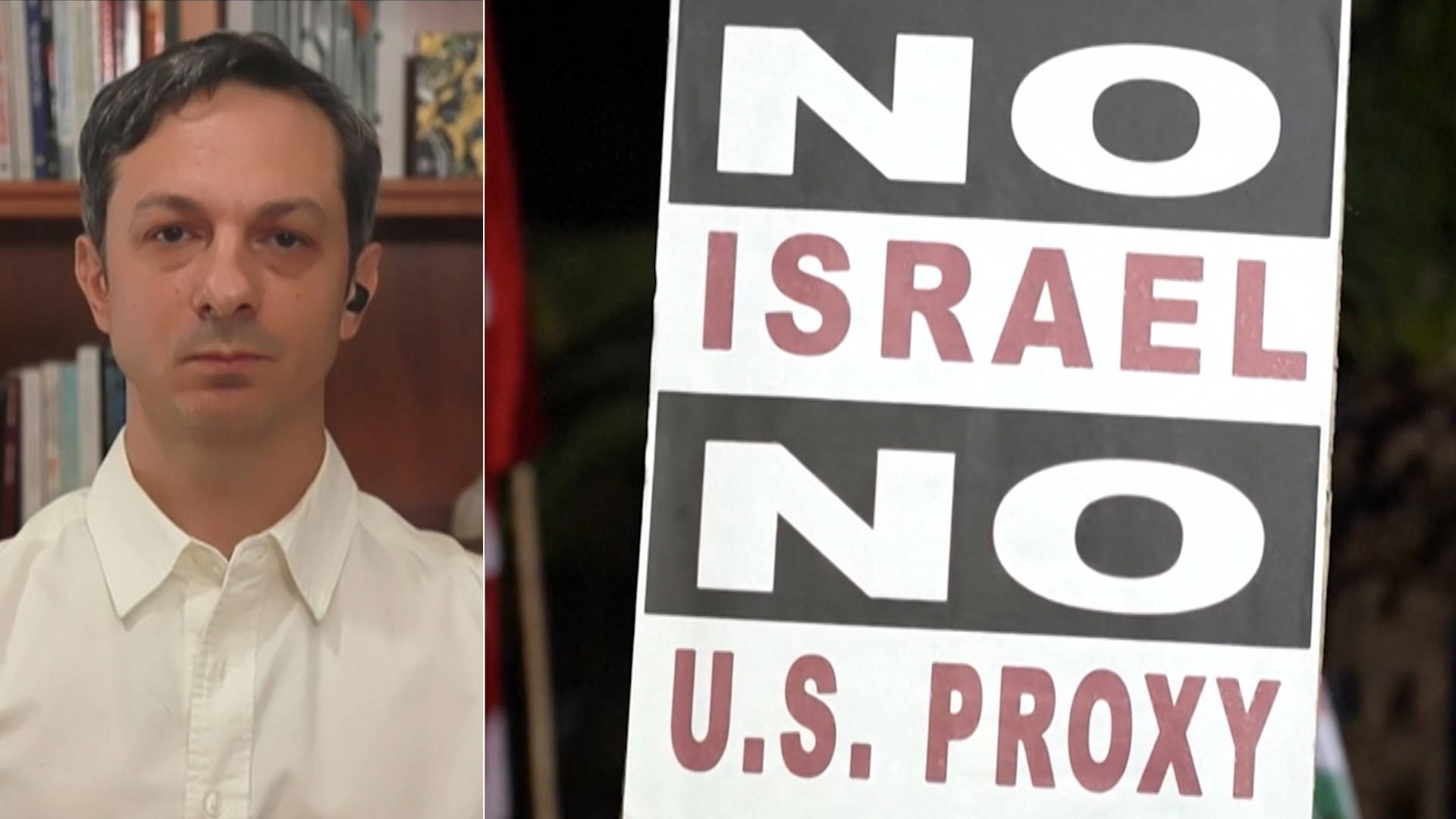
With thousands more U.S. Marines headed to the Middle East and President Trump reportedly considering a ground invasion of Iran, we speak with Mike Prysner, executive director of the Center on Conscience and War, who says his organization has received a massive increase in inquiries from soldiers seeking to submit conscientious objector applications. Prysner cites a “shift in consciousness” among young people in the United States, spurred by the Gaza genocide. “And the military is made up of young people in the United States.”
Transcript
AMY GOODMAN: This is Democracy Now!, democracynow.org. I’m Amy Goodman, with Juan González.
JUAN GONZÁLEZ: We turn now to look at growing opposition to the U.S. and Israeli war on Iran within the U.S. military. The Center on Conscience and War is reporting it has seen a spike in inquiries from soldiers seeking conscientious objector status.
AMY GOODMAN: We’re joined by the group’s executive director, Mike Prysner. He’s in Portland, Oregon. He joined the U.S. Army in 2001 when he was 17, left the military in 2005 after his company participated in the 2003 invasion of Iraq, where he served for a year. He also co-founded March Forward!, an antiwar group of veterans and active service members.
Mike, thanks so much for joining us. You have reported a staggering surge in calls of people, soldiers, asking about conscientious objector status. Explain what that is and just the scope of this issue.
MIKE PRYSNER: Well, conscientious objector just means you have a objection of participating in war in any form. And, you know, we have — it has been a difficult few weeks, because we have so many people and their families who are desperate to find alternatives to being sent to the Middle East. We have a situation where Trump and his team have launched an unprovoked war with no legitimate rationale, no rational justification, and in partnership with a military that has just committed a genocide in the region. They have imposed this on the American people, the Iranian people and tens of thousands of service members and their families who believe this is deeply wrong. You know, we haven’t just experienced a surge in calls, of inquiries, but a surge in people who have actually started the process of filing as conscientious objectors, which is a right to all service members to refuse to participate. You know, we have had about a 1,000% increase in CO clients just since the beginning of the war.
And to put that in perspective, you know, some of our counselors have been doing this for many, many decades, and did this through the entire global war on terror, through the worst years of the Iraq War, the worst years of the Afghanistan War, the highest levels of civilian casualties in both of those wars. And what they are saying is the level that they are seeing now of new conscientious objector clients that we have taken on is unlike anything they have ever seen before, including the worst years of those wars.
And, you know, you have to imagine relatively, right? You know, that’s a small percentage compared to the number of people in the military. I’m not saying there’s a mass uprising of people who are filing as CO right now. It’s a significant number. But those are just the people who have called our organization and sought out our help, even know that this right exists. So, how many people in the military do you think know about the Center on Conscience and War? Probably not that many. And so, while it’s a relatively small number compared to the hundreds of thousands of people in the military, I would imagine a very small subset actually know about our organization. And we find that the more we’re able to reach, the more people will be calling us to file this conscientious objection claim.
JUAN GONZÁLEZ: And, Mike, this is before any ground troops have actually been committed by President Trump to this war. In previous wars, a lot of this conscientious objector status started already in the midst of war. And clearly, in Vietnam, it was a major factor in the demoralization and the reduction of force capability by the United States as thousands fled to Canada, or even while they were in the military, then sought conscientious objector status. What do you envision if the president actually does commit troops on the ground in this war?
MIKE PRYSNER: Well, I imagine it would continue to spike. But what I think is significant is, you know, in the many dozens and dozens and dozens of people I have talked to who have started working on the conscientious objector claim or submitted it with hours to go before deployment — that’s something that’s been happening, too — you know, I haven’t talked to any service member who said that they are scared of dying in a war that they don’t believe in. They’re scared of killing in a war that they don’t believe in. They’re scared of the long-term moral consequences of their actions in this moment right now.
You know, the number one thing that is cited by service members when I ask what their — what was their breaking point, what is the reason that made them decide that they had to become a CO, and it was the Minab school bombing, the U.S. massacre at the girls’ school in Iran. You know, I think the military is aware of that, too. We actually heard from a couple people who said that’s when they lost internet access and social media access on a ship, is when the news of that broke. And so, you know, I think that regardless of whether or not the U.S. commits ground forces, the fact that U.S. troops are being used to kill from neighboring countries, I think that weighs heavily on people.
Look, this is so connected to the past several years. This hasn’t just come out of nowhere. You know, we know that in the American society broadly, the genocide in Gaza caused a significant shift in consciousness among people in the United States, in particular young people in the United States. And the military is made up of young people in the United States. And so, that shift of consciousness has happened in the military, as well. And they have been watching and decided that they couldn’t support a government that would kill children with impunity. And then, here we are in a war that the U.S. is not only waging with that country, but begins that war by carrying out the kind of action that Israel became notorious for throughout that war. And so, they’re having to look at themselves and say, “What am I willing to do? What kind of person am I? Can I be a part of the kinds of atrocities that I’ve turned against over the past several years?”
AMY GOODMAN: And we just have 10 seconds, but several cases of service members who have imminent deployments being taken off the deployment roster when they’re considering applying for conscientious objector status?
MIKE PRYSNER: That is something we can fight for. Your command is obligated to accommodate your beliefs. Look, most people will say, “You joined the military. It doesn’t matter if you think it’s immoral. You signed up for this. You have to follow orders.” Well, nobody signed up to violate their conscience. Nobody signed up to violate their deeply held beliefs. And you know what? There are DOD policies that can protect you from having to exercise that, and we can help you exercise them.
AMY GOODMAN: Mike Prysner, we want to thank you so much for being with us, executive director for the Center on Conscience and War.
Tune in tonight at 7:00 to our live stream at democracynow.org for our 30th anniversary celebration of Democracy Now!, featuring Angela Davis and Patti Smith and Michael Stipe and so many others. I’m Amy Goodman, with Juan González.
Media Options
Facts Only
The Center on Conscience and War has seen a 1,000% increase in conscientious objector clients since the start of the U.S.-Iran war.
Mike Prysner, executive director of the Center on Conscience and War, is a former U.S. Army veteran who served in Iraq from 2003 to 2004.
The organization assists military personnel in filing conscientious objector applications.
Many service members cite the U.S. bombing of a girls' school in Minab, Iran, as a key factor in their decision to seek conscientious objector status.
Some soldiers have been removed from deployment rosters after initiating the conscientious objector process.
The U.S. military is legally required to accommodate conscientious objections.
The surge in inquiries precedes any ground troop deployments to Iran.
The Center on Conscience and War has operated for decades, including during the Iraq and Afghanistan wars.
The organization reports that current levels of conscientious objector inquiries exceed those seen during previous conflicts.
Service members express moral objections to participating in the war, particularly regarding civilian casualties.
The military has restricted internet and social media access for some personnel following the Minab school bombing.
The Center on Conscience and War co-founded March Forward!, an antiwar group of veterans and active service members.
Executive Summary
Full Take
The narrative presented here centers on a moral awakening within the U.S. military, driven by a generational shift in consciousness about war and interventionism. The strongest version of this argument highlights the tangible increase in conscientious objector applications, the specific catalyst of the Minab school bombing, and the broader context of the Gaza genocide influencing young service members. It credibly frames this as a grassroots resistance to perceived injustice, with legal and institutional pathways for dissent.
However, the framing leans heavily on emotional appeals—fear of moral consequences, outrage over civilian casualties—and presents a binary choice between compliance and objection. The focus on "young people" and their moral objections risks oversimplifying the complexities of military service, where systemic pressures, career implications, and operational realities also shape decisions. The claim of a "shift in consciousness" is presented as self-evident, without exploring countervailing perspectives, such as service members who support the mission or view their role as apolitical.
Historically, this echoes patterns of wartime dissent, from Vietnam to the Iraq War, where atrocities and shifting public opinion catalyzed resistance. Yet the narrative assumes a uniform moral clarity among young troops, which may not account for the diversity of motivations within the military. The implications for human agency are significant: if this trend grows, it could strain military cohesion and force a reckoning with the ethical boundaries of warfare. But it also raises questions about the institutional response—will the military accommodate dissent, or will it suppress it through administrative or disciplinary means?
Missing perspectives include the voices of service members who do not object, the operational rationale for military actions, and the geopolitical context of the U.S.-Iran conflict. What would it take to verify the scale of this dissent beyond one organization's client base? How might the military adapt to this challenge, and what precedents exist for large-scale conscientious objection?
Counterstrike scan: A coordinated influence campaign would amplify emotional triggers (civilian casualties, moral outrage) while minimizing systemic complexities (chain of command, legal obligations). It might also frame dissent as a generational rebellion to polarize audiences. This article aligns with some of these tactics—emotional exploitation (ARC-0012) and forced binary choices (ARC-0043)—but stops short of outright manipulation. The focus on individual conscience, while sincere, could be weaponized to undermine military morale if scaled strategically.
Patterns detected: ARC-0012 Emotional Exploitation, ARC-0043 Motte-and-Bailey
Sentinel — Human
This transcript exhibits strong human signals—conversational messiness, moral passion, and institutional idiosyncrasies—with no detectable AI patterns. The low synthetic confidence reflects its alignment with live interview dynamics.