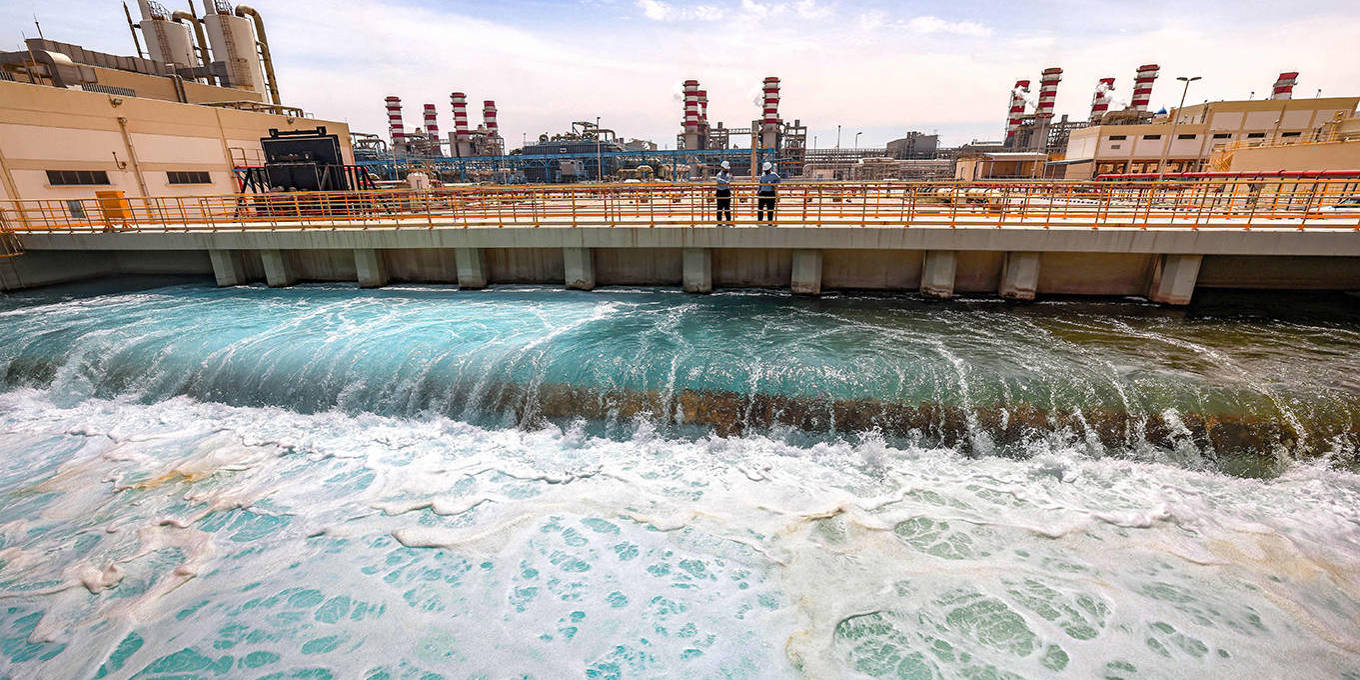
While the rest of the world is mainly concerned about the energy disruptions caused by the Iran war, the Gulf countries are more anxious about the Islamic Republic’s threats to their desalination facilities. If the US attempts to seize Kharg Island, it could spell disaster for the region's "saltwater kingdoms."
SALT LAKE CITY, UTAH – The oil-rich monarchies of the Persian Gulf are often described as petrostates. But the US-Israeli war with Iran has highlighted that they are also saltwater kingdoms, societies whose survival depends on desalination, or converting seawater into potable water at industrial scale. Life in the Gulf relies on the “black magic” of turning oil and oil revenue into water. This technological prowess has fueled the region’s dynamic growth, but now it looms as its greatest vulnerability.
Since the 1970s, the Gulf countries have embraced fossil-fuel-powered solutions to acute water scarcity. Today, the region produces more than 40% of the world’s desalinated water in more than 400 plants. It is difficult to overstate their dependence on desalination, which provides 99% of drinking water supplies in Qatar, more than 90% in Bahrain and Kuwait, 86% in Oman, 70% in Saudi Arabia, and 42% in the United Arab Emirates.
When the United States and Israel first attacked Iran, they targeted the country’s military sites and leadership. But on March 7, Iranian Foreign Minister Abbas Araghchi accused the US of committing a “blatant and desperate crime” by attacking a freshwater desalination plant on Qeshm Island. “Attacking Iran’s infrastructure is a dangerous move with grave consequences,” he added, noting that the US, not Iran, set this precedent.
While the claim remains unverified, its implications are unmistakable. Araghchi signaled a potential shift in the war’s logic: water systems, long treated as civilian lifelines and protected under the Geneva Conventions, had been drawn into the conflict. His warning was clear. If Iran’s infrastructure were attacked, Gulf desalination plants would be fair game.
That same day, Israel bombed some 30 oil depots in Tehran and nearby Alborz province. Oil spilled into streets as a dark haze of smoke and toxic fumes engulfed the capital city. Iran has since responded by widening its targets across the region. On March 8, Bahrain reported that Iran had caused “material damage” to one of its desalination plants, although authorities clarified that there had been “no impact on water supplies or water network capacity.”
The war has since escalated. Strikes from both sides have hit all types of civilian infrastructure, from hotels to airports, erasing nearly every pre-existing taboo and redline. Among the most concerning are strikes on or near nuclear facilities. Iran has targeted the town of Dimona, just miles from the Shimon Peres Negev Nuclear Research Center. Israel struck near Iran’s nuclear power plant in Bushehr, forcing Russian Rosatom staff to evacuate, and, more recently, attacked Iran’s uranium processing facility in Yazd and Khondab Heavy Water Complex.
But global attention is squarely focused on fossil-fuel infrastructure. On March 25, French Finance Minister Roland Lescure said that 30-40% of the Gulf’s refining capacity has been damaged or destroyed, removing 11 million barrels per day from the international market and triggering an oil crisis, particularly in Asia. Moreover, Iranian strikes on Qatar’s Ras Laffan facilities have wiped out 17% of the country’s liquefied natural gas export capacity.
As oil prices surged and the Strait of Hormuz remained largely shut, US President Donald Trump issued a stark ultimatum on March 21, threatening to “obliterate” Iran’s power plants if the country did not reopen the strait within 48 hours. In response, Iranian military spokesman Ebrahim Zolfaqari warned that the Islamic Republic would retaliate by striking regional infrastructure, including “water desalination facilities.”
Shortly afterward, pro-regime Telegram and social-media channels began circulating a chilling list of potential targets, including Saudi Arabia’s Ras al-Khair and Shuaiba desalination plants and the UAE’s Taweelah desalination plant and Barakah nuclear power plant. As the Hudson Institute’s Can Kasapoğlu explains, the vulnerability of desalination infrastructure is a different category of risk. Unlike disruptions to oil markets, which primarily trigger economic consequences by raising prices and constraining supply, striking desalination facilities “directly threatens daily survival in some of the world’s most water-scarce states.”
Facing mounting pressure, Trump abruptly announced a five-day pause on strikes against Iranian power plants just hours before US markets opened on March 23, aiming to steady oil prices; he later extended the deadline to April 6. Despite Trump touting talks with Iran (which the Islamic Republic has denied are taking place), ongoing US military deployments to the region suggest a possible escalation. The Trump administration has also refused to rule out seizing Kharg Island—through which 90% of Iran’s oil exports flow—as part of an all-out effort to cripple the Iranian economy and force the reopening of the Strait of Hormuz.
If the US made such a move, the Gulf countries would likely bear the brunt of retaliation. After earlier US strikes on Kharg Island, Iran accused the UAE of facilitating the attacks. On March 25, Mohammad Bagher Ghalibaf, speaker of the Iranian parliament, warned that if America and Israel occupy an Iranian island with the support of a regional power, “all the vital infrastructure of that regional country will, without restriction, become the target of relentless attacks.” Although Ghalibaf was not explicit, the warning likely refers to the UAE and the islands of Kharg and Larak, but may also allude to the disputed islands of Abu Musa and the Greater and Lesser Tunbs, seized by Iran in 1971.
The Iranian regime is fighting for its survival. It cannot defeat the US or Israel directly, but it can inflict widespread economic pain and strain relations between the US and the Gulf, as well as among the Gulf Cooperation Council’s six members. As the clock ticks down to Trump’s deadline, will the US jeopardize the Gulf’s desalination lifelines in a risky bid to seize Kharg Island and reopen the Strait of Hormuz? If Iran retaliates “without restriction,” the consequences could devastate the Gulf’s saltwater kingdoms.
SALT LAKE CITY, UTAH – The oil-rich monarchies of the Persian Gulf are often described as petrostates. But the US-Israeli war with Iran has highlighted that they are also saltwater kingdoms, societies whose survival depends on desalination, or converting seawater into potable water at industrial scale. Life in the Gulf relies on the “black magic” of turning oil and oil revenue into water. This technological prowess has fueled the region’s dynamic growth, but now it looms as its greatest vulnerability.
Since the 1970s, the Gulf countries have embraced fossil-fuel-powered solutions to acute water scarcity. Today, the region produces more than 40% of the world’s desalinated water in more than 400 plants. It is difficult to overstate their dependence on desalination, which provides 99% of drinking water supplies in Qatar, more than 90% in Bahrain and Kuwait, 86% in Oman, 70% in Saudi Arabia, and 42% in the United Arab Emirates.
When the United States and Israel first attacked Iran, they targeted the country’s military sites and leadership. But on March 7, Iranian Foreign Minister Abbas Araghchi accused the US of committing a “blatant and desperate crime” by attacking a freshwater desalination plant on Qeshm Island. “Attacking Iran’s infrastructure is a dangerous move with grave consequences,” he added, noting that the US, not Iran, set this precedent.
While the claim remains unverified, its implications are unmistakable. Araghchi signaled a potential shift in the war’s logic: water systems, long treated as civilian lifelines and protected under the Geneva Conventions, had been drawn into the conflict. His warning was clear. If Iran’s infrastructure were attacked, Gulf desalination plants would be fair game.
That same day, Israel bombed some 30 oil depots in Tehran and nearby Alborz province. Oil spilled into streets as a dark haze of smoke and toxic fumes engulfed the capital city. Iran has since responded by widening its targets across the region. On March 8, Bahrain reported that Iran had caused “material damage” to one of its desalination plants, although authorities clarified that there had been “no impact on water supplies or water network capacity.”
The war has since escalated. Strikes from both sides have hit all types of civilian infrastructure, from hotels to airports, erasing nearly every pre-existing taboo and redline. Among the most concerning are strikes on or near nuclear facilities. Iran has targeted the town of Dimona, just miles from the Shimon Peres Negev Nuclear Research Center. Israel struck near Iran’s nuclear power plant in Bushehr, forcing Russian Rosatom staff to evacuate, and, more recently, attacked Iran’s uranium processing facility in Yazd and Khondab Heavy Water Complex.
Secure your copy of PS Quarterly: Winners & Losers – and save $20
In the new issue of our magazine, leading thinkers examine how recent developments, from the AI revolution to intensifying geopolitical volatility, are reshuffling the economic and financial deck and generating new winners and losers across the global economy.
Subscribe to PS Premium now, with a $20 discount, to read the issue, featuring Claudia Goldin, Mark Blyth, Dambisa Moyo and others.
Subscribe Now
But global attention is squarely focused on fossil-fuel infrastructure. On March 25, French Finance Minister Roland Lescure said that 30-40% of the Gulf’s refining capacity has been damaged or destroyed, removing 11 million barrels per day from the international market and triggering an oil crisis, particularly in Asia. Moreover, Iranian strikes on Qatar’s Ras Laffan facilities have wiped out 17% of the country’s liquefied natural gas export capacity.
As oil prices surged and the Strait of Hormuz remained largely shut, US President Donald Trump issued a stark ultimatum on March 21, threatening to “obliterate” Iran’s power plants if the country did not reopen the strait within 48 hours. In response, Iranian military spokesman Ebrahim Zolfaqari warned that the Islamic Republic would retaliate by striking regional infrastructure, including “water desalination facilities.”
Shortly afterward, pro-regime Telegram and social-media channels began circulating a chilling list of potential targets, including Saudi Arabia’s Ras al-Khair and Shuaiba desalination plants and the UAE’s Taweelah desalination plant and Barakah nuclear power plant. As the Hudson Institute’s Can Kasapoğlu explains, the vulnerability of desalination infrastructure is a different category of risk. Unlike disruptions to oil markets, which primarily trigger economic consequences by raising prices and constraining supply, striking desalination facilities “directly threatens daily survival in some of the world’s most water-scarce states.”
Facing mounting pressure, Trump abruptly announced a five-day pause on strikes against Iranian power plants just hours before US markets opened on March 23, aiming to steady oil prices; he later extended the deadline to April 6. Despite Trump touting talks with Iran (which the Islamic Republic has denied are taking place), ongoing US military deployments to the region suggest a possible escalation. The Trump administration has also refused to rule out seizing Kharg Island—through which 90% of Iran’s oil exports flow—as part of an all-out effort to cripple the Iranian economy and force the reopening of the Strait of Hormuz.
If the US made such a move, the Gulf countries would likely bear the brunt of retaliation. After earlier US strikes on Kharg Island, Iran accused the UAE of facilitating the attacks. On March 25, Mohammad Bagher Ghalibaf, speaker of the Iranian parliament, warned that if America and Israel occupy an Iranian island with the support of a regional power, “all the vital infrastructure of that regional country will, without restriction, become the target of relentless attacks.” Although Ghalibaf was not explicit, the warning likely refers to the UAE and the islands of Kharg and Larak, but may also allude to the disputed islands of Abu Musa and the Greater and Lesser Tunbs, seized by Iran in 1971.
The Iranian regime is fighting for its survival. It cannot defeat the US or Israel directly, but it can inflict widespread economic pain and strain relations between the US and the Gulf, as well as among the Gulf Cooperation Council’s six members. As the clock ticks down to Trump’s deadline, will the US jeopardize the Gulf’s desalination lifelines in a risky bid to seize Kharg Island and reopen the Strait of Hormuz? If Iran retaliates “without restriction,” the consequences could devastate the Gulf’s saltwater kingdoms.
Facts Only
The Persian Gulf countries rely heavily on desalination for freshwater, with Qatar at 99%, Bahrain and Kuwait over 90%, Oman at 86%, Saudi Arabia at 70%, and the UAE at 42%.
The region produces over 40% of the world’s desalinated water through more than 400 plants.
On March 7, Iranian Foreign Minister Abbas Araghchi accused the US of attacking a desalination plant on Qeshm Island.
Israel bombed 30 oil depots in Tehran and Alborz province on the same day.
Bahrain reported "material damage" to one of its desalination plants on March 8, though water supplies were unaffected.
Strikes have targeted nuclear facilities, including Iran’s Bushehr plant and Israel’s Dimona research center.
On March 25, French Finance Minister Roland Lescure stated that 30-40% of the Gulf’s refining capacity had been damaged, removing 11 million barrels per day from the market.
Iranian strikes on Qatar’s Ras Laffan facilities reduced the country’s LNG export capacity by 17%.
US President Donald Trump threatened to "obliterate" Iran’s power plants on March 21 if the Strait of Hormuz was not reopened within 48 hours.
Iran responded by threatening to strike regional desalination facilities, including Saudi Arabia’s Ras al-Khair and Shuaiba plants and the UAE’s Taweelah plant and Barakah nuclear facility.
Trump paused strikes on Iranian power plants on March 23, later extending the deadline to April 6.
Iran warned that if the US or Israel occupied an Iranian island with regional support, all vital infrastructure of that regional country would become targets.
The US has not ruled out seizing Kharg Island, through which 90% of Iran’s oil exports flow.
Executive Summary
The ongoing US-Israeli conflict with Iran has exposed a critical vulnerability in the Persian Gulf: the region's heavy reliance on desalination plants for freshwater. Gulf countries, often called "petrostates," are also "saltwater kingdoms," with desalination providing up to 99% of drinking water in some nations. The war has escalated to include strikes on civilian infrastructure, including desalination facilities, which Iran has threatened to target in retaliation for attacks on its own infrastructure. On March 7, Iran accused the US of attacking a desalination plant on Qeshm Island, signaling a shift in the conflict's boundaries. Subsequent strikes have damaged oil and gas infrastructure, with Iran warning that it would retaliate against Gulf desalination plants if provoked further. The US has threatened to seize Kharg Island, a key Iranian oil export hub, which could trigger severe Iranian retaliation against Gulf states' vital infrastructure. The conflict risks destabilizing the region's water security, with potential catastrophic consequences for civilian populations.
The situation remains fluid, with the US extending deadlines and claiming talks with Iran, though Iran denies these. The Gulf Cooperation Council (GCC) states face a precarious position, caught between US-Israeli actions and Iranian threats. The conflict has already disrupted global oil markets, with 30-40% of Gulf refining capacity damaged, and Iran has targeted Qatar's LNG facilities. The escalation raises questions about the future of water security in the Gulf and the potential for broader regional destabilization.
Full Take
The strongest version of this narrative highlights a critical but often overlooked vulnerability in the Gulf: the intersection of water security and geopolitical conflict. The article effectively frames desalination infrastructure as a potential battleground, elevating a civilian necessity to a strategic target. This is a legitimate concern, given the region’s extreme dependence on desalinated water and the precedent of infrastructure being weaponized in modern warfare. The piece also correctly notes the escalatory dynamics, where each side’s retaliation risks dragging civilian lifelines into the crossfire.
However, the narrative leans heavily on Iranian threats and US-Israeli actions without equivalent scrutiny of Gulf states' roles in the conflict. The framing of Gulf countries as passive victims of Iranian aggression omits their historical alliances and potential complicity in regional tensions. The article also amplifies fear by emphasizing the catastrophic consequences of desalination strikes without exploring mitigating factors, such as redundancy in water systems or international protections for civilian infrastructure. The repeated focus on "saltwater kingdoms" and "obliteration" risks stoking anxiety rather than fostering a nuanced understanding of the risks.
Root cause: The paradigm here is one of resource warfare, where control over critical infrastructure—oil, water, and nuclear facilities—becomes a proxy for broader geopolitical dominance. The unstated assumption is that water scarcity, exacerbated by climate change and population growth, will increasingly be weaponized in conflicts. This echoes historical patterns of siege warfare, where cutting off essential supplies was a primary tactic to force surrender.
Implications: The immediate cost is borne by civilian populations in the Gulf, who face the dual threats of water shortages and economic instability. Longer-term, this conflict could normalize the targeting of desalination plants, setting a dangerous precedent for future wars in water-scarce regions. The US and Israel may achieve short-term strategic gains, but the erosion of norms protecting civilian infrastructure could backfire globally. Meanwhile, Iran’s asymmetric retaliation strategy could further fracture Gulf Cooperation Council unity, playing into its goal of regional destabilization.
Bridge questions: How resilient are Gulf desalination systems to targeted attacks, and what contingency plans exist? To what extent are Gulf states actively de-escalating, or are they enabling US-Israeli actions that provoke Iranian retaliation? What international legal frameworks could protect desalination plants, and why haven’t they been invoked more forcefully?
Counterstrike scan: A coordinated influence campaign would amplify the existential threat to Gulf water security while downplaying the role of US-Israeli aggression in provoking Iranian retaliation. It might also frame Gulf states as helpless victims to justify further military intervention. The actual content aligns partially with this pattern by emphasizing Iranian threats and the vulnerability of desalination plants, but it does not outright omit US-Israeli actions or fabricate evidence. The tone is alarmist but not overtly manipulative.
Patterns detected: ARC-0024 Ambiguity (vague framing of Gulf states' agency), ARC-0043 Motte-and-Bailey (implied necessity of US action to protect Gulf water security without full context)