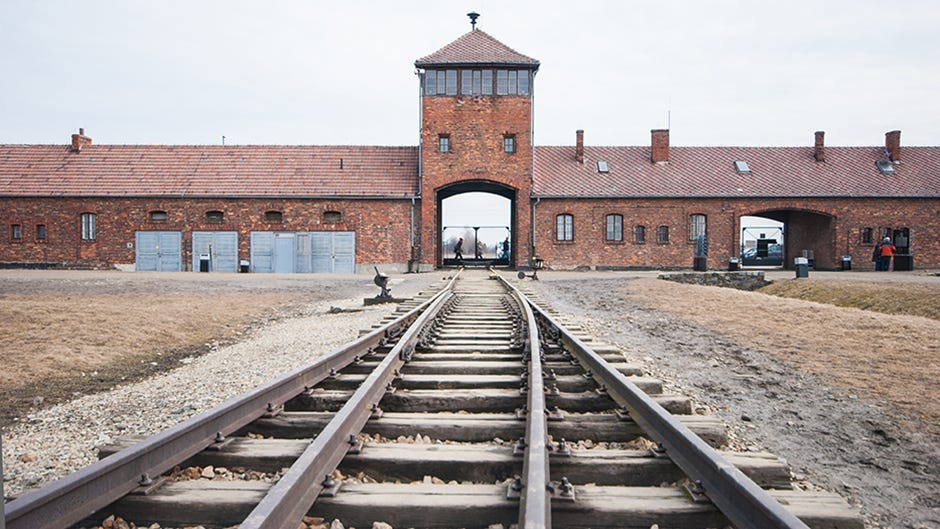
In the past year, ICE detention facilities doubled to 212 sites across 47 states and territories. Once the regime is done with its ethnic cleansing of America, for whom are those camps intended?
I’ve been in more than my due share of mass detention camps during my career — mostly refugee facilities overseas that held thousands, but where the detainees received food, medical care and the other basics of life through international aid, largely from the United Nations. But I also became familiar with holding camps that imprisoned people. At Guantanamo Naval Base, where I served pre-9/11, there were a number of detention facilities, including those that housed migrants. Conditions, again, were spare but humane. The one facility that gave me shivers was Camp X-Ray, a cyclone fence construction which held hardened, violent criminals, almost all Cubans. It was little more than an oversized compartmented cage. After 9/11, this was expanded and renamed Camp Delta, housing ISIS terrorists, and came under congressional investigations for its inhumane conditions. I met and interviewed scores of political prisoners who escaped or were released from “re-education camps” in communist countries. After years of mistreatment and indoctrination, some were utterly defeated human beings; others had lost their minds, but most retained their wits and looked forward to starting a new life in a free country. Finally, I’ve visited one extermination camp, Tuol Sleng, in Cambodia, where in four years’ time, an estimated 20,000 people were tortured and executed. For one year, I sat across the negotiating table from the man who designed and oversaw its operations and the genocide of up to 2 million people.
Let’s just say I know a mass detention center for the wrong reasons when I see one.
Holocaust survivor Elie Wiesel said,
The opposite of love is not hate, it’s indifference. The opposite of art is not ugliness, it’s indifference. The opposite of faith is not heresy, it’s indifference. And the opposite of life is not death, it’s indifference. Indifference, to me, is the epitome of evil.
That is why I fear that the archipelago of migrant detention facilities the Trump administration is constructing throughout the United States could be repurposed as camps for political opponents of the regime. This can only happen if people are largely indifferent, as was the case in Germany under Hitler. Citizens’ protests against the camps have resulted in some cancellations and delays, but mostly on “nimby” (not in my backyard) grounds.
Whether Trump intends to go down this route depends on a number of factors, not least his perception of threat to himself and his questionable mental state. But one thing is clear: he is now laying the groundwork for the possibility.
In July 2025, Congress authorized spending of nearly $170 billion for border security and immigration enforcement, fueling a rapid expansion of detention facilities. More than 70,000 immigrants were under ICE detention as of late December, up from 40,000 when Trump took office, with plans to reach over 100,000 beds. In a little over a year, the number of detention facilities nearly doubled to 212 sites spread across 47 states and territories. The U.S. now operates the world’s largest immigration detention system. Since Trump’s second inauguration, ICE has been detaining over 50,000 people daily — with projections approaching 100,000 as new facilities open. Three-quarters have no criminal conviction. These facilities often lack adequate medical care, legal counsel and basic sanitary standards, leading to comparisons with past internment camps in other countries.
In her book, One Long Night, journalist Andrea Pitzer writes that concentration camps originated not in Germany under the Third Reich or in the Soviet Union, but in 1896 when Spain rounded up thousands of people in Cuba’s countryside during that nation’s war for independence and held them under inhumane conditions in mass detention camps. For over 100 years now, at least one concentration camp has existed somewhere on earth, she notes.
Echoing Wiesel, Pitzer argues that for these camps to be possible, a degree of complicity, or indifference, must permeate society. Absent this, the momentum for establishing them wanes. “Indefinite detention without trial” is “the hallmark of a concentration camp system,” she writes — facilities where civilians are detained en masse without trial, targeted by group identity, under punitive conditions.
The first step is to dehumanize your enemies. Hitler labelled other ethnic groups as untermenschen (subhumans); Stalin characterized detractors as vrag naroda (enemies of the people); and Fidel Castro denigrated his as gusanos (worms). Strongmen dehumanize a group of people in order to justify mistreatment of that group and detain them involuntarily in isolation with no due process.
Trump has attacked his political enemies as “vermin,” the news media as “enemies of the people” and immigrants as the “enemy from within.” His calls to violence and “retribution” rhetoric prepare his followers for draconian policies to deal with these groups. He has gotten them to view whole swaths of their fellow Americans as a danger to society. “Trump has clearly crossed into the domain of Nazi ideology openly,” Robert Jones, founder of the Public Religion Research Institute (PRRI), told NPR. Moreover, Trump’s embrace of cruelty, unilateral actions and his relentless chipping away of the rule of law are further laying of the groundwork to impose despotism on Americans. And it is being done by design.
It is a familiar playbook. The Nazis also acted swiftly in perverting the law and norms, and subverting civil society through propaganda and by incrementally imposing control over key sectors of society. They created a permission structure for citizens to gradually accept their radical policies by casting cruelty as security and suffering as deserved. People learned that it was best to turn a blind eye, or to pretend they did not know about the excesses, including the concentration camps — in other words, they took onto themselves the very indifference that Elie Wiesel equated with evil.
In terms of time, Trump compares favorably with Hitler, having fulfilled 50 percent of the goals of the Republicans’ Project 2025 — essentially a fascist manifesto — in the first year of his second term with their “move fast and break things” approach.
The Fifth Amendment stipulates that no person shall be deprived of liberty without due process. The Fourteenth guarantees equal protection to all persons under U.S. jurisdiction. But these are under threat. By moving fast and breaking things, the administration is rendering those protections meaningless in application while denying it is contravening them in principle.
Americans have been murdered in the streets by Trump’s masked thugs, who also enter homes and arrest people without judicial warrants. Meanwhile, the Trump regime has launched an all-out assault against free and fair elections. And construction continues on a vast gulag archipelago of concentration camps throughout the country. Once the regime is done with its ethnic cleansing of America, for whom are those camps intended?
I, for one, qualify doubly — as a journalist, an “enemy of the people,” and as a former federal employee, “deep state.” My wife, as an immigrant, is, according to Trump, an “enemy within.” Our daughter, who works in the (heavily anti-Trump) labor movement, would be labeled “vermin,” according to the president. Must we fear that, like Elie Wiesel, we will one day be snatched up by ICE goons and dispatched to a stateside Camp X-Ray or Theresienstadt?
Only if our fellow Americans remain indifferent.
Originally published at https://jameslbruno.substack.com
Facts Only
The number of ICE detention facilities in the U.S. has nearly doubled to 212 sites across 47 states and territories.
As of late December, over 70,000 immigrants were detained by ICE, up from 40,000 when Trump took office.
Plans exist to expand detention capacity to over 100,000 beds.
Congress authorized nearly $170 billion for border security and immigration enforcement in July 2025.
Three-quarters of detainees have no criminal conviction.
Conditions in detention facilities often lack adequate medical care, legal counsel, and basic sanitary standards.
The author has firsthand experience with detention camps, including Guantanamo Bay and Cambodian extermination camps.
Trump has referred to political enemies as "vermin" and immigrants as the "enemy from within."
The Trump administration has implemented policies aligned with Project 2025, described as a fascist manifesto.
The Fifth and Fourteenth Amendments are cited as under threat due to policies depriving individuals of liberty without due process.
Public protests have delayed some detention facility constructions, primarily on "not in my backyard" grounds.
The U.S. now operates the world’s largest immigration detention system.
Executive Summary
Full Take
The strongest version of this narrative is a warning about the potential for authoritarian overreach, drawing on historical parallels and the author’s direct experience with detention systems. It credibly highlights the rapid expansion of ICE facilities, the dehumanizing rhetoric used by Trump, and the erosion of legal protections as red flags. The piece effectively uses emotional appeals—such as references to Holocaust survivor Elie Wiesel and the author’s personal encounters with political prisoners—to underscore the moral stakes of indifference.
However, the narrative leans heavily on fear-based framing, which could be seen as emotional exploitation (ARC-0012 Fear Appeals). The comparison of current U.S. policies to Nazi concentration camps, while intended as a cautionary tale, risks exaggeration (ARC-0008 Exaggeration to Absurdity), potentially undermining the legitimacy of the concerns. The piece also assumes a direct trajectory from detention expansion to political repression, which, while plausible, lacks concrete evidence of intent.
The root cause appears to be a paradigm of authoritarianism, where dehumanization and legal erosion pave the way for mass detention. The unstated assumption is that societal indifference will enable this slide, echoing historical patterns where incremental normalization of cruelty leads to systemic oppression. The implications for human dignity are severe: if the narrative is correct, the cost is borne by marginalized groups and political dissidents, while the beneficiaries are those consolidating power.
Bridge questions: What evidence would definitively prove or disprove the claim that these facilities are being built for political opponents? How do we distinguish between legitimate concerns about authoritarianism and hyperbolic comparisons that might desensitize the public to real threats?
Counterstrike scan: A coordinated influence campaign would amplify fear, use selective historical comparisons, and frame opposition as complicit in evil. While this piece employs some of these tactics, it does not fully match the pattern of a bad actor’s playbook, as it relies on verifiable facts and the author’s credible expertise. The emotional tone is strong but not manipulative enough to suggest malice.