The venerable British automaker is staking its future on a grand six-figure electric sedan. Is that what the market wants?
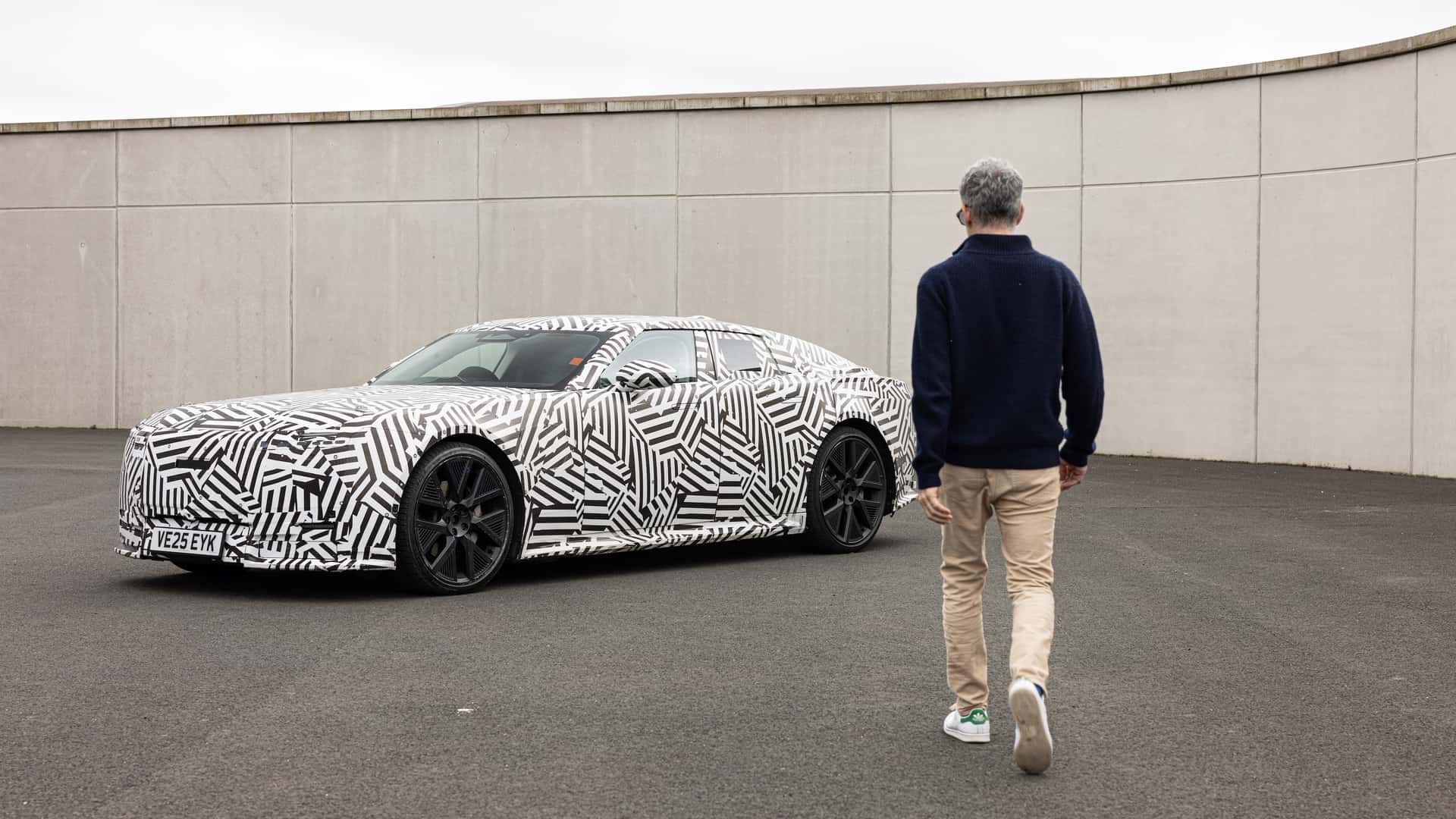
The exterior of the broad 16.5-foot sedan is covered in a camouflaging flurry of opposing black and white diagonal slashes that resemble one of Jasper Johns’ radical “crosshatch” paintings from the mid-1970s. The cossetting interior, its narrow rampart-like band of windows mainly covered by this wallpaper, is dark and unfinished, and blanketed in a matted black felt that, notably, reminds me of a magician’s backdrop, meant to absorb light and disguise sleights of hand.
But despite the lack of badging and iconography, the font on the narrow, rectangular LCD screen behind the thick-rimmed steering wheel is a giveaway. The delicately curvaceous—and internet-derided—sans-serif type, with its ransom note mix of lower- and upper-case letters, is immediately recognizable as belonging to the rebranded Jaguar.
The Type 00 concept showcased the design direction for the forthcoming production vehicle. But based on the camouflaged silhouette, we expect some changes to the final car.
I’m at the leaping-cat brand’s headquarters—built beside its development testing track, on the site of a former British Air Force nuclear bomber training runway—in England’s Midlands. I’ll be among the first Americans to drive, on dry ground, a prototype of the venerable British automaker’s forthcoming six-figure, 1,000+ horsepower, super-sedan, code-named the X900. The entire future of the venerable brand is riding on its massive 23” wheels.
It is evident, from the moment that I tip into the throttle, that the teams of engineers and designers here have been aware of and attentive to this heavy burden.
The big car moves off the line and gathers speed with an intentional, but not abrupt, alacrity. It is plenty quick, and will likely put anything in the brand’s history to shame in a 0-60 race. But it is not trying to snap my neck, like a Tesla or a Lucid; that is not how it will prove itself. Rather, it gets underway with grace and composure, always holding, but not withholding, an alluring sense of more. It does not feel wickedly domineering like an S-Class, or brutally concretized like a 7-Series. It is a boss bitch, strutting in heels, confident that it owns the runway.
Jaguar initially made its name creating sportily bewitching coupes and convertibles, from the earliest SS cars in the 1930s through the XKs, and E-types of the 50s and 60s. But its brand equities are, in my opinion, best defined by its luxurious sedans, which, at their peak—in the first (1968-87) and fourth (2010-19) generations of the XJ nameplate—offered intense refinement, delightfully torquey thrust, and a perfect balance of engagement and isolation.
“The four-door GT is the purest vision of Jaguar,” Rawdon Glover, the brand’s managing director, tells me, concurring. “This new car needs to take Jaguar to its previous hunting grounds, its natural habitat.”
If this means holding a sweepingly endless left-hand corner at 90 mph or bombing down the track’s mile-long back straight at 145 mph in whooshing rapture, then Glover’s team has already achieved high marks in the repatriation department. Power comes on progressively, with a constant sense of tappable reserves, even at triple-digit speeds, and builds with an intriguingly analog linearity, more like an aviation-grade torque-rich V12 than a trio of electric motors (two rear, one front.) The brake pedal is firm but never hard, and the big, vented discs scrub speed predictably without any of the android intervention inherent in many regenerative systems. (Additional regen is apparently available for those who want it, though we didn’t get to sample the various settings.) The feel from the thick steering wheel is tactile, but never jumpy; its feedback filtered through a thin layer of goose down.
But it is the ride that I find most surprising. We repeatedly traverse a course on the back stretch of the proving grounds, meant to mimic the world’s worst sections of broken pavement, and the big cat resolutely absorbs the impacts. Whether they’re cosplaying at concrete that has been washboarded like a gravel path in Joshua Tree two weeks after a freak summer storm, or puzzled to resemble Manhattan’s West Side Highway after a winter of icy expansion, the Jaguar remains unbothered. The adaptive air springs provide the huge donuts with a suspicious amount of travel, granting a sense of connection undergirded by isolation. It doesn’t make the landscape disappear. It’s more like I could feel what each wheel was doing, even when the four-wheel-steering system was working, but I kind of didn’t care. The car is present, but unperturbed.
The sensation is less wafty than a Rolls and not as thunderously damping as a Bentley. It weirdly reminds me of some of my favorite recent Aston Martins, remarkably planted, but pliant, like the DBS (or even, gasp, the DBX). Perhaps this shouldn’t be surprising, since the vehicle dynamics engineer for all of these is the fabled Matt Becker, who was mentored by his father, Lotus project engineer Roger Becker. He designed the body motions of the new car to scientifically mimic the vibrational amplitude and pitch of top-tier Jags of the past, like the dominating XJ-C V12 coupe of the mid 1970. The final result, he warns, is still being dialed in.
The car is remarkably, and intentionally, low, the product of an extremely long wheelbase and some impact-engineering wizardry that allows the thin and flat structural battery pack in the floor to extend beyond the firewall instead of piling up under the passenger compartment. The driver is positioned right at the center of gravity, amidst a perfect 50/50 front-rear weight balance.
As a result, I sit deep in the car, not upon it as in other electric sedans. That sinking feeling is enhanced by the very tall beltline—which seemingly rises above my shoulder—and narrow greenhouse, like the roof had been stepped on by a diplodocus as it craned its neck up for some prehistoric foliage. In hot-rodding terms, it's chopped. This sensation places me in mind of that time I borrowed a 1990 XJ-S V12 coupe to cruise around LA. It’s another car one sits deep within, legs stretched out into a long footwell, like the vehicle is a cocoon.
Forward visibility is relatively assured. But because there are no other cars, or pedestrians, or scooters, or e-assist delivery vehicles careening around me as there would ordinarily be in New York City, I’m not able to get a sense of what this near-clerestory glass would feel like in traffic. My sense is, a little crypt-like and disconcerting. Adding to this sensation is the fact that, following an unfortunate trend introduced on vehicles from the Aston Martin Valkyrie to the Polestar 4, the new Jag lacks a rear windshield.
There's no glass on the fast-back rear end. Like the Polestar 4, the Jaguar relies solely on cameras for rear-view monitoring.
This deletion is predicated, in no small part, on the X900’s very acute fastback rear; a typical windshield-mounted rearview mirror would show little besides the plunging headliner. Instead, supplanting this long-lived convention, Jag has affixed rear-facing cameras and a small rectangular display centered at the base of the dash.
I can cast aspersions on this fad, because that’s what I do, and because I know that current camera-based rear-view mirrors make me feel like I’ve just rode a Tilt-A-Whirl after washing down clam chowder with a tumbler of white Russians. Sadly, or more likely happily, the Jag’s system isn’t working, so I have yet to experience it in person.
Neither, despite repeated requests, will my handlers allow me to get into the X900’s twin rear bucket seats, so I can’t tell you what kind of contortions ingress or egress requires under that dipped roofline, or what it’s like to sit back there. This is unfortunate, as it seems possible that this generation of big Jag sedan could, like some of its predecessors, lend itself to chauffeuring VIPs, and VIPs don’t enjoy thumping their noggins on the door-top surround. Perhaps that’s why VIPs these days ride in Escalades.
Gallery: Jaguar Type 00 Concept
I also didn’t get to experience much of the infotainment system or user interface. But I can tell you that one smallish screen stretches from the driver-side window to about two-fifths of the way across the dash. The portion to the left of the wheel seems to control driver functions like adjusting the steering wheel and mirrors, the drive and regen modes, and the lights. The small portion to the right of the wheel seems like it might house entertainment and navigation features. The center of the dash between the seats was covered, so I couldn’t tell if there was another screen under the felt. But there’s definitely a small phablet-sized screen that protrudes from the top of the tunnel, like an Uber driver’s Galaxy, that handles HVAC controls.
Brand head Glover tells me that Jag doesn’t want to overwhelm passengers with the dazzle of screens on every surface. This seems commendable. Yet the interior also stunningly lacks hard switches. Again, some areas were covered in the stygian fabric, but the only actual buttons I could discern were on the steering wheel. When I bring up this lack to head JaguarLandRover designer Andy Wheel, he demurs, recognizing the movement back to analog functionality required by forthcoming European and Chinese safety regulations.
“We know there's obviously legislation coming in certain markets where we know we're going to have to bring some of that in, and that's obviously something to fret over for another day,” he says. “But we've just wanted to keep it super clean, super intuitive.” Something else to check in on next time, I guess.
Still, these potential liabilities give me a bit of pause. The X900 drives very much like a 21st-century electric Jaguar sedan, with the brand’s signature combination of acceleration, ride, and handling. Under all that op-art shelf paper, it seems like it will have an alluring Jaguar-like shape: specific, unique, elegant, and hopefully not too slavishly mimicking the blank unresolved quality of the front and rear treatment shown on its recent Type 00 concept.
What I personally worry about for the brand is the fact that, as good as the car might be, Jaguar has created a vehicle for a future that, in many ways, may no longer arrive. The marque is no longer chasing volume, no longer competing with the full-range lineups of German luxury giants, instead hoping to move a much smaller number of EVs at an alleged “white space” price point that starts around where the S-Class leaves off, in the lofty $130,000+ realm. It is betting the future on a low-volume flagship electric sedan. But Jag tried and scrapped a long-planned range-topping EV once before, back in 2021, given its inability to conform to the needs of the coming market. In two days with the Jag team, talking solely about the electric flagship and the brand’s heritage, no one mentioned that car once. It was like a curse that could not be spoken aloud for fear of invocation, and the silence was a bit deafening.
Jaguar is highlighting its grand tradition of grand touring cars. But has the world moved on from big sedans and coupes?
Jaguar has always been best when it has been an innovator, leading instead of following. But I can’t help but wonder if the market for six-figure battery-powered sedans is broad enough here, or anywhere, to make this gamble pay off. Lucid, at times the best-selling luxury electric sedan in America, sold only around 4,000 of its high-end Airs here last year. Porsche’s beloved and dynamic Taycan sells in roughly equal numbers, and BMW sold only around 3,000 i7s and Mercedes half that many EQS sedans. And 2025 will likely go down a watershed year for the category in America.
The Germans have very large and profitable lineups of other high-volume vehicles to support these ventures, something Jaguar currently lacks. With expensive, unproven technology, a relaunch that seems intended to shrug off the past (and 90% of its previous customer base) and its long-term reputation for glitchy unreliability, can Jaguar really sustain itself on Ferrari volumes? Glover won’t give me a sales number at which the brand turns a profit, though he assures me there is an attainable one. I hope it’s not like the Panglossian 100,000 annual sales Lotus was predicting to me a few years back. (In the first half of 2025, Lotus sold fewer than 3,000 cars globally.)
The capricious madness of our country’s current leadership—intently quashing our transition to EVs, and then starting senseless wars that disrupt the global flow of oil—makes any hope for market predictability impossible. That predictability is something automakers tend to rely on when investing billions of dollars in products with long cycles of development and amortization.
I know from experience witnessing our responses to the OPEC oil embargo and safety/emissions law of the early 1970s, the economic meltdown of the late 2000s, and the supply chain interruptions during the recent pandemic, that global geopolitical, regulatory, and economic circumstances can have a huge impact on consumers’ automotive choices. In the aftermath of Trump’s latest arbitrary aggressions, we’re already seeing marked increases in searches for electric vehicles. If this lunacy in the Middle East continues unabated, purchase behavior may shift wildly.
The future is an evanescent dream. But we have to imagine the destiny we want to inhabit. I thoroughly enjoyed my time in the Jag prototype, and long for another go with a more finished version. I also believe that an automotive landscape devoid of Jaguars would be far less rich and interesting. Hopefully, with its new super-sedan, Jag has envisioned just the car that tens of thousands of wealthy global iconoclasts will want to buy in 2027. This cat is on its ninth life. Here’s praying it lands on its paws as confidently as this prototype seems to.
Gallery: EMBARGOED Jaguar X900 Prototype Drive
Brett Berk is a freelance automotive writer based in New York. He has driven and reviewed thousands of cars for Car and Driver and Road & Track, where he is a contributing editor. He has also written for Architectural Digest, Billboard, ELLE Decor, Esquire, GQ, Travel + Leisure and Vanity Fair.
Click here to see all articles with lists of the best EVsRECOMMENDED FOR YOU
Jaguar’s Controversial New EV Has A Bizarre Battery Setup
BYD Has Hit A Rough Patch. It Still Plans To Sell 1.5 Million Cars Outside Of China This Year
Over 30 New EVs Are Launching In 2026. Here's What You Need To Know About Them
Google Maps Is Bringing EV Route Planning To Android Auto
Why Jaguar Can't Go Back From Its Most Shocking Design Ever
The Chevy Silverado EV Is A Great Truck. Here's Why This YouTuber Is Selling His
Type 00 Prototype Sighting Shows Jaguar Wasn’t Kidding About That Design
Facts Only
Jaguar is developing a six-figure, 1,000+ horsepower electric sedan prototype, code-named X900.
The prototype was tested at Jaguar’s headquarters in England’s Midlands, built on a former British Air Force runway.
The exterior features a camouflaged design with diagonal black and white slashes, resembling abstract art.
The interior includes a minimalist layout with a narrow LCD screen, thick-rimmed steering wheel, and a lack of traditional badging.
The car’s ride quality is described as composed, with adaptive air springs and a low center of gravity.
The X900 lacks a rear windshield, relying instead on rear-facing cameras for visibility.
The prototype’s infotainment system includes a small screen stretching across part of the dashboard and a phablet-sized HVAC control screen.
Jaguar’s managing director, Rawdon Glover, states the new car aims to return the brand to its "natural habitat" of luxurious grand touring sedans.
The vehicle dynamics engineer, Matt Becker, designed the car’s motions to mimic classic Jaguar models like the XJ-C V12.
Jaguar previously scrapped a planned high-end EV in 2021 due to market concerns.
Competitors like Lucid, Porsche, and Mercedes sell limited volumes of luxury electric sedans, with Lucid selling around 4,000 units in the U.S. last year.
Jaguar has not disclosed specific sales targets for profitability but acknowledges the need for a viable volume.
The prototype’s design and performance suggest a focus on refinement and heritage, but market viability remains uncertain.
Executive Summary
Jaguar is betting its future on a high-performance electric sedan, the X900, a six-figure, 1,000+ horsepower vehicle designed to revive the brand’s legacy of luxurious grand touring. The prototype, driven at Jaguar’s Midlands headquarters, demonstrates refined acceleration, handling, and ride quality, blending analog-like linearity with electric power. The design prioritizes a low, fastback silhouette with a long wheelbase and a unique interior featuring minimal physical controls and camera-based rear visibility. However, the market for ultra-premium electric sedans remains uncertain, with competitors like Lucid, Porsche, and Mercedes selling limited volumes. Jaguar’s strategy shifts away from mass-market appeal, targeting a niche of wealthy buyers, but questions linger about sustainability given its past reliability issues and the volatile geopolitical and economic landscape affecting EV adoption.
The X900’s development reflects Jaguar’s heritage, with engineers like Matt Becker tuning its dynamics to evoke classic models like the XJ-C V12. Yet, the absence of a rear windshield and reliance on cameras, along with an interior dominated by touchscreens, may alienate traditionalists. The brand’s silence on a previously scrapped EV project and its vague profitability targets add to the skepticism. While the prototype impresses with its performance and composure, Jaguar’s gamble hinges on whether the market still values grand sedans in an era dominated by SUVs and economic unpredictability.
Full Take
The strongest version of this narrative credits Jaguar for doubling down on its heritage of luxurious, performance-oriented sedans in an era where most automakers chase SUVs and mass-market EVs. The X900 prototype’s refined dynamics, analog-like power delivery, and deliberate design choices—such as the low seating position and fastback silhouette—demonstrate a clear vision. The brand’s willingness to abandon volume ambitions in favor of a niche, high-margin strategy could be a bold move to redefine itself, especially if it attracts discerning buyers tired of homogenized luxury EVs. The engineering prowess, particularly the ride quality and handling, suggests Jaguar is serious about recapturing its past glory.
However, patterns of potential concern emerge. The reliance on a camera-based rearview system (ARC-0037 *Technological Overpromise*) risks alienating traditionalists who value tactile feedback, while the minimalist interior—lacking hard switches—may frustrate users accustomed to physical controls (ARC-0041 *User Hostility*). The article also highlights Jaguar’s past struggles with reliability and its scrapped EV project, hinting at a pattern of overpromising and underdelivering (ARC-0022 *Selective Amnesia*). The market context is another red flag: the narrative assumes demand for six-figure sedans exists, but sales data from competitors suggest otherwise (ARC-0018 *Wishful Projection*). The geopolitical and economic volatility further complicates this bet, raising questions about whether Jaguar is chasing a fading paradigm.
Root cause: Jaguar’s strategy assumes that heritage and craftsmanship alone can justify a premium in an EV market increasingly driven by technology and utility. This echoes the struggles of other legacy automakers clinging to past identities while ignoring shifting consumer preferences. The implications are stark: if the X900 fails, Jaguar’s survival as an independent brand is at risk. The costs fall on employees, dealers, and loyalists, while the benefits—if any—accrue to a tiny elite. Second-order consequences could include further consolidation in the auto industry, with niche brands either folding or becoming boutique playthings for larger conglomerates.
Bridge questions: What if the real market for ultra-luxury EVs isn’t sedans but something else entirely? Could Jaguar’s focus on heritage blind it to innovative opportunities in mobility or subscription services? How much of this strategy is driven by genuine consumer demand versus internal nostalgia?
Counterstrike scan: A coordinated influence campaign would exaggerate the X900’s market potential while downplaying risks, using phrases like "game-changer" or "revolutionary" to create hype. The actual content here is more measured, acknowledging uncertainties and past failures, which suggests it’s not part of a manipulative playbook. The skepticism about market viability aligns with reality rather than blind promotion.
Sentinel — Human
The article exhibits strong human authorship signals, including vivid personal voice, idiosyncratic metaphors, and experiential depth that AI would struggle to replicate. Minimal stylometric or coherence red flags suggest organic provenance.