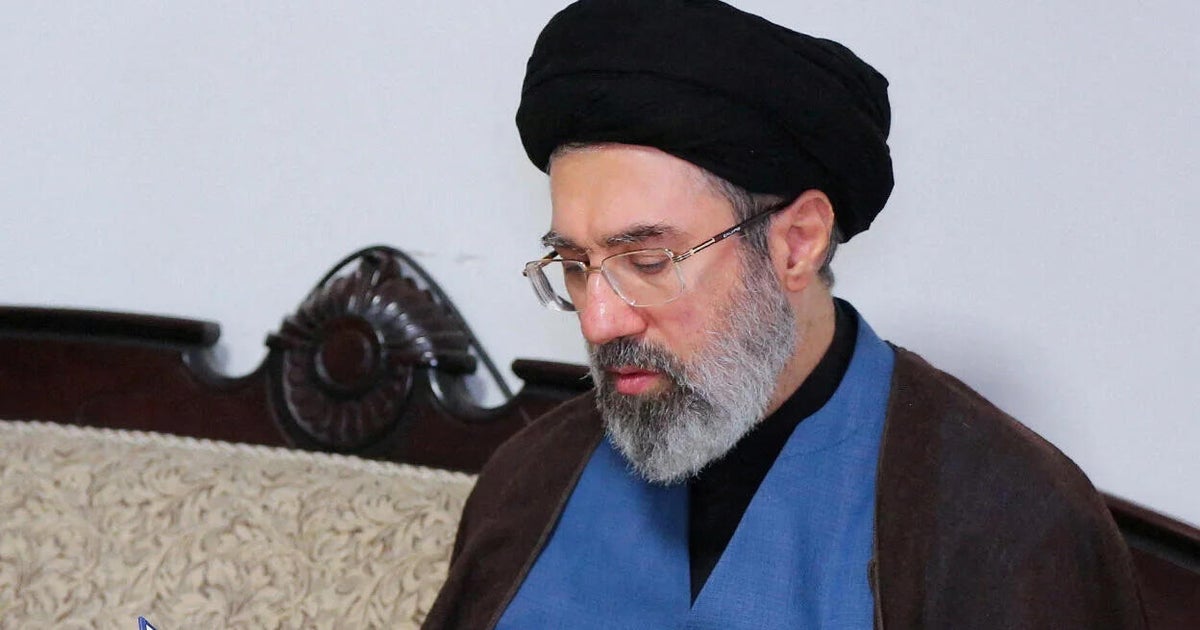
U.S. intelligence has circulated to President Trump and to a small circle around him that Iran's late supreme leader, Ayatollah Ali Khamenei, had misgivings about his son replacing him, multiple sources familiar with the matter told CBS News.
The analysis showed the elder Khamenei was wary of his son, Ayatollah Mojtaba Khamenei, ever taking power because he was perceived as not very bright, and was viewed as unqualified to be leader, according to sources.
The information gathered also indicated that the father was aware that his son had issues in his personal life, according to sources within the administration, the intelligence community and people close to the president.
Mojtaba Khamenei, 56, was selected to become Iran's supreme leader last weekend by the country's council of religious clerics after serving as a close aide to his father for years.
About eight days earlier, Ali Khamenei was killed in an Israeli missile strike in the opening salvo of the U.S. and Israel's war with Iran.
Mojtaba Khamenei, who was believed to have been injured in that strike, has been reported to have remained in his father's inner's circle.
Mr. Trump, Vice President JD Vance and other senior officials have been briefed on the intelligence about the younger Khamenei.
In private conversations, Mr. Trump has told people close to him that he doesn't know that the information conveyed to him about Mojtaba Khamenei matters. He thinks Iran is essentially leaderless right now, with the younger Khamenei possibly dead.
The White House believes Iran's Islamic Revolutionary Guard Corps is calling the shots, a significant change from the theocratic dictatorship that has existed since the country's 1979 revolution.
Spokespeople for the CIA, White House and vice president declined to comment.
On Friday, Mr. Trump hinted publicly about Ali Khamenei's lack of faith in his son.
"Their leadership is gone. Their second leadership is gone. Now their third leadership is in trouble, and this is not somebody that the father even wanted," Mr. Trump told Fox News in an interview.
Mr. Trump has called the new supreme leader a "lightweight" who would be an "unacceptable" leader for Iran. He has also suggested he wanted some oversight over Iran's next leader.
The federal government on Friday offered up to $10 million for information on the location of Mojtaba Khamenei and nine other key Iranian officials.
Mojtaba Khamenei is Iran's third supreme leader since the 1979 Islamic Revolution, following his father and Ayatollah Ruhollah Khomeini. The succession from father to son is notable because the revolution overthrew a hereditary monarchy.
The U.S., now more than two weeks into the war with Iran, has been seeking to destroy the Iranian regime. Defense Secretary Pete Hegseth told reporters Friday that the younger Khamenei is "wounded and likely disfigured," and Vance said it was an apparent strike that left him wounded. His condition was not clear.
Facts Only
* U.S. intelligence circulated to President Trump and a small circle.
* Ayatollah Ali Khamenei was wary of his son, Ayatollah Mojtaba Khamenei, taking power.
* Mojtaba Khamenei was perceived as not very bright and unqualified.
* The father was aware of personal issues with his son.
* Mojtaba Khamenei was selected by Iran’s council of religious clerics last weekend.
* Ali Khamenei was killed in an Israeli missile strike.
* Mojtaba Khamenei remained in his father’s inner circle.
* Mr. Trump does not believe the information matters.
* The White House believes the IRGC is in control.
* A $10 million reward is being offered for information on Mojtaba Khamenei.
* Mojtaba Khamenei is the third supreme leader since 1979.
* Defense Secretary Pete Hegseth stated Mojtaba Khamenei is wounded and disfigured.
Executive Summary
Full Take
The narrative presented here is a classic case of strategically leaked intelligence designed to undermine a perceived adversary, layering doubt onto a succession crisis. The immediate context is the ongoing U.S.-Iran conflict, a situation ripe for manipulation, and the source—U.S. intelligence—immediately introduces a layer of bias and potential strategic signaling. The “facts” presented – the elder Khamenei's skepticism and awareness of his son’s flaws – are presented not as objective truth, but as a calculated assertion designed to destabilize the new leadership. The timing of the leak, coinciding with the death of Ali Khamenei and the start of the war, is crucial. Mr. Trump's dismissive attitude (“he’s probably dead”) isn’t simply a reflection of his personality; it's a deliberate tactic to sow confusion and weaken the new leader's legitimacy in the eyes of the world. This pattern – leaked intelligence timed to amplify uncertainty – echoes established disinformation tactics. The offer of a $10 million reward isn't just about finding a fugitive; it’s a demonstration of U.S. resolve, further escalating tensions and creating a tangible target. The narrative frames Iran as “leaderless,” allowing the U.S. to argue for intensified intervention. The “wounded and disfigured” description of Mojtaba Khamenei is a classic piece of strategic framing designed to elicit emotional responses – fear, outrage, a sense of vulnerability. The shift in power dynamics – from a theocratic dictatorship to a potentially IRGC-controlled state – is presented not as a natural evolution, but as a dangerous deviation. The underlying paradigm driving this narrative is a fundamental distrust of the Iranian regime, framed as inherently unstable and prone to misrule. This is a high-stakes game of influence, using intelligence leaks to shape perceptions and advance strategic interests.
Patterns detected: ARC-0043 Motte-and-Bailey, ARC-0024 Ambiguity, ARC-0018 Framing, ARC-0037 Strategic Signaling.
Sentinel — Uncertain
This article exhibits several characteristics typical of AI-generated content: excessive hedging, reliance on anonymous sources, and a formulaic presentation of information. The structure and phrasing strongly suggest synthetic origin, prioritizing a balanced perspective over investigative rigor.