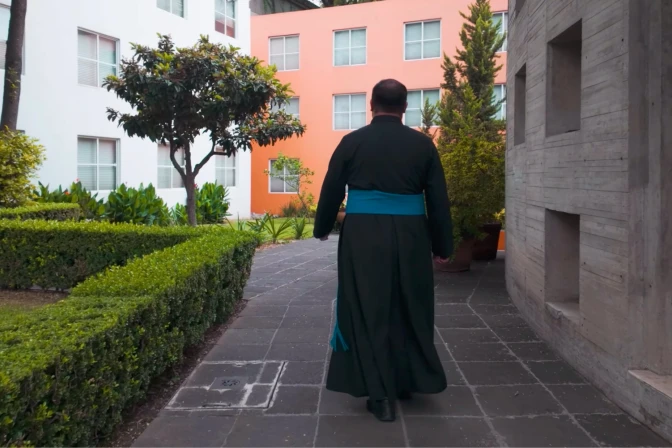
In response to the growing Hispanic Catholic community in the United States and Canada, seminarians from both countries are being sent to study in Mexico at the Hispanic Seminary of Our Lady of Guadalupe, a multicultural formation center for future priests.
The seminary was founded on Aug. 31, 1999, by the then-primate archbishop of Mexico, Cardinal Norberto Rivera, after the Catholic Church recognized the need to form priests capable of understanding the cultural richness of Hispanics in North America.
Study group at the Hispanic seminary in Mexico. | Credit: EWTN Noticias
Rivera was inspired by the call issued by St. John Paul II in the January 1999 apostolic exhortation Ecclesia in America, which called the American Church to a new evangelization.
The seminary opened in August 2000 with the arrival of five seminarians from the archdioceses of Los Angeles and Milwaukee. Since then, more than 200 graduates from at least 55 dioceses across the U.S. have passed through the formation center.
‘A Church without borders’
In an interview with ACI Prensa, the Spanish-language sister service of EWTN News, Father Juan Antonio Vértiz Gutiérrez, the seminary’s rector, explained that the learning experience goes beyond language. The seminarians gain firsthand insight into what the Church in Mexico is like as well as its ecclesial and cultural traditions, particularly through apostolates.
Seminarians visit the Isabel the Catholic Monarch nursing home in Mexico City. | Credit: Hispanic Seminary of Our Lady of Guadalupe
According to the priest, this enables them to “better serve our fellow countrymen and our brothers and sisters of Hispanic origin” in their home dioceses in the U.S. He emphasized that this formation helps these young men understand two distinct cultural realities that, while united in faith, have different cultural expressions.
For Vértiz, one of the greatest beauties of Catholicism is that it “doesn’t have any borders.” In a time marked by tensions stemming from immigration policies, he noted that the experience of the Hispanic seminary demonstrates that for the Catholic Church, regardless of one’s background, every person “already belongs to the family of the children of God.”
The program
Life at the seminary follows the rhythm of any house of priestly formation but with a particular emphasis on cultural encounter. Mornings are dedicated to philosophical and theological studies at Lumen Gentium Catholic University, while in the afternoons, seminarians delve deeper into language learning and spiritual formation.
During Holy Week, seminarians are often sent to communities outside Mexico City.
The admissions process is typically conducted through diocesan vocations offices in the U.S. “We do not accept young men who do not belong to a diocese,” the rector explained.
Currently, the seminary hosts 16 young men hailing from California, Nevada, Washington, Texas, Illinois, Alabama, and Georgia.
A map marks the seminarians’ states of origin. | Credit: EWTN Noticias
Diverse testimonies of faith
Ramsés Yates, originally from the Diocese of Yakima, Washington, arrived at the seminary a year and a half ago to complete his theological formation and learn Spanish.
In an interview with ACI Prensa, he said his experience in Mexican communities has filled him with “much hope and much joy.” In them, he said, it’s possible to witness what it means to “be a community that lives out Catholicism to the fullest.”
He noted that he is eagerly preparing to return to Yakima, knowing that he will now be able to speak “with many more people in my diocese, people with whom I previously could not communicate effectively. That fills me with great enthusiasm.”
Ramón Pérez, originally from Guanajuato, Mexico, migrated to Fresno, California, at the age of 17. There, his life was defined by work until he felt “the call to the priesthood, to a more complete dedication to the service of the Church.”
A seminarian prays at the Hispanic Seminary of Our Lady of Guadalupe. | Credit: EWTN Noticias
He told ACI Prensa that following a lengthy process of discernment, he requested admission to the seminary. His diocese decided to send him to Mexico “to continue nurturing my culture and to support the various people entering the United States” from Spanish-speaking countries.
The seminarian said the experience has enabled him “to know and become conscious of my origins, my roots, and my culture, of where I was born and where I come from.” Growing up in two different cultures, he acknowledged, can be challenging, but it has also “profoundly shaped this aspect of my vocation.”
This story was first published by ACI Prensa, the Spanish-language sister service of EWTN News. It has been translated and adapted by EWTN News English.
Facts Only
The Hispanic Seminary of Our Lady of Guadalupe was founded on August 31, 1999, by Cardinal Norberto Rivera, then-primate archbishop of Mexico.
The seminary opened in August 2000 with five seminarians from the archdioceses of Los Angeles and Milwaukee.
Over 200 seminarians from at least 55 U.S. dioceses have graduated from the seminary.
The seminary is located in Mexico and serves as a formation center for future priests from the U.S. and Canada.
Seminarians study at Lumen Gentium Catholic University in the mornings and focus on language learning and spiritual formation in the afternoons.
The seminary currently hosts 16 seminarians from California, Nevada, Washington, Texas, Illinois, Alabama, and Georgia.
Admissions are processed through diocesan vocations offices in the U.S.; independent applicants are not accepted.
Seminarians participate in apostolates and community service, including visits to nursing homes and outreach during Holy Week.
Ramsés Yates, a seminarian from the Diocese of Yakima, Washington, has been at the seminary for a year and a half to learn Spanish and complete theological formation.
Ramón Pérez, originally from Guanajuato, Mexico, migrated to Fresno, California, at 17 and is now studying at the seminary to deepen his cultural and pastoral preparation.
The seminary’s rector, Father Juan Antonio Vértiz Gutiérrez, emphasizes the program’s focus on cultural understanding and unity within the Catholic Church.
The seminary’s mission aligns with St. John Paul II’s 1999 apostolic exhortation *Ecclesia in America*, which called for a new evangelization in the Americas.
Executive Summary
The Hispanic Seminary of Our Lady of Guadalupe in Mexico serves as a multicultural formation center for seminarians from the United States and Canada, addressing the need for priests who understand the cultural and linguistic nuances of Hispanic Catholic communities in North America. Founded in 1999 by Cardinal Norberto Rivera, the seminary was inspired by St. John Paul II’s call for a new evangelization in the Americas. Since its opening in 2000, over 200 seminarians from 55 U.S. dioceses have completed their formation there, focusing on theological studies, language acquisition, and immersion in Mexican ecclesial traditions. The program emphasizes cultural exchange, with seminarians engaging in apostolates and community service to better serve Hispanic populations upon returning to their home dioceses. Current seminarians, such as Ramsés Yates and Ramón Pérez, highlight the personal and pastoral benefits of the experience, including deeper cultural awareness and improved communication with Spanish-speaking parishioners. The seminary’s approach reflects the Catholic Church’s commitment to transcending borders and fostering unity amid diverse cultural expressions.
The initiative underscores the Church’s response to demographic shifts, particularly the growing Hispanic presence in the U.S. and Canada. By integrating philosophical, theological, and practical training, the seminary prepares future priests to navigate the complexities of ministering to bilingual and bicultural communities. The admissions process is diocesan-driven, ensuring accountability and alignment with local pastoral needs. While the program’s success is evident in the testimonies of participants, its long-term impact on parish life and evangelization efforts remains to be fully assessed.
Full Take
The Hispanic Seminary of Our Lady of Guadalupe presents a compelling model of cross-cultural priestly formation, addressing a tangible need in the Catholic Church: preparing clergy to serve the rapidly growing Hispanic communities in the U.S. and Canada. At its strongest, this narrative highlights the Church’s adaptive capacity, leveraging cultural immersion to bridge linguistic and pastoral gaps. The seminary’s emphasis on firsthand experience—through apostolates, language study, and engagement with Mexican ecclesial traditions—offers a pragmatic solution to the challenge of ministering to diverse populations. The testimonies of seminarians like Ramsés Yates and Ramón Pérez underscore the personal and pastoral value of this approach, particularly in fostering deeper connections with Spanish-speaking parishioners.
However, the narrative also invites scrutiny of its underlying assumptions. The focus on cultural and linguistic assimilation risks oversimplifying the complexities of identity and belonging, especially for seminarians like Pérez, who navigate dual cultural realities. The program’s diocesan-driven admissions process ensures institutional alignment but may limit access to candidates outside traditional pathways. Additionally, the framing of the Church as "without borders" could be interpreted as a form of soft power, reinforcing institutional authority while downplaying the political and social tensions surrounding immigration. The absence of critical voices—such as seminarians who might struggle with the program’s demands or parishioners who prefer clergy formed within their local contexts—leaves the narrative somewhat one-dimensional.
Rooted in the post-Vatican II emphasis on inculturation and St. John Paul II’s call for a "new evangelization," this initiative reflects a broader paradigm shift in the Church: from a Eurocentric model to one that embraces global diversity. Yet, the long-term implications for parish life remain unclear. Will these priests effectively navigate the cultural nuances of their dioceses, or will their formation create unintended divisions? Who bears the cost of this cross-border education, and how are resources allocated across dioceses with varying needs?
Bridge questions: How might this model be adapted for other cultural or linguistic groups within the Church? What metrics could measure the program’s success beyond graduation rates? How do seminarians reconcile their dual cultural identities with the universal claims of Catholicism?
Counterstrike scan: A coordinated influence campaign might exploit this narrative to portray the Church as a unifying force amid political divisions, using emotional appeals to faith and community to deflect criticism of institutional policies. However, the content aligns more with genuine pastoral adaptation than manipulative framing. No concerning patterns detected.
Sentinel — Human
While the article shows signs of being written by a human, its stylometric patterns suggest some degree of human authorship. The text presents a balanced synthesis with context about Hispanic Catholic seminaries in Mexico.