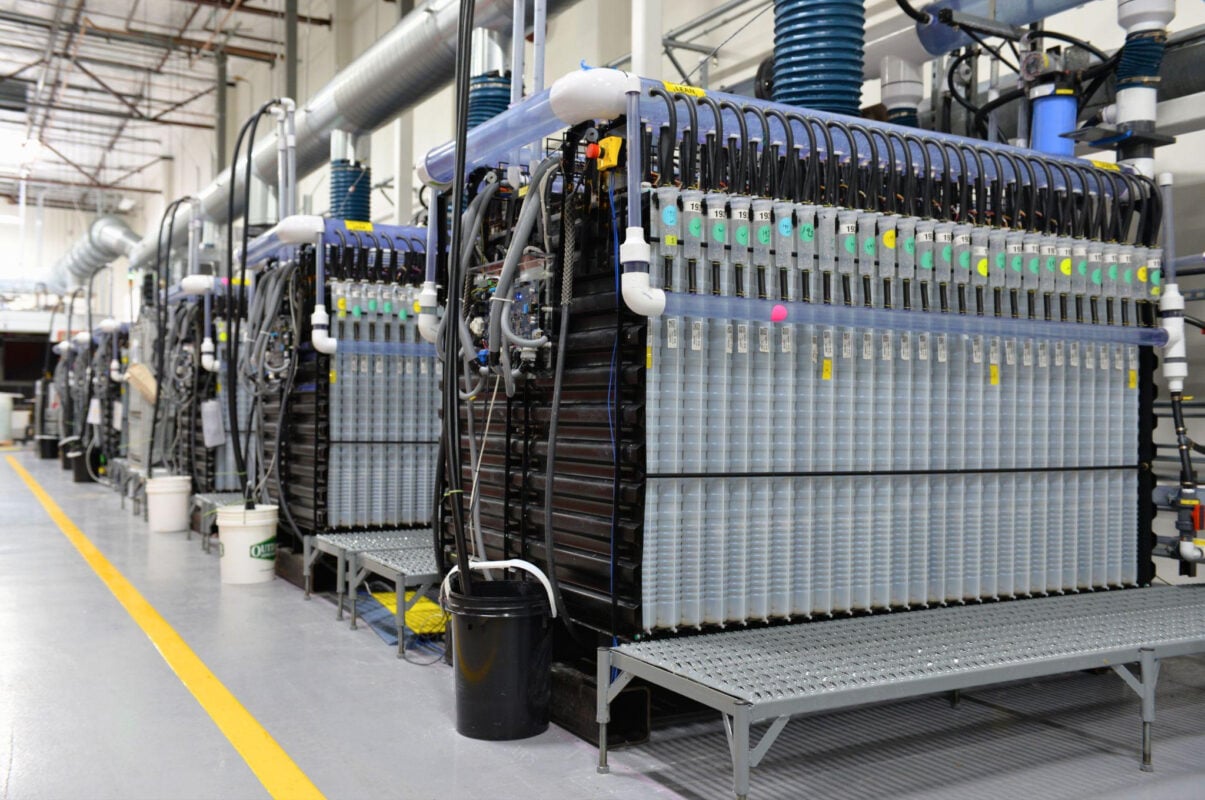
Form Energy has signed a 12GWh supply agreement in the US for its iron-air batteries with AI data centre infrastructure developer Crusoe.
Continuing a busy 2026 so far for the US multi-day energy storage startup, Form Energy announced earlier this week (24 March) that it had signed the strategic capacity agreement at CERAWeek 2026 in Houston, Texas.
The deal gives Crusoe secured volumes, pricing and delivery terms beginning in 2027. Crusoe describes itself as an energy-first data centre developer, focused on providing speed to power (i.e., getting energy resources online quickly) and prioritising low-carbon technologies.
Crusoe secures power alongside GPU computing capacity, which is important in a market landscape where concerns are riding high that data centre developments, particularly for power-hungry AI training campuses, are either going to be queuing up for the same congested grid connection queues as other resources or potentially leeching off energy capacity intended to serve other utility customers.
Try Premium for just $1
- Full premium access for the first month at only $1
- Converts to an annual rate after 30 days unless cancelled
- Cancel anytime during the trial period
Premium Benefits
- Expert industry analysis and interviews
- Digital access to PV Tech Power journal
- Exclusive event discounts
Or get the full Premium subscription right away
Or continue reading this article for free
The US government has recently responded to these concerns by encouraging ‘bring your own power’ (BYOP) or ‘bring your own capacity’ (BYOC) business models, and some data centres are being planned as off-grid facilities to get around grid connection and capacity limitations.
As regular Energy-Storage.news readers will be aware, Form Energy is commercialising a novel non-lithium battery technology that the company claims is based on abundant and cheap raw materials and capable of providing discharge durations of more than a hundred hours at full rated power.
The company emerged from stealth mode in 2021 and, in the past year, has begun operating its first pilot project with utility Great River Energy in Minnesota, US, signed agreements with other utilities in the US, and begun manufacturing its systems at a factory, Form 1, in West Virginia.
Crusoe deal follows 30GWh Google-Xcel deal
So far in 2026, its biggest announcement has been for another data centre-related project: Form Energy iron-air batteries will be used as part of a multi-technology energy supply agreement between Google and Xcel Energy, another utility based in Minnesota.
That project is, so far, the single biggest energy storage project announced in the world in terms of watt-hour capacity, at 30GWh, enabling 100-hour duration dispatch of its 300MW power output.
Just over a week ago, Form announced a partnership with renewables developer FuturEnergy Ireland for its first project outside the US, a 10MW/1,000MWh system expected to come online in 2029.
On the deal with Crusoe, Form Energy said the batteries will be manufactured at Form 1, aligning with US market and government-driven demand for domestically made solutions.
It is worth noting that although the deal, at 12GWh, is significant in scale, it can be seen as prospective until the first projects are underway. For instance, other non-lithium battery storage tech companies were seen to spend a few years racking up tentative multi-gigawatt-hour supply agreements with developers, where nothing was heard beyond the initial announcements.
Still, if Form Energy can pull it off, the Crusoe deal could set the startup on its way to becoming a major supplier to the burgeoning data centre sector.
Some in the industry have raised questions about the round-trip efficiency (RTE) of iron-air batteries, which is considerably lower than that of lithium-ion battery energy storage systems (BESS) or even flow batteries.
This was examined in a deep dive into the Google deal for ESN Premium earlier this month. The low RTE is something Form Energy representatives, including CEO and founder Mateo Jaramillo, have been upfront about since the company emerged from stealth mode.
The company’s concept is that the iron-air battery is designed to cover longer-duration lulls in renewable energy production that could last many hours or even days at a time, rather than the short-duration applications of up to about 1-hour or 10-hour requirements that lithium-ion more typically solves. Form Energy might argue that this, coupled with the claimed low cost of the iron-air batteries, makes the RTE less of an issue.
Facts Only
Actor: Form Energy, Crusoe, Google, Xcel Energy
Event: Signing of a 12GWh supply agreement for iron-air batteries between Form Energy and Crusoe; Announcement of a multi-technology energy supply agreement between Google and Xcel Energy using Form Energy's iron-air batteries.
Timeline: March 2026 (announcement)
Location: Houston, Texas (announcement at CERAWeek); US (all other events)
Executive Summary
Form Energy, a US-based energy storage startup, has signed a 12GWh supply agreement with Crusoe, an AI data centre infrastructure developer. The deal is significant as it provides Crusoe with secured volumes, pricing, and delivery terms for Form Energy's iron-air batteries beginning in 2027. This strategic capacity agreement was announced at CERAWeek 2026 in Houston, Texas.
The iron-air batteries are designed to cover longer-duration lulls in renewable energy production and are claimed to be based on abundant and cheap raw materials. Form Energy emerged from stealth mode in 2021 and has already begun operating pilot projects, signed agreements with utilities, and started manufacturing its systems at a factory.
This deal follows another major announcement by Form Energy for a data centre-related project: Form Energy iron-air batteries will be used as part of a multi-technology energy supply agreement between Google and Xcel Energy. The 30GWh project is currently the single biggest energy storage project announced in terms of watt-hour capacity.
Full Take
Steelman: Form Energy's iron-air battery technology is presented as a solution for long-duration energy storage needs, particularly in the data centre sector. The batteries are claimed to be based on abundant and cheap raw materials and capable of providing discharge durations of more than a hundred hours at full rated power.
Patterns detected: None
Root Cause: The increasing demand for energy-efficient solutions, particularly in the data centre sector, is driving the development and adoption of innovative energy storage technologies such as Form Energy's iron-air batteries.
Implications: If successful, Form Energy's iron-air batteries could significantly contribute to the reduction of carbon emissions from the data centre sector. However, the round-trip efficiency of these batteries is lower than that of lithium-ion battery energy storage systems (BESS), which could potentially impact their widespread adoption.
Bridge Questions: What are the potential long-term impacts of Form Energy's iron-air batteries on the data centre sector and overall renewable energy storage landscape? How can concerns about round-trip efficiency be addressed to facilitate wider adoption of this technology?