A recent killing of a neo-Nazi activist could bring France’s far-right party closer to power than it’s ever been.
Updated at 11:31 a.m. ET on March 20, 2026
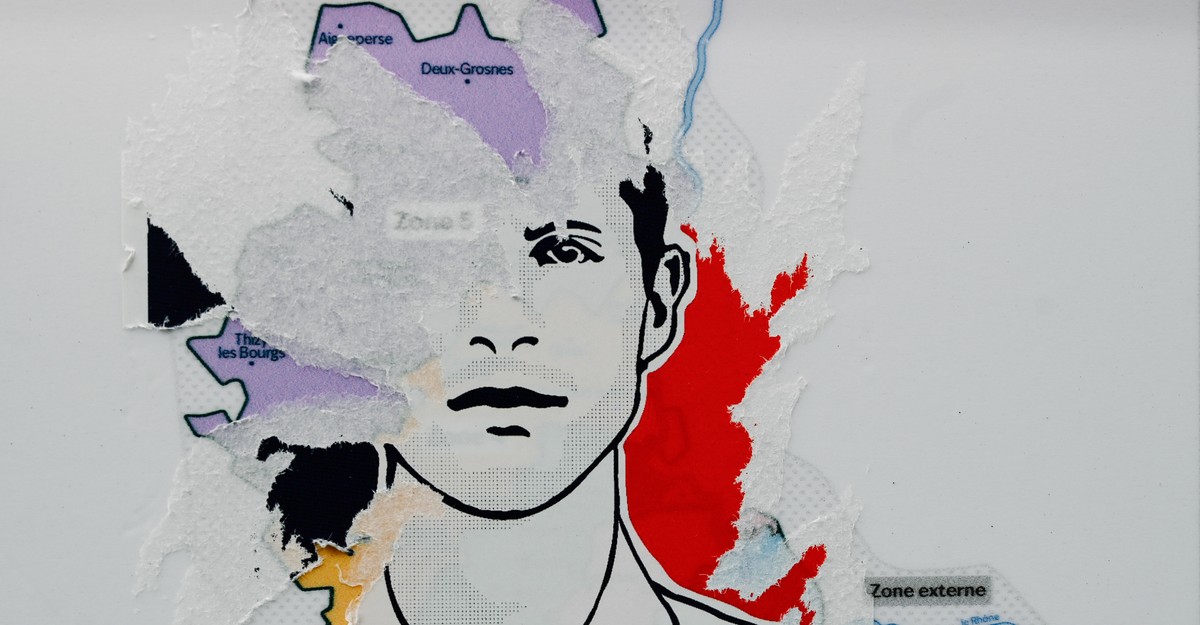
On the evening of February 12, members of a French anti-fascist group allegedly pummeled a 23-year-old neo-Nazi activist named Quentin Deranque. The attack, filmed in Lyon, left Deranque unconscious; two days later, he died from severe brain trauma.
The atrocity could prove to be a boon for the far-right National Rally (abbreviated as RN in French), a party whose decades-long rise has been perhaps the most significant political development in 21st-century France.
Voices on the French right have called Deranque’s killing the country’s “Charlie Kirk moment.” The comparison is self-serving and flawed—Deranque was not a public figure, and he was not assassinated—but the tragedy nonetheless poses a substantial problem for the left. The country’s left-most party, France Unbowed (LFI), has direct ties to the anti-fascist Young Guard, whose members have been charged in relation to the homicide. LFI is shedding legitimacy as a result.
Meanwhile, the centrist bloc, led by President Emmanuel Macron, is deeply unpopular. Macron has managed to keep the RN out of government (and himself in it) by selectively cooperating with LFI, but that strategy is looking less tenable. He is a lame duck without a clear successor, overseeing a diminished establishment.
As the center and far left decline, the RN now appears to be closer to power than ever.
France has a word for how the far right has managed its ascent: dédiabolisation, literally “de-demonization.”
The RN was originally known as the National Front, an extremist party co-founded in 1972 by Jean-Marie Le Pen, who salvaged certain remnants of Vichy fascism. After decades of relative obscurity, Le Pen shocked the country in 2002 by advancing to the second-round presidential-election runoff against the incumbent, Jacques Chirac. All major parties, from left to right, considered this a national emergency. They enacted a two-step response, drawing a cordon sanitaire around Le Pen—refusing him any measure of electoral cooperation—and forming a front républicain, urging their own supporters to cast ballots for Chirac for the good of the republic. The strategy worked: Chirac won 82 percent of the vote.
Today, the RN inspires nowhere near this level of fear. Marine Le Pen, who inherited the National Front from her father, has rehabilitated the party’s image and reshaped its agenda, capturing large numbers of disaffected, downwardly mobile white voters who had previously been stalwarts of the socialist left. She has been able to do this in part by disavowing her father’s anti-Semitism and redirecting her ire toward France’s growing population of Muslim immigrants. In 2015, Le Pen expelled her father from the party that he created after he reaffirmed his infamous comment that the Nazi gas chambers were but a “detail” of the history of World War II. The RN has since positioned itself as one of the staunchest supporters of Israel in French politics. Meanwhile, Jean-Luc Mélenchon, who founded LFI in 2016, has faced growing accusations of anti-Semitism.
Another reason for the extraordinary success of the RN has to do with Macron. After abandoning the Socialist Party, he launched his own political movement in 2016 by forming En Marche (now named Renaissance). Macron poached major figures from the moderate right and adopted much of their agenda, alienating his more liberal supporters and driving the conservative fringe to the RN. All of this has enfeebled the institutional center, which looks less like a durable coalition and more like Macron’s personal political vehicle. In effect, Macron has made himself France’s main bulwark against right-wing nationalism. When he leaves office next year, that barrier could crumble.
In the most recent presidential election, in 2022, the cordon sanitaire against the RN held, but it showed signs of fraying. Although Macron handily defeated Le Pen, she more than doubled the vote share that her father had received 20 years earlier. LFI’s Mélenchon told his supporters not to cast a “single vote” for Le Pen, yet he refused to endorse Macron, creating a gap in the front républicain.
The trend continued in snap parliamentary elections in 2024. Some mainstream candidates strategically dropped out of their race and successfully urged their voters to keep the RN out of power. Still, the far right secured dozens of additional seats and won a plurality of the vote. Many in France seemed to resent the expectation, imposed by the political center, that they must vote against candidates rather than for them.
Last month’s killing could accelerate the far right’s dédiabolisation by making the far left look even more radical by comparison. The Young Guard, the anti-fascist group, was co-founded by an LFI assemblyman, Raphaël Arnault. In fact, two of the suspects detained by police once worked as Arnault’s aides. (Arnault has condemned the killing.)
Two weeks after the homicide, in an unrelated ruling, France’s highest administrative court upheld the Macron government’s designation of LFI as extrême gauche, or “far left,” putting it on par with the RN, which has long been designated as extrême droite. In one poll conducted after Deranque’s death, 63 percent of respondents said that they would vote to block LFI in the second, decisive round of an election, compared with just 45 percent who said that they would do the same for the RN.
France is currently holding two rounds of mayoral elections nationwide that could provide an early indication of how parties will fare in next year’s first presidential contest of the post-Macron era. Marc Weitzmann, a French journalist and longtime observer of the country’s political extremes, told me that Macron’s centrist faction appeared “dead” after the first round, which took place on Sunday. The RN, by contrast, performed well. Even though the election yielded mixed results for LFI, Weitzmann said, Mélenchon contends that his party is “the only force able to confront the far-right.”
As ludicrous as it might sound to French voters who still remember the anti-Semitism and xenophobia of Jean-Marie Le Pen, today the far right is calling for a cordon sanitaire around the far left. Jordan Bardella, the 30-year-old president of the RN, has labeled LFI “a danger for our democracy.” Étienne Ollion, the director of research in sociology at the French National Centre for Scientific Research, told me that this amounted to a “reversal of stigma that would have been unthinkable just five years ago.”
Bardella’s assessment is sheer politicking, to be sure. But voters who have seen the video of left-wing militants stomping on Deranque’s head may find it hard to disagree.
This article originally stated that the journalist Marc Weitzmann said France Unbowed is “the only force able to confront the far-right.” In fact, Weitzmann was describing the thinking of Jean-Luc Mélenchon, the party's founder, not his own.
Facts Only
* Quentin Deranque, a 23-year-old neo-Nazi activist, was allegedly attacked on February 12, 2026.
* The attack was carried out by members of an anti-fascist group.
* Deranque died two days after the attack from severe brain trauma.
* The National Rally (RN) party is benefitting from the event.
* France Unbowed (LFI) has direct ties to the anti-fascist group.
* President Emmanuel Macron’s centrist bloc is unpopular.
* The RN’s strategy is “dédiabolisation.”
* Jean-Marie Le Pen co-founded the National Front in 1972.
* Le Pen advanced to the second round of the 2002 presidential election.
* LFI is designated as “extrême gauche” by the French court.
* 63% of respondents said they would block LFI in a second-round election.