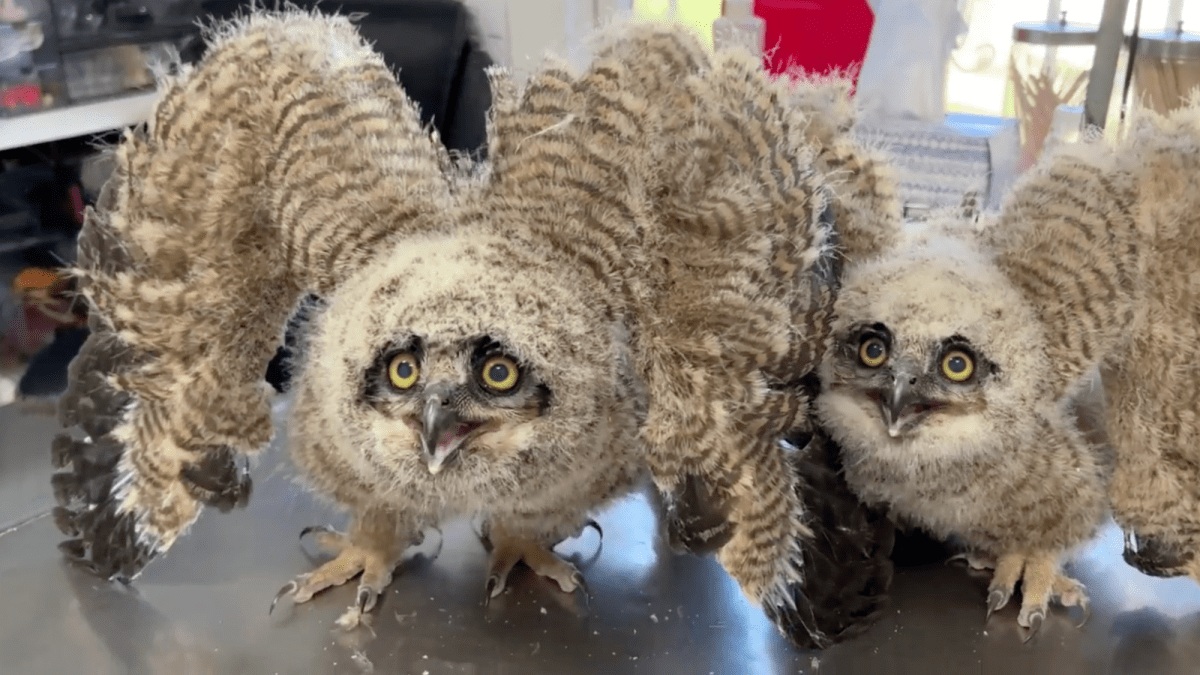
When taking care of injured birds, sometimes a hands-off approach is the best place to start. And that’s exactly what was in store for two great-horned owls (Bubo virginianus) in the caring hands of the team at the Stanislaus Wildlife Care Center in central California.
“Great-horned owls often jump out of the nest before the babies can fly. The parents continue to care for them on the ground,” Donna Burt, a biologist and chairman of the board, executive director, and founder of the Stanislaus Wildlife Care Center, tells Popular Science. “That works fine if the owls are in a protected area, but these were in a soccer field.”
Fortunately, these birds did not have any injuries when they were brought into the animal care center, but they still needed a check-up. During a hands-off exam like this one, veterinarians look closely to see how an animal stands, walks, and looks around, to get a sense of their health and potential injuries. In the case of these four to five-week-old owls, the bird on the left is up on its feet, while the owl on the right is hock sitting. Since it is unable to stand, the bird sits back on its legs, which is a normal action for owls this age. Both birds can snap their beaks and spread their wings in threat displays, which indicates that they are feeling well.
The team can also check on the birds’ eyes during this type of exam. They have a little cloudiness, which is normal for young great-horned owls. They will also blink by lowering the upper eyelids, which is sometimes another threat display.
Great-horned owls are one of North America’s largest owls. They typically weigh between 2.5 and 4.5 pounds. Baby great-horned owls are also the first babies that the Stanislaus Wildlife Care Center receives every single year. Owl pairs begin their courtship in November and lay eggs in late January or early February. The eggs will hatch in March or April. Once hatched, the owls reach full adult size at 10 weeks, but will stay with their parents until the fall.
“When we get tiny baby great-horns, we put them with a non-releasable surrogate owl who cares for and feeds them,” Burt says. “Not only is that easier for us, but it’s better for the babies. Although it can feel rewarding to hand-feed and care for the little fluffballs, it is in their best interest to be raised by owls. They grow faster and develop normal behavior.”
While these two can eat on their own, it will be another few weeks before they can fly. As soon as the birds reach that milestone, they will move to one of the center’s larger aviaries that measure either 50 feet or 100 feet long.
If you come across baby great-horned owls on the ground who appear clean and healthy, the center advises people to leave them alone. If a bird looks injured or sick, contact your local animal control or wildlife rescue center.
Facts Only
Who: Donna Burt (biologist and chairman of the board, executive director, and founder of Stanislaus Wildlife Care Center), great-horned owls, parents of great-horned owls
What: Check-up for two great-horned owls, observing owl's behavior, caring for baby great-horned owls, moving birds to larger aviaries when they can fly
When: Unspecified timeline but occurred after the owls were found on a soccer field
Where: Stanislaus Wildlife Care Center in central California, soccer field
Executive Summary
Full Take
The article provides an interesting case study of the challenges faced by wildlife care centers when dealing with injured animals. In this instance, two great-horned owls were brought to the Stanislaus Wildlife Care Center due to prematurely leaving their nest. This behavior is common among great-horned owls and shows how the parents continue to care for them on the ground if they jump out of the nest before flying. However, in urban environments like a soccer field, such situations can pose risks for the birds.
The article also highlights the importance of understanding normal behavior for different species when assessing their health. In this case, the team at the wildlife care center was able to determine that both owls were healthy based on their ability to threaten with beak snaps and wing spreads. This serves as an example of how observing animals' behaviors can provide valuable insights into their well-being.
Finally, the article stresses the importance of leaving baby great-horned owls alone if they appear clean and healthy, while contacting local animal control or a wildlife rescue center if a bird looks injured or sick. This underscores the need for public education about wildlife care and the role people can play in ensuring the safety and health of wild animals.
Patterns detected: none