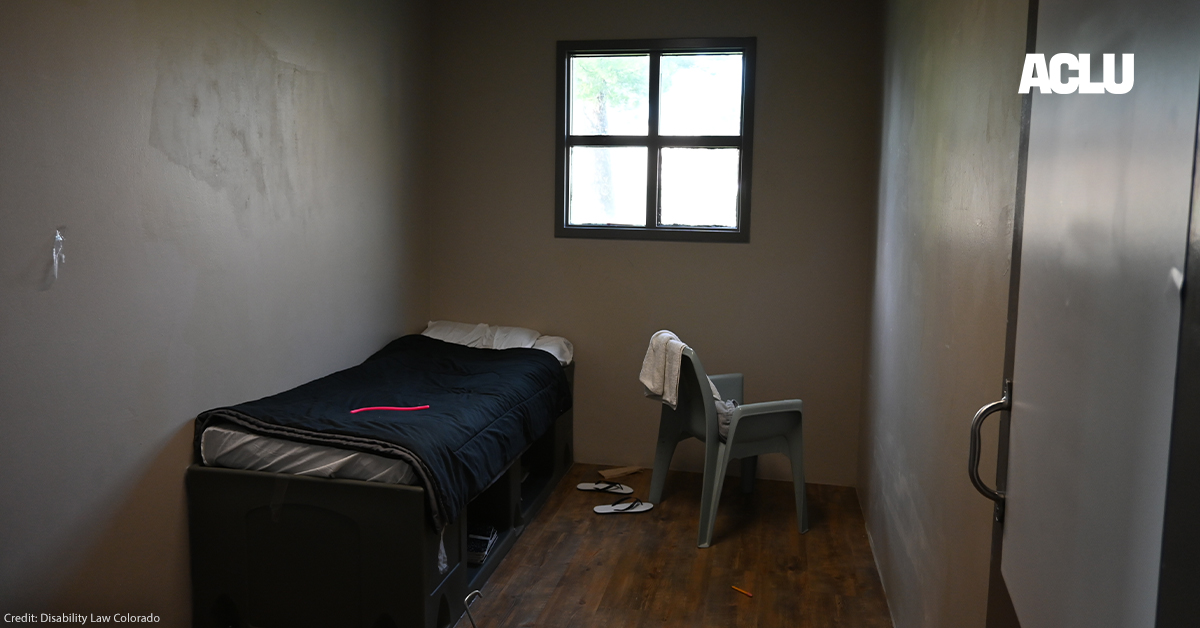
*Editor's Note: This photo was originally published by Disability Law Colorado in its recent report: Breaking Point: Conditions in the Colorado Division of Youth Services (2021–2025)
Tony S. is 12 years old and has been locked up for over six months, even though a Colorado judge in his delinquency case said he should be released. Tony has been diagnosed with autism spectrum disorder and a medical condition that causes cognitive impairments, behavioral issues, and developmental delays. He is scared to go to court in handcuffs. He wants to listen to country music and play board games, like other kids his age.
Tony, who's named using a pseudonym due to his status as a minor, is a named plaintiff in a class-action lawsuit filed in March by the ACLU National Prison Project, the ACLU of Colorado, advocacy organizations Children’s Rights and Disability Law Colorado, and the law firm Ropes & Gray. For hundreds of children like Tony, the judges in their delinquency cases have specifically said that they should not be locked up in detention but rather, released to a foster placement or back home, with services like therapy. Yet, these children languish for days, weeks, or months locked in detention facilities simply because of Colorado’s failure to find any other place for them. Children with disabilities and foster children are at particular risk of this unlawful detention.
The state’s failure to release children from jail to a more suitable, community-based setting violates their constitutional and statutory rights. For kids with disabilities, confining them in an institution when they could be in a community setting is a violation of the Americans with Disabilities Act. The Fourteenth Amendment also protects the right to be free from detention while a judge is deciding their case, a heightened protection afforded to children.
The conditions at a Division of Youth Services (DYS) Residential Youth Center in Colorado look shockingly like an adult jail. The doors are always locked. There’s barbed wire around the perimeter of the campus. The cell-like bedrooms have a bed, a plastic chair, and maybe a desk. There’s an overhead light that stays turned on all night so that staff can see through the window of the cell door. Kids are handcuffed when they leave the building, including when going to court. To the extent that there is any education, kids ages 12 to 17 are in the same classroom. Kids are often subject to strip searches and violent restraint tactics.
Kids here describe their days as filled with despair, loneliness, and boredom. In one video call, another 12-year-old boy said he spent his spring break doing very little — to his dismay. The break simply meant there were no classes, despite there being little else for kids to do in detention besides school. Instead, he taught himself how to shuffle a deck of cards. He asked if we could teach him the bridge part if we visited.
Any time that a child spends in detention can have long-term harmful effects. The harm is especially pronounced for kids who spend weeks and months in these restrictive settings. Research has shown that detention harms children physically, neurologically, psychologically, socially, developmentally, and academically. Time in detention derails education, disrupts relationships, limits kids’ future opportunities, and increases the likelihood a child remains involved with the system. This is not news to Colorado officials: The state has repeatedly acknowledged the harmful effects of detention on kids and has long been on notice of its failure to timely release children from detention to more community-integrated settings, as required by law.
Colorado is not an aberration. Many states are guilty of incarcerating children simply because it’s the easiest place to keep them. Instead of investing in community-based services and wraparound supports, states leave children to sit in detention, isolating them from their friends and families. Just this month, U.S. Senator Jon Ossoff and Representative Jen Kiggans issued a bipartisan Congressional report documenting this grim reality in several states. Last month, a proposed bill was introduced in the Tennessee Legislature that would allow locking foster children in detention for no other reason than the shortage of foster homes.
There are many places kids should be: in school, at a park with their friends, at sports practice, home with their siblings or parents, at a summer camp, or ballet class. Jail is no place for kids. Communities are where kids belong. Our lawsuit serves as a warning to states nationwide: The way governments treat and care for their most vulnerable children does not go unnoticed. Colorado must immediately invest in adequate processes and an array of placements and services to support children living in home settings, not in detention.
Facts Only
A 12-year-old boy named Tony S., diagnosed with autism and cognitive impairments, has been detained in a Colorado juvenile facility for over six months despite a judge’s order for his release.
Tony is a plaintiff in a class-action lawsuit filed in March by the ACLU, Children’s Rights, Disability Law Colorado, and the law firm Ropes & Gray.
The lawsuit alleges that Colorado detains children in juvenile facilities even after judges rule they should be released to foster care or home with services.
Children with disabilities and foster children are disproportionately affected by this practice.
Conditions in Colorado’s Division of Youth Services (DYS) facilities include locked doors, barbed wire, cell-like bedrooms, and constant overhead lighting.
Children are handcuffed when leaving the facility, including for court appearances.
Educational opportunities are limited, with children ages 12–17 placed in the same classroom.
Strip searches and violent restraint tactics are reportedly used.
A 12-year-old boy described spending spring break with little to do, teaching himself to shuffle cards.
Research shows detention harms children physically, neurologically, psychologically, and academically.
Colorado officials have previously acknowledged the harmful effects of detention but continue the practice.
A bipartisan Congressional report and proposed Tennessee legislation highlight similar issues in other states.
The lawsuit demands Colorado invest in community-based placements and services instead of detention.
Executive Summary
A class-action lawsuit has been filed against Colorado’s Division of Youth Services (DYS) for unlawfully detaining children in juvenile facilities, even after judges have ordered their release. The plaintiffs, including a 12-year-old boy with autism and cognitive impairments, allege that the state fails to provide community-based placements, violating constitutional and disability rights. Conditions in these facilities resemble adult jails, with locked doors, barbed wire, and restrictive measures like handcuffing during court appearances. Children report severe emotional distress, with days marked by boredom and isolation. Research confirms that prolonged detention harms development, education, and future opportunities. The lawsuit highlights a systemic issue where states prioritize detention over community-based solutions, despite acknowledging its harm. Advocates argue that children belong in supportive environments, not incarceration, and demand immediate reforms to ensure timely releases and adequate services.
The case reflects broader national trends, with other states also detaining children due to foster care shortages or lack of alternatives. A recent bipartisan report and proposed legislation in Tennessee underscore the widespread nature of this problem. The lawsuit serves as a warning to states that such practices violate legal and ethical standards, urging investment in community-based care over institutionalization.
Full Take
The strongest version of this narrative is that Colorado’s juvenile detention system is failing children by prioritizing institutionalization over community-based care, despite legal and ethical obligations. The lawsuit presents compelling evidence of systemic neglect, with children—particularly those with disabilities—suffering unnecessary harm. The conditions described (locked doors, handcuffs, isolation) align with broader critiques of carceral systems, reinforcing the argument that detention is inherently damaging to youth development.
However, the narrative could be strengthened by addressing potential counterarguments: Are there legitimate logistical challenges in placing children in foster care or home settings? Does the state lack resources, or is this a policy failure? The article frames the issue as a clear violation of rights, but the root cause—whether bureaucratic inertia, funding shortages, or ideological resistance to reform—remains underexplored. The emotional weight of children’s testimonies is powerful, but without broader systemic context, the analysis risks oversimplifying a complex problem.
This story echoes historical patterns of institutionalizing vulnerable populations under the guise of "care," a practice long criticized by disability and child welfare advocates. The implications are stark: When states default to detention, they perpetuate cycles of trauma and systemic involvement, undermining the very rehabilitation they claim to pursue. The lawsuit’s demand for community-based solutions aligns with decades of research favoring restorative justice over punitive measures.
Bridge questions: What would a functional alternative to detention look like in practice? How do other states successfully transition children out of detention, and what barriers prevent Colorado from doing the same? If the state acknowledges the harm of detention, why has reform been so slow?
Counterstrike scan: A coordinated influence campaign might exploit this narrative to push for defunding juvenile justice systems entirely, framing all detention as abusive without nuance. However, the article’s focus on legal violations and specific policy failures—rather than broad ideological attacks—suggests a principled critique rather than a manipulative one. No structural alignment with a hypothetical attack playbook is detected.
Patterns detected: none
Sentinel — Human
The text displays the rhetorical style and specific sourcing markers of human-written advocacy journalism, focused on linking individual experiences to systemic legal and policy failures.