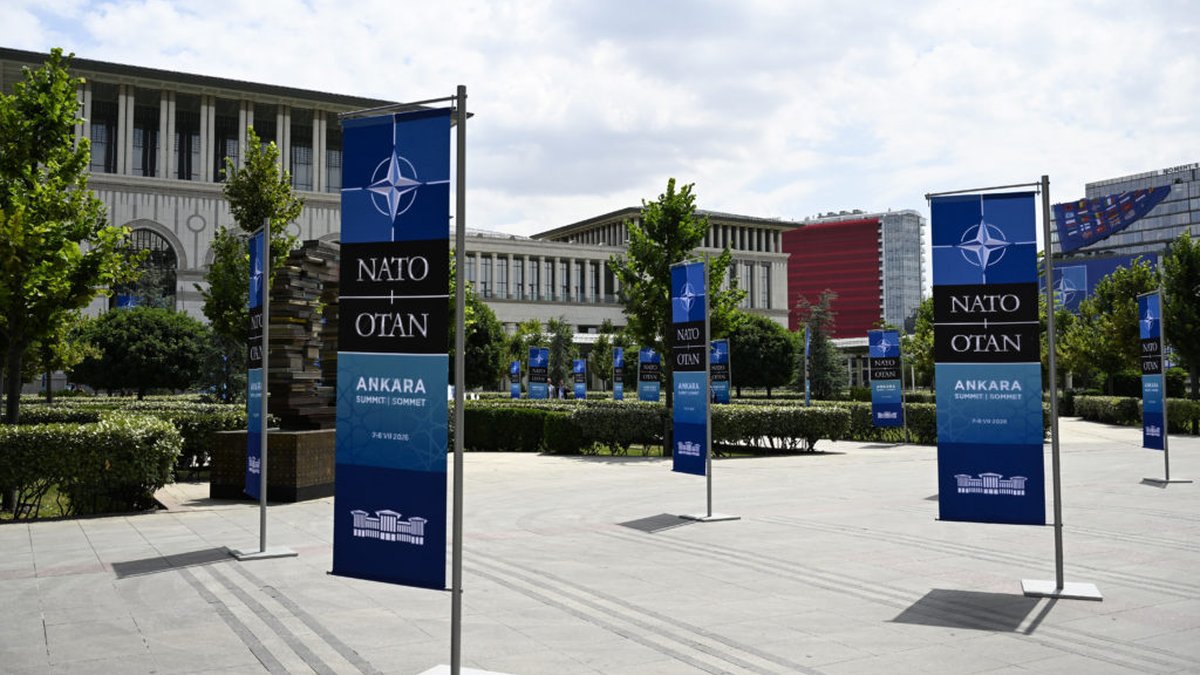
By — Nick Schifrin Nick Schifrin By — Veronica Vela Veronica Vela By — Zeba Warsi Zeba Warsi Leave your feedback Share Copy URL https://www.pbs.org/newshour/show/can-nato-allies-deliver-on-promises-to-increase-military-spending Email Facebook Twitter LinkedIn Pinterest Tumblr Share on Facebook Share on Twitter Transcript Audio President Trump is departing for a pivotal summit with NATO allies after a year in which he's questioned European countries’ sovereignty and doubted the alliance's very utility. Nick Schifrin reports from Ankara, Turkey, where the NATO summit will take place. Read the Full Transcript Notice: Transcripts are machine and human generated and lightly edited for accuracy. They may contain errors. Amna Nawaz: Welcome to the "News Hour."President Trump has often been a proud disrupter on the world stage, and today was no different. He acknowledged today that he intervened directly with the president of FIFA, which led to the overturning of a penalty that would have banned a star American striker from tonight's World Cup match. In response, some European soccer leaders are questioning the integrity of the entire tournament.And, tonight, President Trump is departing for a pivotal summit with NATO allies, after a year in which he's questioned European countries' sovereignty and doubted the very utility of the alliance. We will get to the soccer controversy in just a moment.But, first, Nick Schifrin joins me from Ankara, Turkey, where the NATO summit will take place.So, Nick, what are administration officials saying ahead of this pivotal summit? Nick Schifrin: Amna, as one senior official put it to me, it is -- quote -- "Show me the money time."It was one year ago at the Hague summit that all NATO leaders pledged to spend 5 percent of their GDP on defense, and President Trump declared the U.S.' military presence in Europe was -- quote -- "not a ripoff." That was a good day for NATO.But, since then, it has been a bad year. And the president's national security strategies criticize European -- quote -- "civilizational erasure." The president threatened to seize Greenland, which, of course, is an autonomous part of Denmark.Even this weekend, Amna, as a senior administration official was briefing reporters, the official said that the U.S.' acquiring Greenland would still be -- quote -- "the best way" to meet the defense needs of NATO. President Trump has also questioned the very reason for the alliance's existence after Europeans resisted helping the U.S.-Israeli war with Iran.And the Pentagon indicates that they will draw down troops and bases from Europe. And so European officials arrive here both knowing that if they want to placate President Trump -- and that is an if -- they will have to present what Mark Rutte, the secretary-general of NATO, today called clear, concrete, and credible plans to reach that 5 percent goal.As that senior administration official put it to us, the U.S. is no longer interested in burden-shifting. They are talking about burden-sharing. And that really indicates how much the historic U.S. and European security ties, Amna, have begun to fray. Amna Nawaz: And so, Nick, what do you anticipate will hear in the summit? Will they acknowledge that sort of momentum and shift? Nick Schifrin: Privately, Amna, European officials do acknowledge this, but, publicly, they are much more careful, saying what one European official told me today would be a -- quote -- "more European NATO."But there's a different tone here. Amna, last year European officials arrived here describing an effort, an attempt, a hope, to try and keep the U.S. committed to Europe. Now they acknowledge that the Europe -- is going to reduce its presence in Europe. So their goal is just to minimize the damage of the transition.There are more than 70,000 U.S. troops in Europe. And if the U.S. withdraws quicker than Europe can mobilize, that could create a security vacuum that would make Europe vulnerable. What Europe wants is, frankly, what it doesn't always get, predictability and collaboration.But, as always, today, Rutte played his Trump whisperer role, and he praised what he called the president's forcefulness. Mark Rutte, NATO Secretary-General: President Trump has been extremely forceful, encouraging us to do this. You could argue that he is the first president of the U.S. since Eisenhower who was able to come to this situation where the Europeans and the Canadians will spend the same as the as the Americans.This equalization was a wish for 50, 60 years, and now it's happening, and I think in large part through his leadership. Nick Schifrin: The irony here, Amna, is that European defense spending and capabilities are growing at the exact same time that tension within the alliance is growing, mostly because of President Trump's rhetoric. Amna Nawaz: Nick, meanwhile, we know, as you have been covering, one of the topics at the summit beyond NATO will be Ukraine. What do we expect to come from these meetings when it comes to that ongoing war? Nick Schifrin: I mean, it's certainly a topic that European officials are desperate to present a united front on. But Ukraine is extremely vulnerable right now to Russian attack, as we saw overnight. A Russian barrage of missiles and drones hit Kyiv. All of Russia's ballistic missiles struck their targets.That means that Kyiv has run out of Patriot air defense. The Russian attack killed at least 22 people. President Trump will meet Ukrainian President Volodymyr Zelenskyy here on the sidelines of NATO. And Zelenskyy, of course, will emphasize getting more European and U.S. air defense, as the U.S. and Europe are also talking about some joint models, joint production in the defense industrial base. Amna Nawaz: And, briefly, Nick, before we let you go, what are we expecting from President Trump in the way of an announcement tomorrow alongside the Turkish leader, Erdogan? Nick Schifrin: So, they -- the two will meet. And Turkey has been asking for two major military parts from the United States, engines for Turkish military jets and also being back into the American F-35 military jet program.You will recall, Amna, of course, that Turkey was removed from the program and sanctioned during the first Trump administration after it refused to give up air defense missiles provided by Russia. U.S. officials are hinting, although not confirming, there could be progress to allow Turkey back into the F-35 program.That is something that has split Capitol Hill. It's split experts. Israel has come out against it. But it's something, Amna, that Prime Minister Erdogan has made such a key priority in his personal dealings with President Trump. Amna Nawaz: All right, that is Nick Schifrin reporting live from the site of the NATO summit in Ankara, Turkey.Nick, thank you. Listen to this Segment Watch Watch the Full Episode PBS NewsHour from Jul 06, 2026 By — Nick Schifrin Nick Schifrin Nick Schifrin is PBS News Hour’s Foreign Affairs and Defense Correspondent and serves as the host of Compass Points from PBS News. @nickschifrin By — Veronica Vela Veronica Vela By — Zeba Warsi Zeba Warsi Zeba Warsi is a foreign affairs producer, based in Washington DC. She's a Columbia Journalism School graduate with an M.A. in Political journalism. She was one of the leading members of the NewsHour team that won the 2024 Peabody award for News for our coverage of the war in Gaza and Israel. @Zebaism