By Ross Nesbitt
A recent article argued that Americans are fighting data centers because they are really afraid of artificial intelligence. The author suggests that local opposition to giant AI facilities is a misplaced proxy battle and that the real discussion should be national AI policy.
There is truth in that observation. Many people are worried about artificial intelligence itself rather than the warehouses full of servers that power it.
But there is another possibility that deserves equal attention.
Perhaps people are not rejecting AI.
Perhaps they are rejecting dependence.
The Difference Between AI and Someone Else's AI
For decades, computing followed a predictable path.
We bought computers because we wanted control.
A spreadsheet on our desktop belonged to us.
A photograph stored on our hard drive belonged to us.
A program running on our machine continued working even if the manufacturer disappeared.
The modern AI industry often asks us to reverse that relationship.
Instead of owning intelligence, we rent access to it.
Instead of running models locally, we send our questions, documents, images, and conversations to distant data centers owned by a handful of companies.
The result is a curious paradox.
The most powerful personal computers in history are sitting on our desks, yet many AI systems require us to ask permission from remote servers before they can think.
The Home Lab Rebellion
Among hobbyists, makers, Linux users, and home-lab builders, a quiet rebellion is underway.
People are assembling machines with large GPUs, installing local models, and experimenting with systems that can operate entirely inside their own homes.
The goal is not merely privacy.
The goal is sovereignty.
A local model cannot be rate-limited by a quarterly earnings report.
A local model cannot suddenly change its terms of service.
A local model cannot decide that your favorite workflow is no longer supported.
When intelligence runs on your hardware, you regain a measure of control over your own tools.
That is not nostalgia.
It is resilience.
The Cat Test
My friend Jim asks a simple question.
"Can I put AI on a robot and tell it to be kind to the cat?"
That question reaches directly into the heart of the alignment debate.
The interesting thing is that solving it may not require a hyperscale data center.
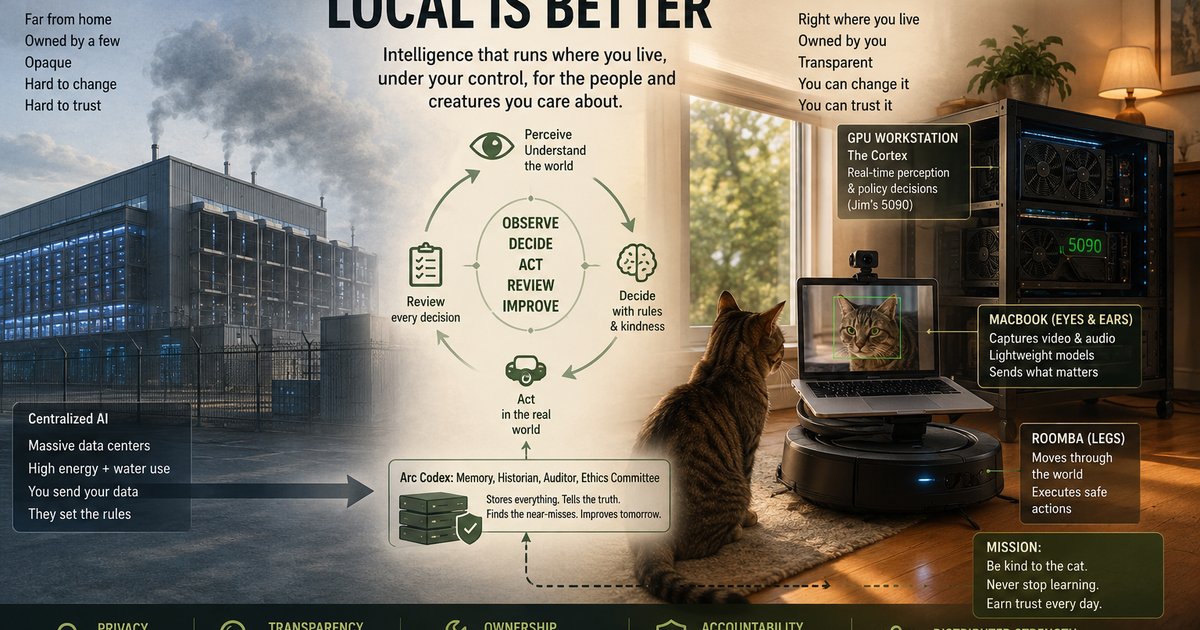
Imagine a simple architecture.
A MacBook mounted on a mobile platform serves as eyes and ears.
A local GPU workstation equipped with a modern graphics card acts as the robot's visual cortex.
The robot's movements are constrained by safety rules.
A separate auditing system records every decision for later review.
The entire system can operate inside a home.
No cloud required.
No subscription required.
No remote approval required.
Just a machine attempting to understand and navigate a physical environment while respecting the living creatures around it.
This is AI at a human scale.
The Accountability Advantage
Large AI systems often emphasize capability.
Home builders naturally emphasize observability.
When a local robot makes a decision, every frame, every confidence score, every action can be stored and reviewed.
The question changes from:
"Can we guarantee the robot will never make a mistake?"
to:
"Can we inspect every mistake and continuously improve?"
That is engineering.
It is also governance.
The homeowner becomes regulator, auditor, and stakeholder simultaneously.
No congressional hearing required.
The Coming Appliance Era
The dominant narrative assumes AI must live in giant facilities consuming vast amounts of electricity.
Yet history suggests another possibility.
Mainframes gave way to personal computers.
Corporate servers gave way to laptops.
Professional cameras gave way to smartphones.
Again and again, computation moves toward the edge.
As hardware improves, intelligence follows.
The future may not belong exclusively to warehouse-scale AI.
It may belong to millions of intelligent appliances.
Robots that vacuum floors.
Systems that monitor gardens.
Assistants that organize family photographs.
Tools that help seniors remain independent.
Machines that understand their owners because they live alongside them.
Many of these applications do not require a trillion-dollar cloud.
They require reliability, privacy, and trust.
Local Is Not Anti-Technology
Critics sometimes portray local-first computing as resistance to progress.
The opposite is true.
The home-lab community has historically been among the earliest adopters of new technologies.
What they resist is concentration.
The debate should not be framed as a choice between AI and no AI.
The real question is whether intelligence will be concentrated into a handful of facilities owned by a handful of organizations, or distributed among millions of individuals who can inspect, modify, and understand the systems they depend upon.
That is not merely a technical question.
It is a civic one.
The future of AI may be decided not only in data centers, boardrooms, and legislatures.
It may also be decided in garages, workshops, spare bedrooms, and home laboratories where ordinary people are quietly proving that intelligence can run locally.
And if history is any guide, the technologies that ultimately reshape society often begin exactly there.
Facts Only
* Some people are worried about artificial intelligence itself rather than data centers.
* The modern AI industry asks users to rent access to intelligence instead of owning it.
* Many hobbyists assemble machines with large GPUs and install local models.
* Local models are argued to provide sovereignty because they cannot be rate-limited or change terms of service based on external earnings reports.
* A local model allows users to regain control over their tools when intelligence runs on personal hardware.
* An AI system can be built locally without requiring a hyperscale data center, cloud subscription, or remote approval.
* Local systems allow for enhanced observability, where every decision and action can be stored and reviewed.
* Home builders act as regulators, auditors, and stakeholders simultaneously in local systems.
* The future of AI may belong to millions of intelligent appliances rather than exclusive warehouse-scale AI.
Executive Summary
The debate surrounding artificial intelligence is reframed from a conflict over physical data centers to a conflict over dependence and sovereignty. The article suggests that opposition to large AI facilities is often a proxy for a deeper fear of centralized control, arguing that the true policy discussion should focus on national AI governance rather than infrastructure location.
The core argument posits a difference between owning intelligence (as in early computing) and renting access to it through remote data centers, which subjects users to external terms of service and rate limits. This centralization is countered by a movement among hobbyists and builders assembling local machine learning systems, emphasizing the goal of sovereignty and resilience.
The author proposes that distributed, edge-based AI architecture—where intelligence runs locally on personal hardware—offers a pathway for enhanced accountability. By running models within a home environment, users gain observability over every decision, shifting the focus from guaranteeing zero mistakes to continuously inspecting and improving errors. This perspective challenges the assumption that AI must reside exclusively in hyperscale facilities, suggesting an "Appliance Era" where intelligence is distributed among millions of localized systems.
Full Take
The narrative establishes a tension between the centralized, corporate distribution of intelligence and the decentralized, localized desire for control—a classic pattern of resisting concentrated power. The argument expertly redirects the focus from an abstract fear (AI existence) to a concrete concern (loss of autonomy/dependence). This technique leverages moral panic around large infrastructure to pivot toward a defense of individual agency.
The article employs a powerful contrast: hyperscale infrastructure, which prioritizes capability and scale, versus edge computing, which prioritizes observability and sovereignty. The move from asking "Can we guarantee the robot will never make a mistake?" to "Can we inspect every mistake and continuously improve?" represents a critical shift in accountability structures—moving regulatory burden away from external bodies and onto the local user.
The core implication is that resistance to AI centralization is not merely technological; it is a civic fight over who holds authority and how power is distributed. This framework functions as an intellectual challenge to the status quo by suggesting that solutions might not require massive infrastructural shifts but rather changes in governance structures, enabled by localized systems. The pattern detected: ARC-0043 Motte-and-Bailey, used here to frame the debate between a centralized "castle" (data centers) and decentralized "outposts" (home labs).
Sentinel — Human
This text exhibits strong human authorship, characterized by a specific, resonant voice and carefully constructed rhetorical analogies used to build a cohesive argument about decentralized intelligence.