Qatar and Ukraine signed a defence agreement on Saturday which includes cooperation on countering threats from missiles and drones, the Gulf state's government said, as Iran presses an aerial campaign against its neighbours.
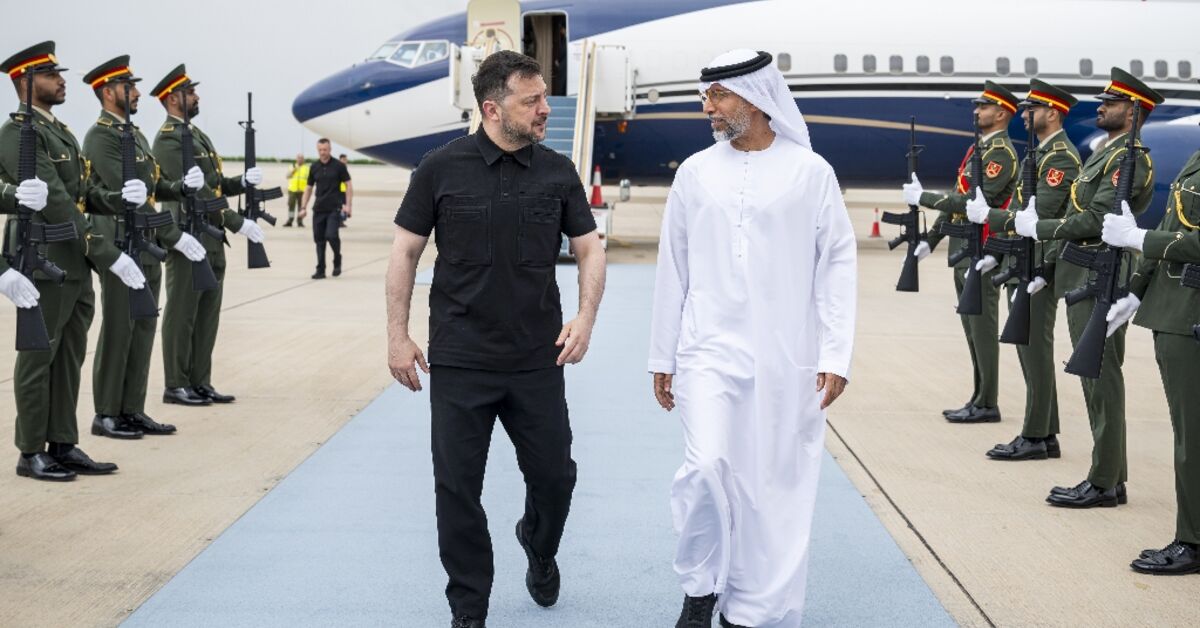
Earlier on Saturday, Ukrainian President Volodymyr Zelensky -- during a previously unannounced flurry of visits to Gulf nations -- said his country and the United Arab Emirates have agreed to cooperate on defence amid drones Iran launches in retaliation for US-Israeli strikes.
Ukraine also signed an air defence agreement with Saudi Arabia during Zelensky's visit to the kingdom, two senior officials told AFP on Friday.
Kyiv has sought to leverage its expertise in downing Russian drones to help Gulf nations and has deployed anti-drone experts to all three countries Zelensky has visited during his diplomatic tour.
"The agreement includes collaboration in technological fields, development of joint investments and the exchange of expertise in countering missiles and unmanned aerial systems," Qatar's defence ministry said in a statement during Zelensky's visit.
Ukraine has not disclosed what exactly has been agreed as part of the deals.
After meetings in Saudi Arabia on Thursday, Zelensky held talks in the UAE with Emirati President Mohamed bin Zayed Al Nahyan.
"We agreed to cooperate in the field of security and defence. Our teams will finalise the details," Zelensky said on social media on Saturday.
"For all normal states, it is important to ensure stability and protect lives amid today's threats. Ukraine has relevant expertise in this area," he said.
Ukraine touts its anti-drone defences as the best in the world.
It has proposed swapping its interceptors for the vastly more expensive air-defence missiles that Gulf countries are using to down Iranian drones. Kyiv says it needs more of them to fend off near-daily Russian missile attacks.
"Protection must be sufficient everywhere. That is why we are open to joint work that, in a strategic perspective, will certainly strengthen our peoples and the protection of life in our countries," Zelensky said on Saturday.
In the UAE, Zelensky met Ukrainian anti-drone experts, who "have been working here to help in protecting lives".
"Today, Ukraine not only needs assistance but is also ready to support those who support us," Zelensky said.
Facts Only
Ukrainian President Volodymyr Zelensky visited Saudi Arabia, the United Arab Emirates, and Qatar in a previously unannounced diplomatic tour.
Ukraine and Qatar signed a defence agreement on Saturday, including cooperation on countering missile and drone threats.
The agreement with Qatar involves collaboration in technological fields, joint investments, and expertise exchange in countering unmanned aerial systems.
Ukraine and the UAE agreed to cooperate on defence, with details to be finalized by their respective teams.
Ukraine and Saudi Arabia signed an air defence agreement during Zelensky's visit, as confirmed by two senior officials.
Ukraine has deployed anti-drone experts to Saudi Arabia, the UAE, and Qatar.
Zelensky met with Emirati President Mohamed bin Zayed Al Nahyan and Ukrainian anti-drone experts in the UAE.
Ukraine has proposed swapping its interceptors for more expensive air-defence missiles used by Gulf nations.
Zelensky stated that Ukraine is ready to support countries that assist it, citing its expertise in anti-drone defences.
The visits occur amid Iran's aerial campaign against its neighbours, including drone launches in retaliation for US-Israeli strikes.
Executive Summary
Full Take
The strongest version of this narrative highlights Ukraine's strategic pivot to leverage its battlefield expertise in drone defence as a diplomatic asset, positioning itself as a valuable partner to Gulf nations facing similar threats from Iran. The agreements underscore a mutual interest in technological and security cooperation, with Ukraine offering its proven capabilities in exchange for support—potentially including advanced air-defence systems. This framing credits Ukraine with adaptability and resourcefulness, while acknowledging the Gulf states' pragmatic need for effective countermeasures against regional threats.
However, the narrative also invites scrutiny of its underlying assumptions. The emphasis on Ukraine's "best in the world" anti-drone defences, while plausible, lacks independent verification in the text. The absence of specific details about the agreements—what is being exchanged, the scope of cooperation, or the timeline for implementation—creates ambiguity that could be exploited. The framing of Iran's actions as purely retaliatory, without deeper context on the cycle of escalation, risks oversimplifying a complex geopolitical dynamic. Additionally, the narrative leans on the moral weight of Ukraine's struggle, subtly implying that Gulf nations have a duty to reciprocate its support—a potential appeal to guilt or solidarity that could obscure harder strategic calculations.
Rooted in the paradigm of security interdependence, this narrative assumes that technological and tactical collaboration can bridge disparate geopolitical interests. It echoes Cold War-era patterns of proxy alliances, where expertise and hardware are traded for political or material backing. Yet, the second-order implications are significant: if Ukraine secures advanced air-defence systems from Gulf partners, it could alter the balance in its conflict with Russia, but it may also entangle Gulf nations further in a conflict they have thus far approached cautiously. The human cost—both in Ukraine and in potential escalation in the Gulf—remains an unaddressed tension.
Bridge questions: How might the Gulf nations' domestic politics influence the implementation of these agreements? What risks does Ukraine face in becoming a security provider while still relying on external support for its own defence? Would the narrative shift if Iran's drone campaigns were framed as defensive rather than aggressive?
Counterstrike scan: A coordinated influence campaign pushing this narrative might amplify Ukraine's strategic value while downplaying the risks to Gulf nations, using emotional appeals about shared threats to obscure divergent interests. The actual content, however, does not match this pattern—it presents the agreements as pragmatic collaborations without overt manipulation. The focus remains on verifiable actions and stated intentions, without the hallmarks of a deceptive playbook.
Patterns detected: none
Sentinel — Human
The article appears to be written by a human journalist, as it contains idiosyncratic language and specific details that are not typically found in synthetic or AI-generated content.