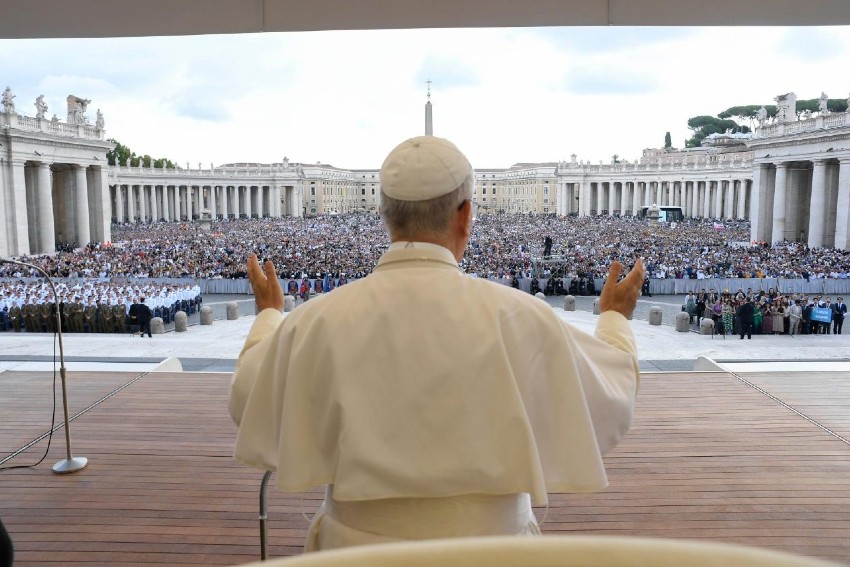
Pope Leo XIV in Rome today called for dialogue, a ceasefire, and peace in the war between Israel, the United and States, and Iran
Letter #15, 2026, Sunday, March 1: The Pope and the War
It is the second Sunday in Lent, and we are suddenly, since yesterday, in a time of new war —and in this time, Pope Leo‘s voice is a powerful, solitary voice calling for peace.
***
This afternoon, Pope Leo XIV visited the Quarticciolo — one of Rome’s more impoverished and dangerous neighborhoods, with a large open-air drug market.
He was the first Pope to visit this corner of the city in 46 years, since John Paul II came on February 3, 1980.
The Pope met first with children on the parish sports field at the Church of the Ascension of Our Lord Jesus Christ, tended by the Dehonian Fathers. Leo told the children he was “very happy to be here with you this evening.”
Then he spoke about the evil in their neighborhood — the drugs, the violence — and said that human freedom means we can choose goodness, and that choosing goodness is how we gradually transform the world.
“Always reject what harms your health,” the pope told them. “Say yes to what is good. Always no to drugs, yes to wellbeing.”
Then he turned to the war.
“I’m deeply concerned, and we don’t know how many days it will last, about the situation in the Middle East,” Leo said. “War again! And we must be heralds of Jesus’ peace, which God desires for everyone! We must pray much for peace, live in unity, and reject the temptation to harm others; violence is never the right choice.”
He told the children of the Quarticciolo that believers must be “messengers of peace.” He spoke of children in Gaza: “Many children in this world have no family, home, food, or bed. This is a tragedy we see. In Gaza, many children died, lost parents, school, and shelter.”
In his homily, Pope Leo preached the Transfiguration — the Gospel of the Second Sunday of Lent (Matthew 17). He told the parish that life is a journey that requires trust, and that we are always tempted to control everything, when the true treasure is found in accepting God’s hidden promises.
The Noon Angelus
Hours earlier, at noon, the Pope had stood at the window of the Apostolic Palace and laid the theological groundwork for what he would do that afternoon.
Reflecting on the Transfiguration, Leo described Christ’s radiance on Mount Tabor as something that “foreshadows the light of Easter: an event of death and resurrection, of darkness and new light that Christ radiates on all bodies scourged by violence, crucified by pain, or abandoned in misery.”
He said the Transfiguration “transfigures the wounds of history, enlightening our minds and hearts.” Then he asked the crowd a question that hung in the Lenten air: “Does this captivate us? Do we see the true face of God with a gaze of wonder and love?”
Then the pope turned from Mount Tabor to the fires burning across the Middle East.
On Saturday, the United States and Israel launched a joint military assault on Iran — Operation Epic Fury — targeting sites across Tehran, Isfahan, and Qom. Iranian state media confirmed the death of Supreme Leader Ayatollah Ali Khamenei after 37 years in power.
Tehran retaliated with missile strikes against Israel and Gulf nations hosting American military bases. The bombs fell just days after an Omani diplomat announced that a breakthrough on Iran’s nuclear program was within reach — that peace was close.
Pope Leo XIV did not mince words.
“I address to the parties involved a heartfelt appeal to assume the moral responsibility to stop the spiral of violence before it becomes an irreparable abyss,” he said.
He warned the world was staring at “a tragedy of enormous proportions.”
And then he spoke these words: “Stability and peace are not built with mutual threats, nor with weapons, which sow destruction, pain, and death, but only through a reasonable, authentic, and responsible dialogue.”
He called on diplomacy to “recover its role” and demanded that the good of peoples be promoted — “peoples who long for peaceful coexistence founded on justice.” And he closed with a plea that cut to the bone: “Let diplomacy silence the weapons.”
At noon, the pope preached the Transfiguration — Christ’s radiance piercing through darkness — and pleaded for nations to stop a war.
By late afternoon, he was sitting with mothers of addicted children in a Roman neighborhood that most of the world has forgotten, telling children to be messengers of peace and telling the elderly that God’s love is a greater force than whatever has broken their families.
—RM
Facts Only
Pope Leo XIV visited Rome’s Quarticciolo neighborhood on March 1, 2026, marking the first papal visit there in 46 years.
He met with children at the Church of the Ascension of Our Lord Jesus Christ, discussing local issues like drug use and violence.
The pope addressed the ongoing war between Israel, the United States, and Iran, urging peace and dialogue.
On the same day, during the Noon Angelus at the Apostolic Palace, he referenced the Transfiguration and condemned the escalating conflict.
The U.S. and Israel launched Operation Epic Fury on February 28, 2026, targeting Tehran, Isfahan, and Qom, resulting in the death of Iranian Supreme Leader Ayatollah Ali Khamenei.
Iran retaliated with missile strikes against Israel and Gulf nations hosting U.S. military bases.
The conflict followed a reported diplomatic breakthrough on Iran’s nuclear program, which was announced by an Omani diplomat days prior.
Pope Leo XIV called for an immediate ceasefire, warning of "a tragedy of enormous proportions" and emphasizing diplomacy over military action.
He highlighted the suffering of children in Gaza, linking local and global crises in his homily.
The pope’s visit to Quarticciolo included discussions with mothers of addicted children and elderly residents.
Executive Summary
Full Take
The strongest version of this narrative positions Pope Leo XIV as a moral counterweight to geopolitical brinkmanship, using his spiritual authority to reframe war as a failure of both diplomacy and human empathy. His dual appeals—first to global leaders, then to marginalized communities—create a compelling contrast between institutional power and grassroots suffering, reinforcing the idea that peace is a shared responsibility. The article effectively leverages the pope’s symbolic role, juxtaposing his calls for dialogue with the abrupt collapse of nuclear negotiations and the outbreak of violence.
Pattern scan: The framing leans toward emotional resonance, particularly in its focus on children in Gaza and Rome’s impoverished neighborhoods, which could risk weaponized empathy (ARC-0012). However, the narrative avoids overt manipulation by grounding its moral urgency in verifiable events (e.g., the death of Khamenei, the timing of the strikes). The pope’s rhetoric is consistent with his institutional role, and the article does not distort his statements or manufacture outrage.
Root cause: The paradigm here is the tension between hard power and moral suasion. The unstated assumption is that spiritual leadership can influence geopolitical outcomes—a premise that historically yields mixed results. The pattern echoes Cold War-era papal interventions (e.g., John Paul II’s role in Eastern Europe), where religious authority filled gaps left by failed diplomacy.
Implications: For human agency, the pope’s message elevates individual choice (e.g., rejecting drugs, embracing peace) as a counter to systemic violence. The beneficiaries of this narrative are those advocating for de-escalation, while the costs fall on hawks who may dismiss his appeals as naive. Second-order consequences could include increased pressure on diplomatic channels or, conversely, further marginalization of non-military solutions if the conflict intensifies.
Bridge questions: How might the pope’s appeal resonate differently in regions directly affected by the war versus those observing from afar? What historical precedents exist for religious leaders successfully mediating modern conflicts, and what conditions made those interventions effective? If diplomacy were to "silence the weapons," as the pope urges, what structural changes would be required to sustain that peace?
Counterstrike scan: A coordinated influence campaign would likely amplify the pope’s moral authority to delegitimize military action, framing opposition to war as a universal religious imperative. The actual content aligns with this playbook but lacks signs of orchestration—it presents the pope’s statements as organic responses to unfolding events, without exaggerated claims or forced binaries. The narrative’s integrity holds.