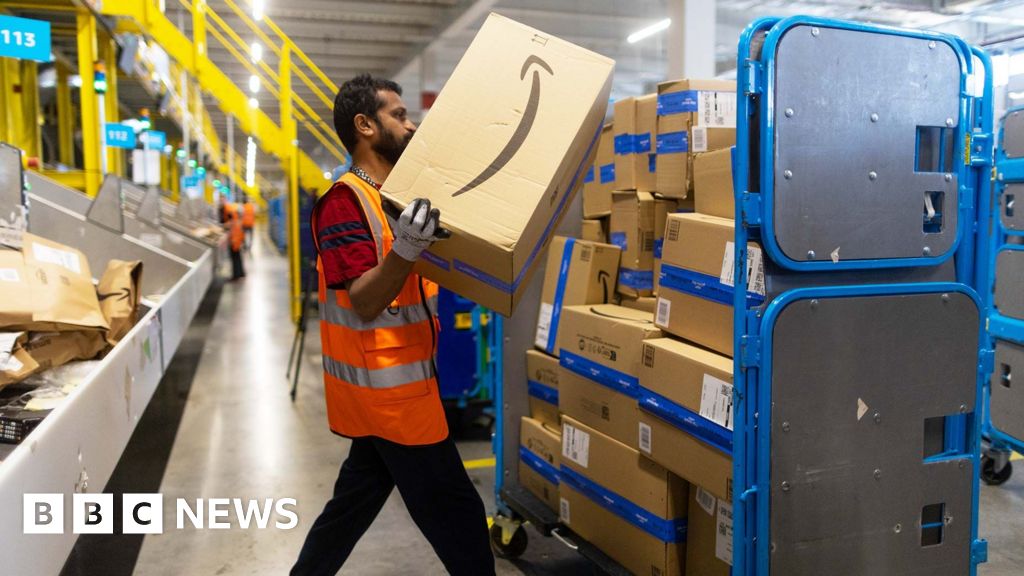
Vitamins, repair tape and a jar of mango chutney - just some of what my household bought last month via Amazon's sprawling online shopping platform.
We also shopped at the company's supermarket chain Whole Foods, streamed its TV shows, read books on Kindle e-readers, and browsed countless websites no doubt powered by Amazon Web Services (AWS), its highly profitable cloud-computing business.
And that isn't half of the interconnected products and services offered by the global behemoth, which earlier this year overtook US superstore giant Walmart to become the world's largest company by annual sales.
But why does Amazon, launched by Jeff Bezos in 1995 as an online bookstore out of a rented garage, have so few serious rivals in the West when it comes to e-commerce? Couldn't we consumers benefit from a bit more competition?
First, to be sure, Amazon isn't without competitors in any of the segments it is in, including e-commerce. Major US retailers like Walmart and Target both have broad-based, rapidly-expanding online retail arms, and offer their own versions of Amazon's Prime subscription service.
In the UK, Tesco leads in online groceries, and Zalando is Germany's biggest internet retailer of clothing. When it comes to ultra-cheap products, Chinese websites Temu and Shein are major forces.
Then there is eBay, which earlier this month received a $55.5bn (£41.7bn) takeover offer from video games retailer GameStop. Ebay has a different business model to Amazon, with its focus on auctions, second-hand goods, and collectible items.
And while GameStop says it hopes eBay could one-day become a stronger competitor to Amazon, the latter currently towers over all its rivals when it comes to total e-commerce market share.
In the US, Amazon accounts for 40.5% of all online retail sales, while its nearest rival Walmart has 9.2%, according to figures from last month. Ebay is down at around 3%.
Amazon also strongly dominates in the UK, where it accounts for about 30% of online retail sales.
"Amazon is not an undisputed monopolist in e-commerce, but it is the dominant firm," says Annabelle Gawer, director of the Centre of Digital Economy at the University of Surrey. "And the scope of what it sells is unparalleled."
A combination of factors has made Amazon exceptionally difficult to rival, note experts.
One is a 'first-mover' advantage. Among the earliest to scale online retail – and with a clear vision of how the internet could revolutionise shopping with convenience and speed – it captured market share faster than many rivals.
Just as important was the willingness of its shareholders, for many years, to allow the company to lose money by selling products at a loss, and later to aggressively reinvest early profits back into the business to fuel growth. To this day Amazon has never paid shareholders a dividend.
"[The strategy] constrained the competition," says David Yoffie, a professor emeritus at Harvard Business School (HBS). For traditional companies, pursuing the same approach would have significantly damaged their stock price and angered shareholders, he says.
Today Amazon has a big advantage over retail rivals in that it can use funds from its most lucrative businesses – notably AWS, its main profit engine – to sustain its lower-margin retail operation and invest in new ventures.
Positioning itself as a technology company also helped. Algorithms, automation and data have been central to Amazon's ability to scale, driving efficiency and shaping its customer experience.
Moreover, it has a culture of bold experimentation, says Sunil Gupta, also a professor at HBS, entering areas from cloud computing and consumer devices to own-brand products, original content production and healthcare – and moving on if something fails.
Experts also point to two pivotal business moves. One, instituted in 2000, was to go from being an online retailer to an online platform, allowing third-party sellers to offer their goods in its online store.
The result was a "network effect" explains Gupta. More sellers meant more products, which kept customers from going elsewhere – and in turn attracted even more sellers. "It is very hard for a new player to break that," adds Gupta.
The other was the launch of Amazon Prime, in the US in 2005 and the UK in 2007, offering free and fast delivery in return for an annual subscription fee. This made the platform "very sticky", says Emily West, a professor of communication at the University of Massachusetts Amherst who has studied and written about Amazon.
"You have the free shipping, in which case you may as well just search for your stuff on Amazon," she says.
While Prime itself is not particularly profitable – most of Amazon's e-commerce profits come from advertising and third-party seller fees – what is included with Prime has grown to a broad bundle, from a vast library of movies and shows to stream, including Amazon's own content, to discounts at US Whole Foods, making membership even harder to cancel.
"Amazon is not just a website that sells products," says Gawer. "It's an ecosystem of multiple businesses that are reinforcing each other… which makes it very hard to compete with."
But there could additionally be another reason Amazon lacks rivals - behaviour that some allege violates competition law, preventing existing competitors from growing and new ones from emerging.
In the US, both the Federal Trade Commission (FTC) and the state of California have separate antitrust lawsuits against Amazon set for trial in early 2027, alleging the company uses unlawful practices to maintain its dominance and harm competition, with California last month releasing a trove of evidence.
Amazon denies the allegations and is fighting the legal action.
The FTC case is broad, but a key allegation is that Amazon prevents new or smaller marketplaces from gaining a foothold because it stops them from competing on price.
It is accused of penalising its sellers – for example by lowering their product's visibility in search results or removing their "Buy Box" – if it finds they have lower prices on other websites.
The alleged result is that shoppers have little incentive to leave Amazon because prices are the same and rival platforms' typical strategy of lowering fees for sellers to encourage cheaper prices fails because sellers fear losing sales on Amazon.
One solution some have called for is to break Amazon into multiple stand-alone companies. "It would oxygenate the market," says Stacy Mitchell is co-executive director of the US based non-profit Institute for Local Self-Reliance, which is part of the Athena coalition fighting to change the way Amazon operates.
Others, however, see a breakup as unlikely – Google, for example, avoided one in its recent competition case.
Meanwhile with deep pockets – hundreds of billions if not trillions – and enough time, most experts agree a company could build a copycat of Amazon's e-commerce platform. It would be cheaper, of course, for an incumbent such as Walmart, which is clearly borrowing elements of Amazon's playbook.
Yet Amazon's next threat may not come from another conventional retailer at all.
There is a very different kind of shopping experience on the horizon. E-commerce is starting to be embedded directly in generative AI interfaces like ChatGPT, letting users buy products without leaving the sites – a development that could threaten Amazon's dominance in online retail.
"You aren't necessarily seeing a company that is impossible to compete against," sums up Yoffie.
Facts Only
Amazon is the world’s largest company by annual sales, surpassing Walmart in 2024.
It holds 40.5% of U.S. online retail sales and 30% in the UK, with Walmart at 9.2% and eBay at 3%.
Amazon was founded in 1995 as an online bookstore by Jeff Bezos.
It operates Whole Foods, AWS, Kindle, Prime, and original content production.
Amazon has never paid shareholders a dividend, reinvesting profits aggressively.
AWS is Amazon’s primary profit engine, subsidizing lower-margin retail operations.
Amazon opened its platform to third-party sellers in 2000, creating a network effect.
Prime launched in 2005 (U.S.) and 2007 (UK), bundling free shipping, streaming, and discounts.
The U.S. FTC and California have filed antitrust lawsuits against Amazon, set for trial in 2027.
Allegations include penalizing sellers for lower prices on other platforms.
GameStop offered to acquire eBay for $55.5 billion in 2024.
Temu and Shein are major competitors in ultra-cheap products.
Experts suggest AI-driven shopping interfaces could challenge Amazon’s dominance.
Executive Summary
Amazon dominates global e-commerce, accounting for 40.5% of U.S. online retail sales and 30% in the UK, far outpacing rivals like Walmart (9.2%) and eBay (3%). Its dominance stems from early scaling, aggressive reinvestment of profits, and a diversified ecosystem—including AWS, Prime subscriptions, and third-party seller integration—that creates a self-reinforcing network effect. Competitors like Walmart, Target, and Tesco have expanded online but struggle to match Amazon’s scope or convenience. Regulatory scrutiny is growing, with the U.S. FTC and California alleging antitrust violations, including penalizing sellers for lower prices elsewhere. While Amazon’s model isn’t unassailable—emerging threats like AI-driven shopping interfaces could disrupt its dominance—its deep pockets, data-driven efficiency, and bundled services make it uniquely resilient.
The article presents multiple perspectives: experts highlight Amazon’s strategic advantages, while critics argue its practices stifle competition. Some advocate for breaking up the company, though others see this as unlikely. The narrative acknowledges Amazon’s innovation but also questions whether its market power harms consumers and competitors alike.
Full Take
**Steelman:** Amazon’s dominance is a product of visionary strategy—early scaling, relentless reinvestment, and ecosystem integration—that delivered unmatched convenience. Its critics often underestimate how its bundled services (Prime, AWS, third-party sellers) create value beyond mere market share. The antitrust cases, while serious, don’t yet prove harm to consumers, who benefit from low prices and vast selection.
**Pattern Scan:** The narrative leans into a familiar "tech giant as unstoppable force" trope, but avoids overt emotional exploitation. However, it subtly frames Amazon’s dominance as inevitable, which could echo **ARC-0024 Ambiguity** (implied inevitability without rigorous causal analysis). The antitrust allegations are presented as credible but lack counterarguments from Amazon’s legal defense, risking **ARC-0043 Motte-and-Bailey** (focusing on the broad claim of dominance while sidestepping nuanced legal debates).
**Root Cause:** The paradigm here is "winner-takes-most" digital capitalism, where network effects and data moats entrench incumbents. The unstated assumption is that competition *should* exist, but the piece doesn’t interrogate whether Amazon’s model is inherently anti-competitive or simply more efficient. Historically, this mirrors past monopolies (e.g., Standard Oil), but with a twist: Amazon’s diversification (cloud, media, logistics) makes it harder to dismantle.
**Implications:** For human agency, Amazon’s dominance limits consumer choice in subtle ways—not just price, but the *architecture* of shopping (e.g., Prime’s stickiness). The beneficiaries are shareholders and consumers who prioritize convenience; the costs fall on smaller sellers, rival platforms, and potentially innovation if Amazon’s ecosystem stifles alternatives. Second-order effects include regulatory overreach risks (e.g., breaking up AWS could harm cloud competition) and the rise of AI shopping as a disruptive wildcard.
**Bridge Questions:**
1. If Amazon’s practices harm competition, why haven’t regulators acted sooner—and what metrics would prove harm?
2. Could AI shopping interfaces *decentralize* e-commerce, or will they just create new gatekeepers?
3. What would a "healthy" e-commerce ecosystem look like, and is Amazon’s model compatible with it?
**Counterstrike Scan:** A bad actor pushing this narrative might amplify the "Amazon is unstoppable" framing to discourage competition or justify regulatory overreach. However, the article balances this with critiques and emerging threats (AI, antitrust), avoiding a coordinated attack pattern. The tone remains analytical, not alarmist.
Patterns detected: **ARC-0024 Ambiguity**, **ARC-0043 Motte-and-Bailey** (minor)
Sentinel — Human
The text is a well-structured analytical piece that synthesizes known economic and competitive theories to explain Amazon's dominance, grounded by specific expert commentary and legal context.