Many passengers unaware of the new rule, with few signs or announcements throughout the airport
Air passengers departing from Hong Kong have said they were unaware of a new rule limiting the number of power banks they could carry to two, with few reminder signs visible at the airport on the first day of its enforcement on Sunday.
Hong Kong International Airport announced on Saturday night that departing passengers were restricted to carrying no more than two power banks.
Citing new regulations from the International Civil Aviation Organization (ICAO), the Airport Authority said the global aviation body had introduced the requirements to address emerging aviation safety risks posed by lithium battery power banks.
On Sunday morning, no specific notices concerning the latest regulation were displayed at check-in areas, and no public announcements were broadcast to alert passengers.
Most of the existing signs only reminded passengers not to place lithium batteries in checked luggage and not to use power banks during flights.
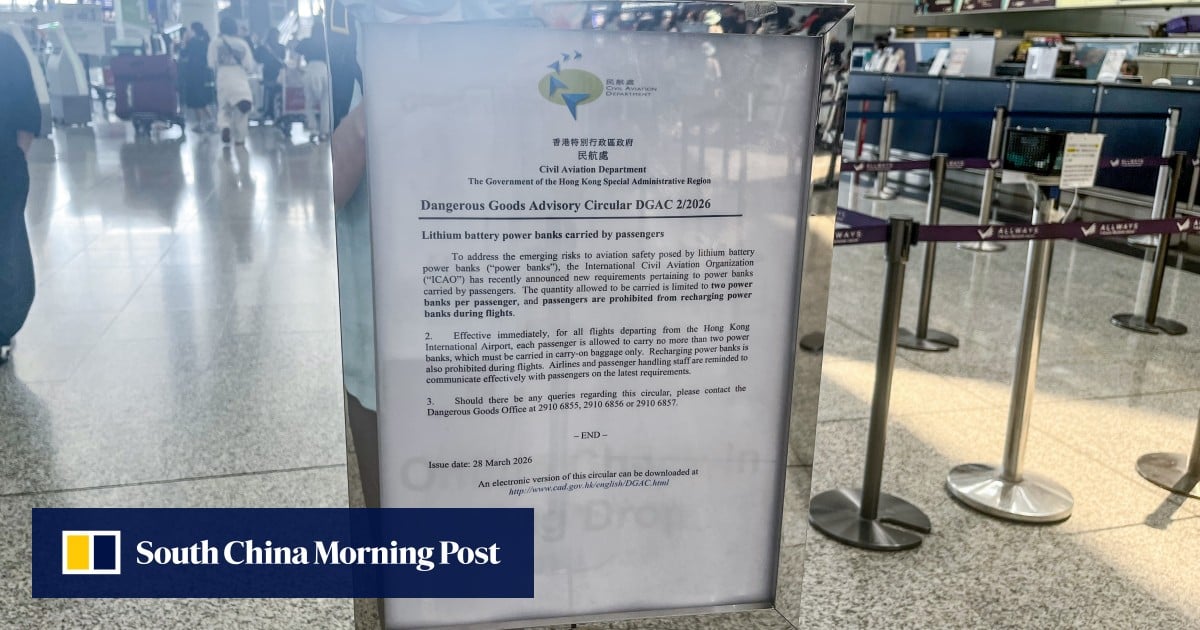
Just one Civil Aviation Department notice about the new rules was evident near the Greater Bay Airlines counters in the departure hall.
Facts Only
Hong Kong International Airport announced a new rule on Saturday night restricting departing passengers to carrying no more than two power banks.
The rule took effect on Sunday.
The Airport Authority cited new regulations from the International Civil Aviation Organization (ICAO) as the basis for the restriction.
The ICAO introduced the requirements to address aviation safety risks posed by lithium battery power banks.
On Sunday morning, no specific notices about the new regulation were displayed at check-in areas.
No public announcements were broadcast to alert passengers about the rule.
Existing signs primarily reminded passengers not to place lithium batteries in checked luggage and not to use power banks during flights.
Only one Civil Aviation Department notice about the new rules was visible near the Greater Bay Airlines counters in the departure hall.
Many passengers were unaware of the new limit on the first day of enforcement.
Executive Summary
Hong Kong International Airport implemented a new rule on Sunday limiting departing passengers to carrying no more than two power banks, citing updated regulations from the International Civil Aviation Organization (ICAO). The measure aims to mitigate aviation safety risks associated with lithium battery power banks. However, many passengers were caught off guard, as the airport provided minimal advance notice and few visible reminders on the first day of enforcement. While existing signs warned against placing lithium batteries in checked luggage or using power banks during flights, only one notice about the new restriction was observed near the Greater Bay Airlines counters. The lack of widespread announcements or signage left travelers unaware, raising concerns about the effectiveness of the rollout.
The ICAO’s decision reflects growing global concerns over lithium battery safety, particularly the fire risks posed by power banks. While the rule aligns with international aviation standards, its sudden implementation without robust passenger communication highlights a potential gap between regulatory intent and practical execution. The situation underscores the challenges airports face in balancing safety protocols with passenger awareness, especially when new rules are introduced with little lead time.
Full Take
The strongest version of this narrative highlights a legitimate safety concern—lithium battery risks in aviation—while critiquing the execution of the policy rollout. The ICAO’s decision is grounded in real hazards, and Hong Kong’s compliance reflects a responsible adherence to global standards. However, the lack of visible signage and public announcements on day one suggests a failure in communication strategy, leaving passengers unprepared and potentially frustrated. This tension between regulatory necessity and operational transparency is a recurring challenge in public policy, where even well-intentioned rules can backfire if not implemented thoughtfully.
Pattern scan: The framing leans toward highlighting institutional oversight rather than malicious intent, but the emphasis on passenger confusion could subtly amplify distrust in authority. The absence of counter-perspectives (e.g., airport staff reasoning or ICAO’s full justification) leaves room for one-sided interpretation. That said, no overt manipulation patterns are detected—this appears to be a straightforward report on a policy gap.
Root cause: The paradigm here is the clash between top-down regulatory enforcement and bottom-up public awareness. The unstated assumption is that passengers should inherently know or adapt quickly to new rules, even when communication is minimal. This echoes historical patterns where bureaucratic efficiency takes precedence over user experience, risking compliance failures despite good intentions.
Implications: For human agency, the cost falls on travelers who may face last-minute confiscations or delays due to lack of awareness. The benefit accrues to aviation safety, but only if the rule is consistently enforced and understood. Second-order consequences could include passenger pushback, reputational strain on the airport, or even circumvention of the rule if enforcement remains inconsistent.
Bridge questions: How might airports balance rapid regulatory compliance with effective passenger education? What systems could prevent such communication gaps in the future? Would a phased rollout with clearer warnings have achieved the same safety goals without the confusion?
Counterstrike scan: If this were part of a coordinated campaign, the playbook might involve exaggerating passenger frustration to undermine trust in the airport or ICAO. However, the content here is observational, not inflammatory, and lacks the hallmarks of a deliberate influence operation. The focus remains on factual reporting of a policy implementation issue.