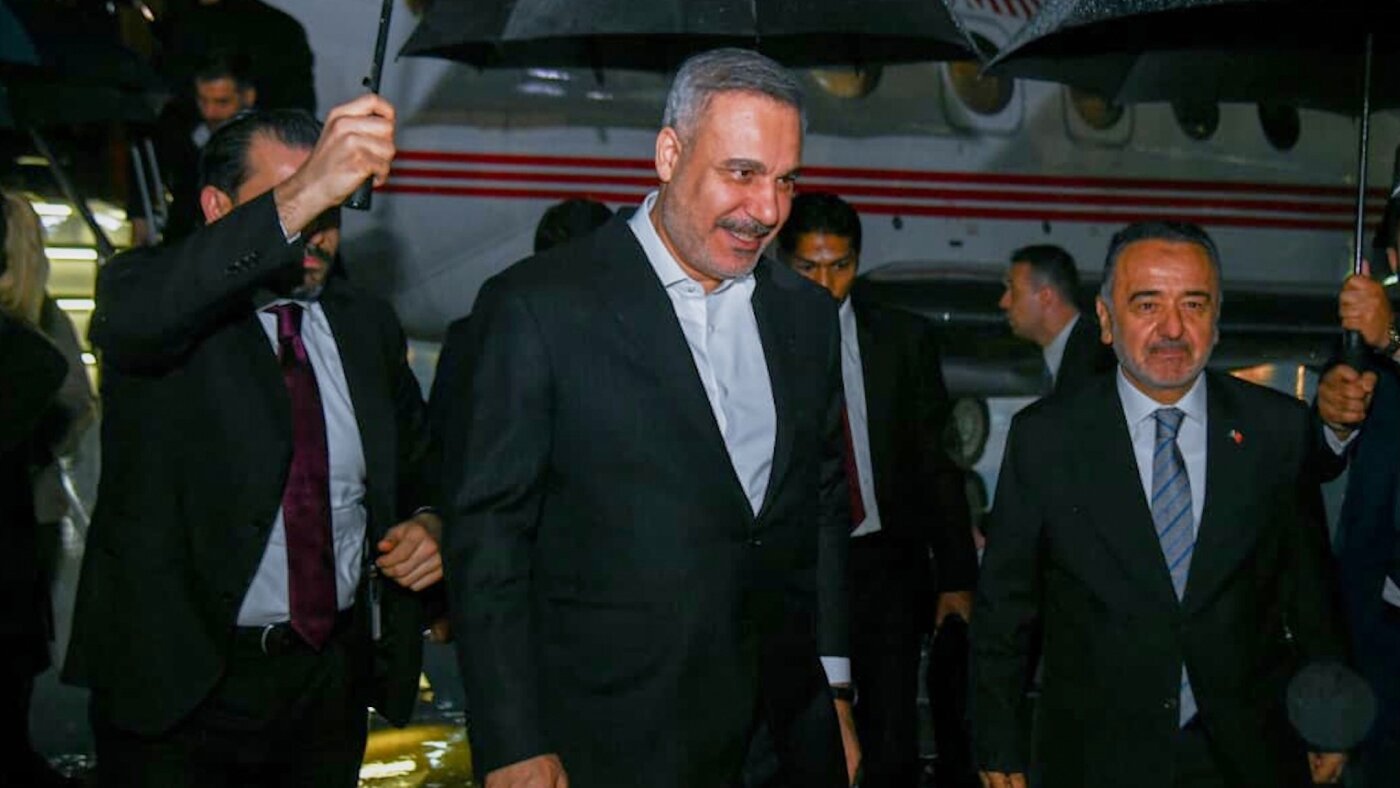
Foreign ministers from Pakistan, Saudi Arabia, Turkey and Egypt will meet in Islamabad today in an attempt to come up with a plan to de-escalate the Iran war.
The meeting comes as several thousand more U.S. troops arrived in the region and after another group got involved in the expanding conflict: Yemen's Houthis.
The Iran-backed Houthis launched missiles towards Israel, and there's concern their involvement could threaten another vital global shipping lane in the Red Sea.
Here are more updates on day 30 of the Iran war.
Diplomacy Push in Pakistan
The four foreign ministers from regional powers will meet in Islamabad today and Monday for a push towards diplomacy to end the war.
In a statement ahead of the meeting, the Egyptian government said: "Discussions are expected to focus on recent developments related to regional military escalation and ongoing diplomatic efforts to contain tensions and promote de-escalation."
"The talks come amid heightened concerns about regional stability, with participating countries seeking to coordinate their stances and support political solutions to emerging crises," it added.
Whether whatever consensus the countries known as "the quad" come up with will be accepted by the US, Israel, and Iran is another question.
Pakistan has emerged as a possible peace-broker in the conflict, passing messages between the U.S. and Tehran. Foreign Minister Ishaq Dar said Saturday that "dialogue, diplomacy, and such confidence-building measures are the only way forward."
Dar also welcomed the fact Iran has agreed to allow 20 Pakistan-flagged ships – or two a day – through the Strait of Hormuz.
Houthis enter war
Iranian-backed Houthi militants in Yemen launched the first missile they have fired since the war began toward Israel on Saturday. Israel's military successfully intercepted it but the Houthis' attack opens another front in a war that has now moved into its second month.
Up until Saturday's missile launch the Houthis had stayed out of this war. But a Houthi spokesman said attacks will continue until "the aggression on all resistance fronts stops."
The Yemen-based rebels were active during Israel's war in Gaza, firing on cargo ships in the Red Sea and disrupting global commercial traffic.
With Iran essentially blockading the Strait of Hormuz, driving up global oil prices, there are concerns that if the Houthis start attacking ships in the Red Sea again global shipping will be even more disrupted.
Iran also hit multiple sites around Tel Aviv and Jerusalem Saturday and Israel's military says Iran is increasingly using cluster bombs.
Designed to detonate at high altitude the munition disperses dozens of smaller bombs that are more challenging for Israel's multi-layered air defense system to intercept and can cause damage over a wider area.
Dozens of countries have signed onto a cluster munitions treaty banning the weapons – except Iran, Israel and the U.S.
Iran threatens U.S. universities in region
Iranian authorities and residents say more airstrikes hit them overnight. Social media videos from across Iran showed strikes hitting all over the country.
Israel's military said it had completed what it called a wide-scale wave of strikes targeting weapons production and storage sites.
Iran claims U.S.-Israeli strikes hit a Tehran university over the weekend and Iran's Revolutionary Guard Corps threatened American university campuses in the Middle East in retaliation.
"We advise all employees, professors, and students of American universities in the region and residents of their surrounding areas" to stay a kilometer away from campuses, the statement, carried by Iranian media, said.
Several US universities have campuses in the Gulf, including New York University in the United Arab Emirates and Texas A&M University, among others, in Qatar.
Meanwhile, Iran continues to fire drones and missiles at Gulf countries, with Kuwait saying it was intercepting missile and drone attacks early Sunday. Saudi Arabia said it intercepted and destroyed ten drones.
Iran also claimed it had attacked two major aluminium sites in Bahrain and the United Arab Emirates (UAE). Emirates Global Aluminium confirmed an Iranian attack wounded several and caused significant damage to its plant.
U.S. Troops injured, more arrive
At least 15 U.S. service members were wounded Friday in an Iranian strike on a Saudi air base that hosts American troops, according to the Associated Press, including at least five in serious condition. The missile and drone strikes targeted Saudi Arabia's Prince Sultan air base, located outside the capital Riyadh.
Iran has targeted U.S. service members at bases throughout the region since the war began a month ago, in retaliation for the U.S. attacks and seeking to drive troops out of the region. Overall, the Pentagon has put the U.S. casualty toll at 13 killed and more than 300 injured.
On Saturday, troops from the Japan-based 31st Marine Expeditionary Unit, made up of around 3,500 sailors and Marines, arrived in the Middle East, according to U.S. Central Command.
The U.S. military will not say where and how they might be deployed. Thousands more soldiers from the U.S. military's 82nd Airborne Division are also expected to be deployed.
Journalists killed in Lebanon
Three Lebanese journalists covering the Israeli invasion of the country's south were killed in an Israeli airstrike in Jezzine.
One of them worked for a TV channel affiliated with Hezbollah and Israel accuses him of being a militant rather than a journalist – but has not provided evidence. The journalist Israel says it targeted was Ali Shaeb, a veteran TV correspondent and household name in Lebanon. After killing him, Israel's military issued a statement accusing him of exposing the locations of Israeli troops.
The other two journalists killed were siblings, TV correspondent Fatima Ftouni and her cameraman brother, Mohammed Ftouni. Afterward their father appeared on TV, saying he was proud of his children.
All three had been covering Israel's invasion of southern Lebanon.
Lebanese officials called the attack a flagrant violation of international law, and said they're complaining to the UN Security Council. Hundreds of fellow journalists marched at a protest vigil in Lebanon's capital.
The three journalists were among at least 47 people killed Saturday in Israeli attacks, according to Lebanese health officials.
Nine of those killed were paramedics, which the head of the World Health Organization called "a tragedy," noting health workers are protected under international law.
Israel has intensified its attacks across Lebanon, mostly in the South, where Israeli ground troops are moving northward to try to oust Hezbollah militants.
Another Israeli soldier was also killed in Lebanon, with Prime Minister Benjamin Netanyahu expressing his condolences on X over the weekend.
Developments in Syria, Iraq
The war is spreading to more parts of the Middle East. On Sunday, Syria said it had intercepted a drone strike from Iraq targeting a U.S. military base. Pro-Iran Iraqi groups have claimed responsibility for some attacks on US interests.
Separately, the Syrian and UAE governments condemned an attack targeting the residence of the Kurdish region's president Nechirvan Barzani.
French President Emmanuel Macron also condemned the attack saying: "The sovereignty of Iraq, and of Kurdistan within it, is essential to regional stability. Everything must be done to prevent Iraq from being drawn into the ongoing escalation."
On Sunday, the Israeli army said it had launched its "first" attack into Lebanon from Syria.
Jane Arraf in Amman, Emily Feng in Van, Turkey, Lauren Frayer in Jezzine, Lebanon, Carrie Khan in Tel Aviv, and Kate Bartlett in Johannesburg contributed to this report.
Facts Only
Foreign ministers from Pakistan, Saudi Arabia, Turkey, and Egypt are meeting in Islamabad to discuss de-escalation of the Iran war.
The meeting follows missile launches by Yemen's Houthis toward Israel, marking their first direct involvement in the conflict.
Iran has allowed 20 Pakistan-flagged ships to pass through the Strait of Hormuz, easing previous restrictions.
Israel intercepted a Houthi missile and reported Iranian cluster bomb attacks on Tel Aviv and Jerusalem.
Iran threatened U.S. university campuses in the Middle East after claiming strikes on a Tehran university.
Kuwait and Saudi Arabia intercepted Iranian drone and missile attacks, while Iran claimed strikes on aluminum plants in Bahrain and the UAE.
At least 15 U.S. service members were wounded in an Iranian strike on a Saudi air base hosting American troops.
Three Lebanese journalists were killed in an Israeli airstrike in Jezzine, Lebanon, with Israel accusing one of being a Hezbollah militant.
Israel has intensified attacks in southern Lebanon, with ground troops advancing northward against Hezbollah.
Syria intercepted a drone strike from Iraq targeting a U.S. military base, while pro-Iran groups claimed responsibility for attacks on U.S. interests.
The Israeli military launched its first attack into Lebanon from Syria.
The U.S. has deployed additional troops, including the 31st Marine Expeditionary Unit, to the Middle East.
Executive Summary
Foreign ministers from Pakistan, Saudi Arabia, Turkey, and Egypt are convening in Islamabad to discuss de-escalation strategies amid the ongoing Iran war, now in its second month. The meeting follows increased regional tensions, including missile strikes by Yemen's Houthis toward Israel and Iran's attacks on Gulf states. Pakistan has positioned itself as a potential mediator, facilitating communication between the U.S. and Iran, while Iran has partially eased restrictions on Pakistani ships transiting the Strait of Hormuz. Meanwhile, the conflict has expanded with Houthi involvement, Israeli strikes in Lebanon killing journalists and paramedics, and Iran targeting U.S. military bases and Gulf infrastructure. The U.S. has deployed additional troops to the region, with casualties reported from Iranian strikes. The war's spread to Syria and Iraq further complicates regional stability, as attacks on U.S. bases and Kurdish leadership raise concerns about broader escalation.
The situation remains fluid, with diplomatic efforts competing against military actions. While regional powers seek a political solution, the involvement of non-state actors like the Houthis and Hezbollah, alongside direct state-on-state confrontations, underscores the conflict's complexity. The human cost is rising, with journalists and medical workers among the casualties, and global shipping routes under threat from potential Houthi and Iranian disruptions.
Full Take
The strongest version of this narrative highlights the urgent need for diplomatic intervention as the Iran war escalates, with regional powers attempting to broker peace while military actions intensify. The article credibly documents the expanding conflict, from Houthi missile strikes to Iranian attacks on Gulf states and U.S. bases, and the human toll, including journalist deaths in Lebanon. It also notes Pakistan's emerging role as a mediator, a rare point of potential de-escalation.
However, the framing leans toward a "great power" lens, emphasizing state actors while underplaying the agency of non-state groups like Hezbollah and the Houthis, who are portrayed as Iranian proxies rather than independent actors with their own strategic goals. The article also risks normalizing the targeting of journalists by presenting Israel's accusations against Ali Shaeb without independent verification, which could reinforce a pattern of dismissing civilian casualties in conflict zones (ARC-0024 Ambiguity). The focus on U.S. troop deployments and casualties, while important, may overshadow the broader regional destabilization, including attacks on Kurdish leadership and the threat to global shipping lanes.
Root causes include the long-standing U.S.-Iran rivalry, Israel's military campaigns, and the proxy dynamics that have turned the Middle East into a battleground for influence. The assumption that diplomacy can succeed without addressing these underlying tensions is questionable. The implications for human dignity are severe: journalists and medics are being killed, civilians are caught in crossfire, and economic disruptions threaten global stability. The second-order consequences—such as the potential for a wider war or the collapse of fragile states like Lebanon—are barely addressed.
Bridge questions: How might the Houthis' and Hezbollah's actions reflect local grievances rather than mere Iranian direction? What would a sustainable peace process require beyond short-term de-escalation? How does the framing of "proxy wars" obscure the autonomy of non-state actors?
Counterstrike scan: A coordinated influence campaign would amplify the "proxy war" narrative to justify military interventions while downplaying civilian harm. The article does not fully match this pattern, as it includes critical details like journalist deaths and Iranian threats to U.S. universities. However, the lack of deeper context on non-state actors' motivations could serve a simplistic "good vs. evil" framing if exploited by bad actors.
Patterns detected: ARC-0024 Ambiguity (journalist targeting), ARC-0043 Motte-and-Bailey (proxy war framing)