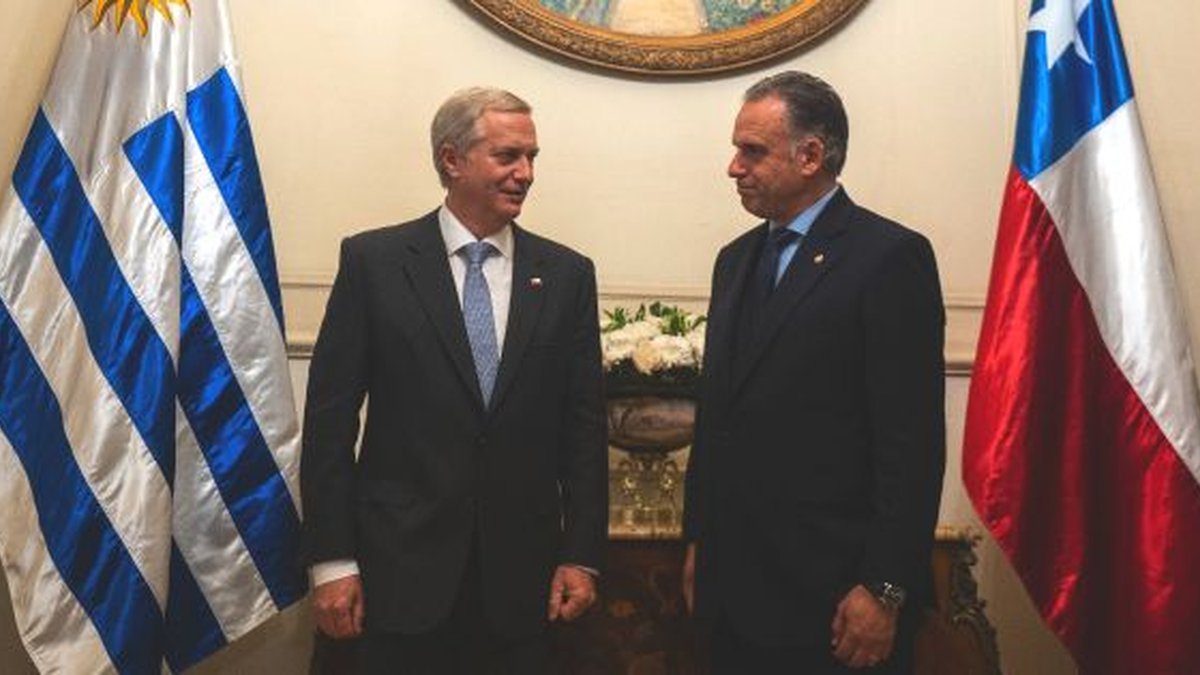
Chile's President José Antonio Kast argued on Wednesday in Montevideo that the region's countries must toughen their laws to combat organized crime, with life sentences for those who lead gangs and a regime of total isolation in prisons to stop them from continuing to operate from behind bars. The president laid out his position after meeting with Uruguayan President Yamandú Orsi, as part of an official visit to Uruguay.
During a breakfast organized by the Marketing Executives Association, Kast held that security is the main condition for economic development and described organized crime as a “cancer” affecting all of Latin America. He linked his proposals to the Santiago Agreement, the initiative promoted by Chilean diplomacy to coordinate the fight against organized crime at a regional level, which Uruguay and Paraguay have said they intend to join. “What we have to seek is for all our laws to move forward so that a life sentence applies to those who lead the organization. We must apply the most drastic penalties to them and keep them in conditions of total isolation,” he said.
The Chilean president argued that the fight against drug trafficking must target command structures and not only those who carry out the crimes. He compared the workings of criminal organizations to those of a company, in which a leadership keeps making decisions even if some of its members are arrested. Along those lines, he stressed the need to strengthen regional cooperation against drug trafficking, human trafficking and arms trafficking, and set out “secure borders” and “controlled migration” as conditions, holding that organized crime “recognizes no borders.”
Asked about the possibility of using the armed forces for permanent public-security tasks —an approach adopted by other governments in the region— Kast distanced himself: “Going out into public order with soldiers carrying a rifle can end very badly.” The warning sets his approach apart from that of other leaders who have turned to military deployment to confront gangs, and places the focus of his proposal on the legislative and prison spheres rather than on the use of military force.
The measures Kast outlined would require legal reforms in each country and do not, for now, constitute a policy agreed by the regional bloc. The Chilean president also said that with Orsi they discussed the need to boost economic growth and advance integration projects, and stated that Chile's willingness to cooperate with Uruguay “transcends political colors,” in reference to the ideological differences between his right-wing government and Orsi's center-left one. The visit came days after the Mercosur summit in Asunción, where regional security had taken a central place in several leaders' addresses.
Top Comments
Disclaimer & comment rulesNo comments for this story
Please log in or register (it’s free!) to comment. Login with Facebook
Sentinel — Human
The text exhibits the structure and specificity of professional journalistic reporting. The clear attribution and focused presentation suggest human authorship, likely wire copy or beat reporting.