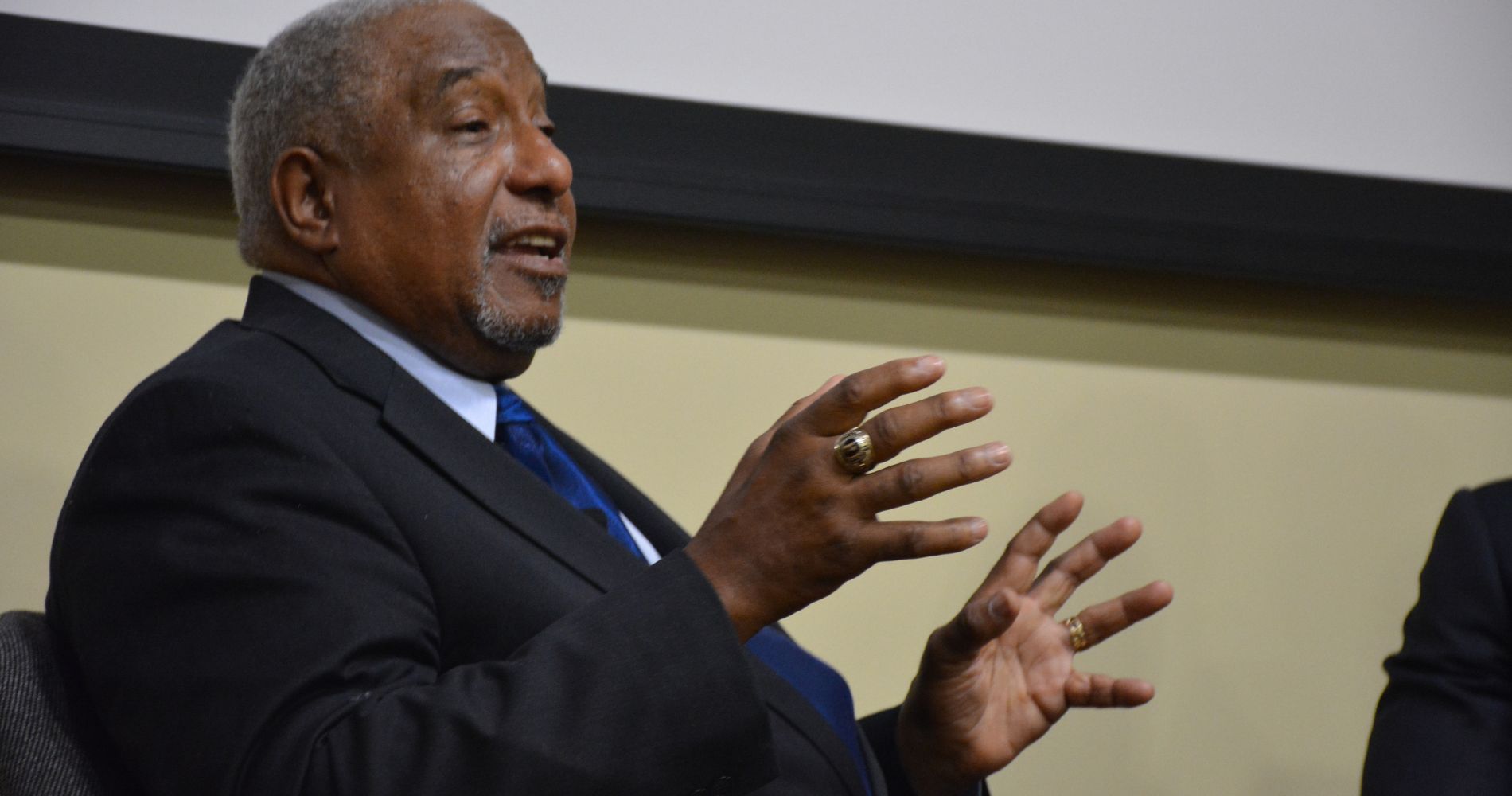
Dr. Bernard LaFayette Jr., 85, died following a heart attack on March 5 at his home in Tuskegee, Alabama. He championed nonviolence as a strategy to advance social justice and laid the groundwork for the Selma voting rights campaign that led to the Voting Rights Act in 1965.
“A Sword Cut Me in Half”
Bernard LaFayette Jr. was born in Tampa, Florida, in 1940. When he was seven, he experienced humiliation and violence while riding a segregated streetcar in downtown Tampa. The system forced Black patrons to pay at the front of the trolley, then exit and reboard at the back of the car.
Bernard was with his maternal grandmother, Rozelia Forrester, who was known as Ma Foster, as The New York Times recounted. She paid the fare and they went to the back door to reboard. But as they were getting back on, the trolley driver pulled away and knocked his grandmother to the ground.
Watching her fall, Dr. LaFayette wrote in his memoir, In Peace and Freedom: My Journey in Selma, “I felt like a sword cut me in half, and I vowed I would do something about this problem one day.”
Seeing his beloved grandmother abused filled him “with an emotional feeling that [he] would never forget.” He later recalled, “It was the moment that caused me to decide that I was going to use my life to fight against the segregation system.” He joined the NAACP at age 12.
“This Was Our Daily Lives”
It was Ma Foster who insisted that her grandson would become a minister and sent him to American Baptist Seminary in Nashville. As a 19-year-old freshman, he and his roommate, John Lewis, learned nonviolence in workshops taught by the Rev. James Lawson and at the Highlander Folk School.
Early in 1960, the two roommates joined Diane Nash, James Bevel, and others to launch a nonviolent sit-in campaign that ultimately made Nashville the first major Southern city to desegregate its downtown. Their commitment to nonviolence and the success of their desegregation campaign in Nashville made them leaders in the Student Nonviolent Coordinating Committee (SNCC), which they helped to found in 1960.
In his eulogy for John Lewis in 2020, President Barack Obama spoke about how the two roommates integrated a Greyhound bus while traveling home for Christmas break. Weeks after the Supreme Court in Boynton v. Virginia barred racial segregation in interstate travel, John Lewis was headed home to Troy, Alabama, and Bernard LaFayette to Tampa, Florida. The two sat in the front of the bus and refused to move, even as the enraged driver stormed off the bus and into the bus station at every stop through the night. The two young people had no idea what or who he might bring back with him.
“Imagine the courage of two people…, on their own, to challenge an entire infrastructure of oppression,” President Obama said. “Nobody was there to protect them. There were no camera crews to record events.”
The following year, an interracial group of students determined to test the enforcement of Boynton were traveling by bus through the South when they were attacked by mobs of white people in Anniston and Birmingham, Alabama, and had to cancel their planned Freedom Ride to New Orleans.
Dr. LaFayette, John Lewis, and other members of the Nashville movement decided to continue the mission. When they arrived in Montgomery on May 20, 1961, more than 300 white people were waiting at the Greyhound station in downtown Montgomery, where they had been promised several minutes to launch their attack without police interference. The Freedom Riders were pulled out of the bus and viciously attacked with baseball bats, hammers, and pipes as police stood by and refused to protect them.
“We didn’t run; we didn’t fight back,” Dr. LaFayette wrote in his memoir. “We got back up when slammed to the ground, and looked our attackers directly in the eyes, fighting violence with nonviolence.”
From Montgomery, the Freedom Riders continued on to Jackson, Mississippi, where Dr. LaFayette was arrested and held for more than a month in the infamous Parchman Farm prison with several hundred young civil rights activists.
Dr. LaFayette left college after the Freedom Rides to participate in the movement full time. He later reflected that he and his fellow activists did not fully appreciate the impact of their work back then.
“We lived through this, but this was our daily lives,” he told The Associated Press in 2021. “When you think about it, we weren’t trying to make history or trying to rewrite history. We were responding to the problems of the particular time.”
“I’ll Take Selma”
SNCC was organizing voter registration projects across the South, but had initially ruled out Selma as too dangerous. Dr. LaFayette was not deterred. “I’ll take Selma,” he told Jim Forman, and in 1963, he and his wife, Colia Liddell Lafayette, also a prominent civil rights activist, moved to Selma.
As director of SNCC’s Alabama Voter Registration Campaign, Dr. LaFayette worked with local organizations like the Dallas County Voters League, which was started in the 1930s by S.W. and Amelia Boynton, taking the “time to develop local leadership and to bring various levels of leadership together in a way that they were able to sustain themselves through the struggle.”
In his memoir, he described the work of going door-to-door, quietly and gradually building leadership, confidence, and momentum that led to the historic Selma to Montgomery march in 1965.
On June 12, 1963, Dr. LaFayette was one of several people targeted in what the FBI said was a coordinated attack on civil rights workers. On the same night that Medgar Evers was shot to death in his driveway, Dr. LaFayette was beaten outside his home in Selma by a white man armed with a gun. He called for help, and his neighbor came outside with a rifle.
Standing between the two armed men, Dr. LaFayette said he felt “an extraordinary sense of internal strength instead of fear.” He asked his neighbor not to shoot and looked his assailant in his eyes. Nonviolence is a fight “to win that person over, a struggle of the human spirit,” he wrote. He persuaded both men into lowering their weapons. The next day, according to The New York Times, he wore his bloodied shirt to work to show everyone he was not afraid.
Dr. LaFayette demonstrated extraordinary courage in the face of constant death threats. By 1965, he had been arrested 10 times in four Southern states and had been beaten by white civilians and police alike.
After laying the groundwork for the Selma to Montgomery march for voting rights, Dr. LaFayette was in Chicago working on a new project for the Rev. Dr. Martin Luther King Jr. on March 7, 1965, when state and local police used billy clubs, whips, and tear gas to attack hundreds of nonviolent civil rights protesters on the Edmund Pettus Bridge, stopping their planned march to Montgomery. The day became known as “Bloody Sunday,” and the spectacle of police brutally attacking peaceful protesters galvanized support for voting rights legislation among lawmakers and the president.
He had planned to join the march the following day. Instead, Dr. LaFayette organized a contingent of activists from Chicago to travel to Selma, where two weeks later they joined thousands of demonstrators for the 54-mile march to Montgomery.
The Voting Rights Act was signed into law on August 6, 1965.
“We Are Going for Broke”
Dr. LaFayette worked with the Southern Christian Leadership Conference in Chicago, where AP reports he trained young Black leaders in the Chicago Freedom Movement and organized tenant unions. “The tenant protections we have today are really a direct outcome of that work in Chicago,” Mary Lou Finley, a professor emeritus at Antioch University Seattle who worked with him, told AP.
He also persuaded the city to develop the nation’s first mass screening for lead poisoning, Ms. Finley said.
In a discussion with EJI’s Bryan Stevenson in 2015, Dr. Lafayette recalled how Dr. King persuaded him to become the national coordinator of the Poor People’s Campaign in 1968.
“He called me up and said, ‘This is going to be my last campaign. And we are going for broke.’”
Dr. Lafayette headed straight to Atlanta to begin formulating the strategy for the campaign.
On the morning of Dr. King’s assassination, Dr. LaFayette was in Memphis with Dr. King, who instructed him on the need “to institutionalize and internationalize nonviolence.” He devoted the rest of his life to that mission, becoming what SNCC called “one of the most widely recognized authorities on strategies for nonviolent social change and one of the leading exponents of nonviolent direct action in the world.”
After completing his bachelor’s degree at American Baptist and earning a master’s and doctorate from Harvard University, he led the Center for Nonviolence and Peace Studies at the University of Rhode Island, chaired the Consortium on Peace Research, and conducted nonviolence training in Latin America, South Africa, and Nigeria.
“Bernard did work in Latin America. He did nonviolence workshops in South Africa with the African National Congress. He went to Nigeria when the civil war was happening there,” former U.S. Ambassador to the United Nations Andrew Young told AP. “Bernard literally went everywhere he was invited as sort of a global prophet of nonviolence.”
On the House floor yesterday, U.S. Rep. Terri Sewell spoke of Dr. LaFayette as an “extraordinary man who had extraordinary talents and extraordinary courage” and who “placed himself on the front lines of the struggle for civil rights, risking life and limb to challenge injustice and dismantle segregation across the South.” Working closely with Dr. King, she said “he helped to advocate a philosophy of nonviolent social change that moved our nation closer to its founding promise of liberty and justice for all.”
“Generations of Americans have the right to vote today because Bernard LaFayette refused to yield to fear,” Steven Reed, the first Black Mayor of Montgomery, said in a statement. “His example challenges each of us to stand firm in the face of injustice, to lead with compassion, and to carry forward the work he and so many others began. We honor his legacy not only with our words, but with our continued commitment to building a more just, equitable, and hopeful future.”
Dr. LaFayette wrote in his memoir that facing constant death threats as a civil rights advocate in the South taught him that the value of life “lies not in longevity, but in what people do to give it significance.”
Facts Only
Dr. Bernard LaFayette Jr. died on March 5 at his home in Tuskegee, Alabama, at age 85.
He was born in Tampa, Florida, in 1940.
At age seven, he witnessed his grandmother being knocked down by a segregated streetcar driver.
He joined the NAACP at age 12.
He attended American Baptist Seminary in Nashville, where he roomed with John Lewis.
In 1960, he co-founded the Student Nonviolent Coordinating Committee (SNCC).
He participated in the Nashville sit-ins, leading to the desegregation of the city’s downtown.
He joined the Freedom Rides in 1961, enduring violent attacks in Montgomery, Alabama, and imprisonment in Mississippi.
In 1963, he moved to Selma, Alabama, to lead SNCC’s voter registration campaign.
On June 12, 1963, he was beaten outside his home in Selma, the same night Medgar Evers was assassinated.
He helped organize the Selma to Montgomery march in 1965, contributing to the passage of the Voting Rights Act.
He worked with Dr. Martin Luther King Jr. on the Poor People’s Campaign in 1968.
He earned a master’s and doctorate from Harvard University.
He led the Center for Nonviolence and Peace Studies at the University of Rhode Island.
He conducted nonviolence training internationally, including in Latin America, South Africa, and Nigeria.
He was arrested 10 times across four Southern states during the civil rights movement.
Executive Summary
Dr. Bernard LaFayette Jr., a pivotal figure in the civil rights movement, passed away at 85 after a heart attack in Tuskegee, Alabama. His lifelong commitment to nonviolent activism began in childhood when he witnessed his grandmother being humiliated on a segregated streetcar, an event that shaped his resolve to fight segregation. As a student at American Baptist Seminary, he co-founded the Student Nonviolent Coordinating Committee (SNCC) and participated in the Nashville sit-ins, which successfully desegregated the city’s downtown. Alongside John Lewis, he joined the Freedom Rides, enduring violent attacks and imprisonment to challenge segregation in interstate travel. In Selma, Alabama, he organized voter registration efforts that laid the foundation for the 1965 Selma to Montgomery march, a turning point in the passage of the Voting Rights Act. Later, he worked with Dr. Martin Luther King Jr. on the Poor People’s Campaign and became a global advocate for nonviolent social change, training activists in Latin America, South Africa, and Nigeria. His legacy includes institutionalizing nonviolence as a strategy for justice, influencing tenant protections in Chicago, and inspiring generations of activists.
LaFayette’s activism was marked by extraordinary courage, including surviving a beating the same night Medgar Evers was assassinated and enduring repeated arrests and threats. His work bridged local organizing with national and international movements, emphasizing leadership development and sustained resistance. Colleagues and leaders, including President Barack Obama and U.S. Rep. Terri Sewell, have highlighted his role in advancing civil rights through principled, nonviolent action. His death is mourned as the loss of a visionary who dedicated his life to dismantling oppression and empowering marginalized communities.
Full Take
**STEELMAN:** Dr. Bernard LaFayette Jr.’s life exemplifies the transformative power of nonviolent resistance. His early trauma—witnessing his grandmother’s humiliation under segregation—fueled a lifelong commitment to justice, not through retaliation but through disciplined, strategic activism. The article presents a compelling narrative of moral courage: a young man who, alongside peers like John Lewis, risked his life to dismantle systemic racism, from sit-ins to Freedom Rides to voter registration drives. His work in Selma was foundational to the Voting Rights Act, and his later global advocacy for nonviolence underscores his belief in its universal applicability. The piece rightly frames him as a bridge between local organizing and broader social movements, emphasizing his role in training future leaders. By centering his firsthand accounts and the testimonies of figures like Obama and Andrew Young, the narrative reinforces LaFayette’s legitimacy as a moral authority in civil rights history.
**PATTERN SCAN:** The article leans into emotional resonance—LaFayette’s childhood trauma, the visceral violence of Bloody Sunday, his bloodied shirt as a symbol of defiance—but avoids overt manipulation. The framing is celebratory, bordering on hagiographic, which is expected in an obituary. However, it stops short of mythologizing; his struggles (arrests, beatings, death threats) are presented as evidence of his commitment, not as martyrdom porn. The piece does employ a subtle **ARC-0012 Heroic Narrative** pattern, where LaFayette’s life is distilled into a series of triumphant moments, but it balances this with concrete details of his strategic work (e.g., door-to-door organizing in Selma, tenant unions in Chicago). No distortion or bad faith is detected; the claims are sourced from his memoir, interviews, and historical records.
**ROOT CAUSE:** The narrative rests on the assumption that nonviolent resistance is the most effective (and morally superior) path to social change—a paradigm LaFayette embodied. This reflects the broader civil rights movement’s strategic choice to leverage moral clarity and media visibility to force systemic concessions. The article implicitly contrasts this with violent resistance, though it doesn’t engage with critiques of nonviolence’s limitations (e.g., reliance on state or public sympathy, slow pace of change). Historically, this echoes the Gandhian-Kingian tradition, but it also raises questions about whose voices are centered in movement histories: LaFayette’s story, like Lewis’s, is often told at the expense of less palatable or more radical figures (e.g., Malcolm X, the Deacons for Defense).
**IMPLICATIONS:** LaFayette’s legacy highlights the tension between institutional change and grassroots power. The Voting Rights Act was a landmark achievement, yet its subsequent gutting by the Supreme Court (e.g., *Shelby County v. Holder*) underscores the fragility of legal victories without sustained political pressure. His global work suggests nonviolence’s adaptability, but also its dependence on local contexts—what worked in Selma may not translate seamlessly to Nigeria or South Africa. The article’s focus on his courage risks obscuring the collective nature of movement work; even his "I’ll take Selma" moment relied on pre-existing local networks like the Dallas County Voters League.
**BRIDGE QUESTIONS:**
How might the civil rights movement’s history be different if more attention were paid to the tensions between nonviolent and armed resistance strategies?
To what extent does the celebration of figures like LaFayette and Lewis reinforce a "respectability politics" framework for activism, where only certain forms of protest are deemed legitimate?
If nonviolence is framed as a universal tool, how do we account for contexts where state violence or media indifference renders it ineffective?
**COUNTERSTRIKE SCAN:** A bad-faith actor pushing this narrative might amplify the heroic framing to dismiss contemporary movements (e.g., BLM) as "too radical" or "not strategic enough," using LaFayette’s legacy to police protest tactics. They might also cherry-pick his quotes to argue that nonviolence is the *only* valid path, erasing the diversity of resistance strategies. However, the article itself avoids this trap; it presents LaFayette’s choices as his own, not as a universal blueprint. The content aligns with a genuine tribute, not a coordinated influence campaign.
Patterns detected: ARC-0012 Heroic Narrative (mild)
Sentinel — Human
The article shows signs of human authorship with varied sentence lengths and some deviations from formulaic patterns, but there are hints of coordinated messaging in its argumentative structure.