What happens if both political parties come to distrust the Court’s judgment?
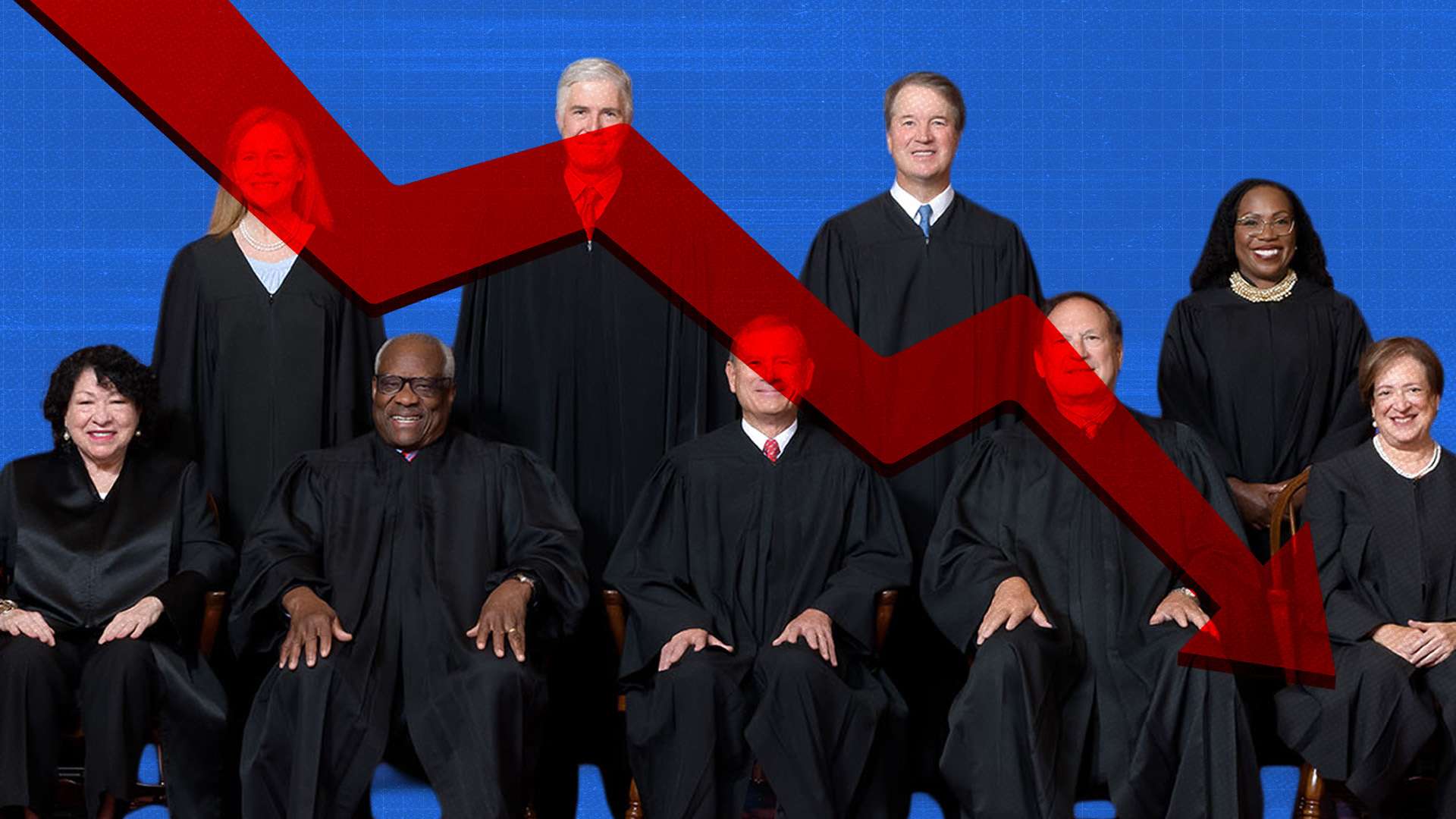
According to a new poll conducted by NBC News, the percentage of registered U.S. voters who have a "great deal" or "quite a bit" of confidence in the U.S. Supreme Court has reached a new low. What's going on?
You’re reading Injustice System from Damon Root and Reason. Get more of Damon’s commentary on constitutional law and American history.
Here is how NBC's senior Supreme Court reporter Lawrence Hurley summarized the results:
The latest NBC News poll shows that 22% of registered voters nationally said they have a "great deal" or "quite a bit" of confidence in the high court. Another 40% said they had "some" confidence, while 38% said they had "very little" or "no" confidence.
The previous low point for voters' impressions of the Supreme Court came in the wake of the ruling that overturned Roe v. Wade in 2022, when 27% said they had a great deal or quite a bit of confidence.
These new poll results become even more interesting when partisanship is factored in. For example, in 2024, 53 percent of Republicans who were asked by NBC said their confidence in the Court was high. Yet in 2026, that number dropped to 35 percent. Meanwhile, in the same period, the confidence figure actually slightly increased among Democrats, who went from 4 percent voicing a "great deal" or "quite a bit" of confidence in SCOTUS in 2024 to 9 percent reporting that kind of favorable view in 2026.
This suggests that the Supreme Court's recent decision against President Donald Trump's illegal tariff regime may have given a tiny boost to the Court's reputation among Democrats (who still remain overwhelmingly negative) while simultaneously hurting the Court's standing in the eyes of Republicans, who now may perhaps share the president's view that Justices Neil Gorsuch and Amy Coney Barrett in particular are "an embarrassment to their families" because they voted against Trump.
I wonder if this trend will continue if the Supreme Court hands Trump another defeat later this term over his unconstitutional birthright citizenship order. I seriously doubt we'll ever get to the point where Democrats view the current SCOTUS more favorably than Republicans view it, but perhaps distrusting the current Court will become more of a genuinely bipartisan affair in the near future.
You may be wondering if such negative poll numbers actually matter for the Supreme Court. In Federalist No. 78, Alexander Hamilton explained that one of the key reasons why the Constitution established lifetime tenure for federal judges was to ensure judicial independence in the face of "the effects of those ill humors which the arts of designing men, or the influence of particular conjunctures, sometimes disseminate among the people themselves." In other words, the idea of a politically unpopular judiciary was built into the system. Federal judges don't stand for reelection, after all, and typically remain on the bench until they retire or die, so why can't they handle some negative approval ratings? Call it an occupational downside to an otherwise pretty sweet gig.
On the other hand, as Hamilton also pointed out in that same Federalist paper, the judiciary "may truly be said to have neither FORCE nor WILL but merely judgment; and must ultimately depend upon the aid of the executive arm even for the efficacy of its judgments."
Here is one way to think about that particular Hamilton quote: What happens if the Supreme Court's judgment comes to be mostly distrusted by both political parties? Will that make it politically easier for presidents to defy court orders? Will it make it easier for the Supreme Court's most outspoken critics in Congress to push through court-packing or some other far-reaching plan designed to upend the judiciary?
If the Supreme Court's poll numbers truly plummet, it's at least conceivable that we could find out.
Facts Only
A new NBC News poll shows 22% of registered U.S. voters have a "great deal" or "quite a bit" of confidence in the U.S. Supreme Court.
40% of voters report having "some" confidence, while 38% have "very little" or "no" confidence.
The previous low in confidence was 27% in 2022, following the overturning of *Roe v. Wade*.
Republican confidence in the Court dropped from 53% in 2024 to 35% in 2026.
Democratic confidence in the Court rose from 4% in 2024 to 9% in 2026.
The Supreme Court recently ruled against former President Donald Trump’s tariff regime.
Trump has criticized Justices Neil Gorsuch and Amy Coney Barrett, calling them "an embarrassment to their families" for ruling against him.
The article references *Federalist No. 78*, where Alexander Hamilton argues that lifetime tenure for judges ensures independence from public opinion.
Hamilton also notes that the judiciary lacks enforcement power and relies on the executive branch to implement its rulings.
The article speculates about potential consequences of sustained low confidence, including presidential defiance of court orders or congressional efforts to reform the judiciary.
Executive Summary
A recent NBC News poll reveals that public confidence in the U.S. Supreme Court has hit a new low, with only 22% of registered voters expressing a "great deal" or "quite a bit" of confidence in the institution. This marks a decline from the previous low of 27% following the 2022 overturning of *Roe v. Wade*. The poll also highlights partisan shifts: Republican confidence dropped from 53% in 2024 to 35% in 2026, while Democratic confidence slightly increased from 4% to 9% over the same period. The shift among Republicans may stem from the Court's recent rulings against former President Donald Trump, including a decision striking down his tariff regime. Meanwhile, Democrats remain overwhelmingly negative, though the slight uptick suggests some approval of decisions opposing Trump’s policies.
The article contextualizes these findings by referencing Alexander Hamilton’s *Federalist No. 78*, which argues that judicial independence is designed to withstand public disapproval. However, it also raises concerns about the long-term consequences of sustained distrust, such as potential defiance of court orders by presidents or congressional efforts to restructure the judiciary. The analysis suggests that if bipartisan distrust grows, the Court’s authority could be undermined, even though its judges are insulated from electoral pressures.
Full Take
The strongest version of this narrative highlights a legitimate concern: the Supreme Court’s declining public confidence could erode its institutional legitimacy, particularly if distrust becomes bipartisan. The article credibly presents polling data and partisan shifts, acknowledging that judicial independence was designed to withstand unpopularity. However, it also raises a critical question: if both major parties lose faith in the Court, could this embolden efforts to undermine its authority, such as court-packing or executive defiance?
Pattern scan: The framing leans toward *ARC-0024 Ambiguity* by speculating about future consequences (e.g., "it's at least conceivable") without concrete evidence that such outcomes are imminent. There’s also a subtle *ARC-0043 Motte-and-Bailey* dynamic—presenting the Court’s unpopularity as a neutral fact while implying it could lead to systemic instability, a more extreme claim.
Root cause: The narrative assumes that public trust is essential for judicial authority, but it doesn’t fully explore whether the Court’s power has ever truly depended on popularity. Historically, the Court has weathered unpopular rulings (e.g., *Brown v. Board of Education*), suggesting resilience. The unstated assumption is that partisan polarization is uniquely threatening today, but the article doesn’t compare this moment to past crises.
Implications: If distrust grows, the Court’s moral authority could weaken, making compliance with rulings more contingent on political alignment. This could benefit actors who seek to bypass judicial constraints, while ordinary citizens may face greater legal uncertainty. Second-order effects might include increased politicization of judicial appointments or attempts to delegitimize rulings through media campaigns.
Bridge questions: How much does public confidence actually correlate with the Court’s ability to function? Are there historical examples where low approval didn’t lead to institutional collapse? What mechanisms, beyond public opinion, ensure judicial compliance?
Counterstrike scan: A bad actor pushing this narrative might amplify partisan distrust to justify radical reforms (e.g., court-packing) or to delegitimize the Court ahead of unfavorable rulings. However, the article itself presents data and context without overt manipulation, focusing on legitimate concerns rather than stoking outrage. No structural alignment with a coordinated influence campaign is detected.
Sentinel — Human
The article shows strong signs of human authorship, with a distinct voice, erratic sentence structure, and personal musings inconsistent with AI generation.