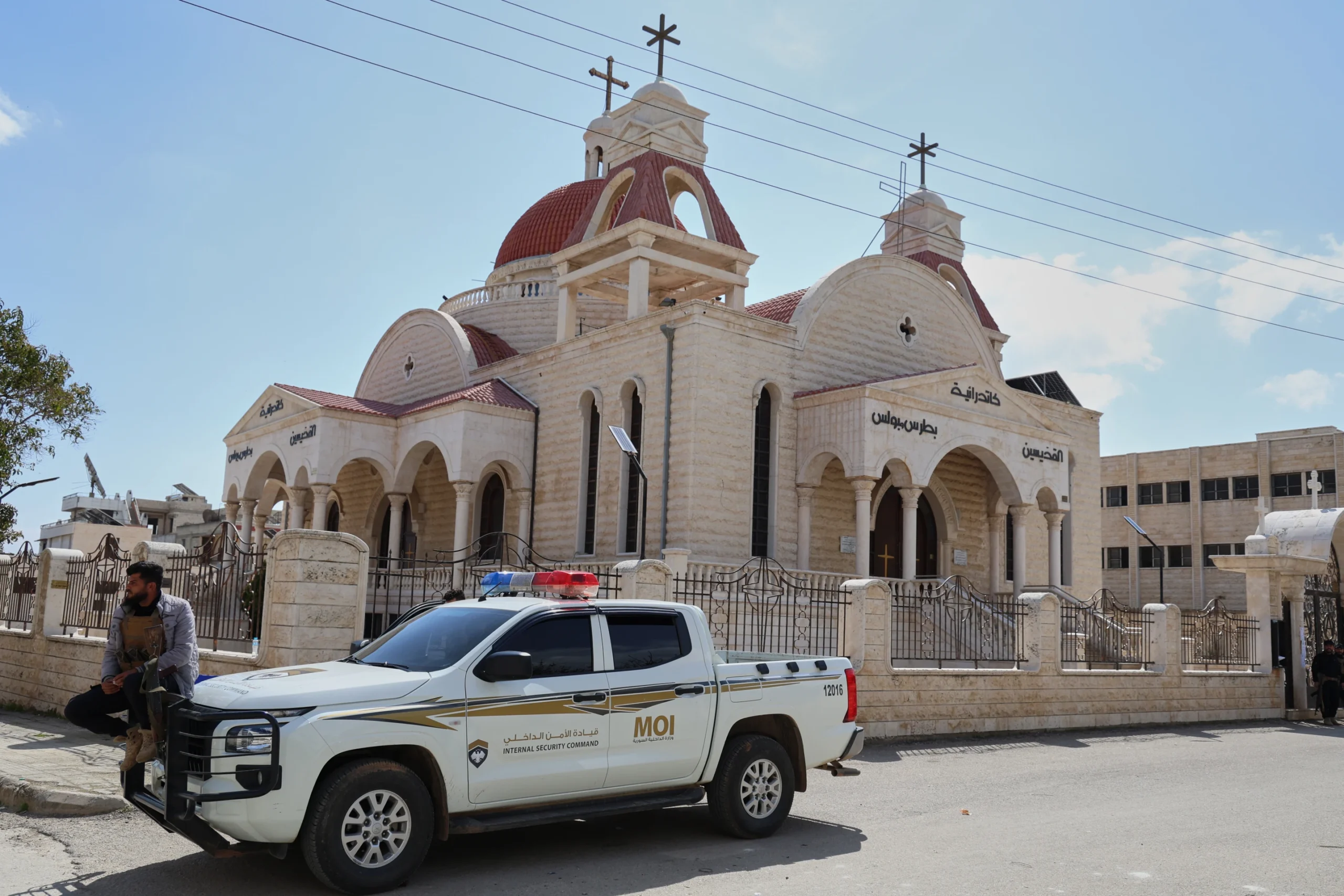
SUQAYLABIYAH, Syria — An argument between two men in a Christian town in central Syria led to sectarian attacks that caused widespread damage to homes, shops and cars in a reminder of religious violence that followed the fall of longtime leader Bashar Assad two years ago.
The attacks in the predominantly Christian town of Suqaylabiyah in Hama province are the latest to target members of Syria’s Christian minority, many of whom have left the country since the conflict began 15 years ago, leaving half a million people dead and the population deeply divided.
There was no immediate word on casualties in the attacks that lasted until the early hours of Saturday, during which scores of men on motorcycles from the nearby Sunni town of Qalaat al-Madiq attacked the property of Christians.
“We passed through a state of terror, fear, and panic,” said Liyan Dweir, whose clothes shop was riddled with bullets and suffered heavy damage. His children were terrified during the hourslong assault, he said.
Dweir said an argument between a resident of Suqaylabiyah and another from Qalaat al-Madiq led to scores of men from the Sunni town storming the area and attacking shops, homes and cars.
“It is unfair that because of an argument two towns clashed,” he said.
Another Suqaylabiyah resident, Nafeh al-Nader, said young men broke the gate of his house and kicked a diesel heater, setting a room on fire. They tried to set another room on fire but were unsuccessful after a neighbor rushed for help, and was hit with a stick by one of the attackers.
Government forces brought in reinforcements into Suqaylabiyah, calming the violence. Hundreds of residents marched through the streets Saturday demanding accountability and declaring a strike until the perpetrators are punished.
Since the fall of Assad in December 2024, members of the country’s Alawite, Druze and Christian minorities have been subjected to attacks by gunmen loyal to the country’s new Islamist rulers. Hundreds of people have been killed, including Alawites in Syria’s coastal region in March last year and Druze in the southern province of Sweida in July.
Syria’s interim President Ahmad al-Sharaa’s government has condemned attacks on minorities but many accuse it of looking the other way or being unable to control the armed groups it is trying to absorb.
During Syria’s conflict that began in 2011, Suqaylabiyah was held by forces loyal to Assad while Qalaat al-Madiq was held by insurgent groups that eventually overthrew the Assad family’s 54-year rule.
Anger has been on the rise among many Syrians after the country’s authorities banned the consumption of alcohol in the capital of Damascus. The ban affects Christian neighborhoods in Damascus that are famous for their restaurants and pubs.
Christians made up about 10% of Syria’s prewar population of 23 million. They enjoyed freedom of worship under the Assad government and some high government posts. Initially, many Christians were willing to give the new authorities a chance but the situation worsened in June after a suicide bombing inside a church outside Damascus killed 25 people and wounded dozens.
Facts Only
An argument between two men in Suqaylabiyah, a Christian town in Hama province, escalated into sectarian violence.
Scores of men from the Sunni town of Qalaat al-Madiq attacked Christian property, including homes, shops, and cars.
The attacks occurred late into Friday night and early Saturday morning.
Liyan Dweir, a resident, reported his clothes shop was riddled with bullets and heavily damaged.
Nafeh al-Nader, another resident, stated attackers broke into his home and set a room on fire.
Government forces reinforced Suqaylabiyah to calm the violence.
Hundreds of residents marched on Saturday, demanding accountability and declaring a strike.
Syria’s interim President Ahmad al-Sharaa’s government has condemned attacks on minorities.
Since the fall of Bashar Assad in December 2024, minority groups have faced increased attacks.
A recent alcohol ban in Damascus has heightened tensions, particularly in Christian neighborhoods.
Christians made up about 10% of Syria’s prewar population of 23 million.
A suicide bombing at a church outside Damascus in June killed 25 people and wounded dozens.
Executive Summary
Full Take
The strongest version of this narrative highlights the fragility of Syria’s post-Assad social fabric, where sectarian tensions simmer beneath the surface and erupt violently over minor disputes. The reporting effectively captures the immediate human impact—fear, property destruction, and demands for justice—while situating the incident within a broader pattern of minority persecution. The inclusion of government condemnation alongside accusations of inaction adds nuance, avoiding a simplistic "oppressor vs. victim" framing.
Patterns detected: ARC-0043 Motte-and-Bailey (condemning attacks while tolerating armed groups), ARC-0024 Ambiguity (vague attribution of "gunmen loyal to Islamist rulers" without clear evidence).
The root cause appears to be the collapse of Assad’s secular authoritarianism, which, despite its repression, maintained a fragile stability for minorities. The new Islamist-influenced governance structure struggles to enforce order, creating a power vacuum where local grievances escalate into sectarian violence. The alcohol ban and church bombing suggest a broader ideological shift targeting Christian cultural practices, reinforcing a paradigm of religious dominance over pluralism.
Implications for human agency are dire: minorities face displacement or submission, while the state’s inability to protect them erodes trust in governance. The second-order consequence may be accelerated emigration, further destabilizing Syria’s demographic balance.
Bridge questions: How might Syria’s interim government regain control over armed factions without alienating its Islamist base? What role do external actors play in fueling or mitigating these tensions? Would decentralized local governance reduce sectarian clashes, or entrench divisions further?
Counterstrike scan: A coordinated influence campaign would amplify sectarian fear to justify authoritarian crackdowns or foreign intervention. The article does not match this pattern; it presents a grounded account of local violence without exaggerated claims or calls for external action. The focus on civilian suffering and government failure aligns with journalistic integrity, not manipulation.