A few years ago in Dhahran, the Saudi state oil company, Aramco, gave me a tour of its headquarters, a facility so sparkling and orderly that one could forget that its whole purpose was to extract from the ground one of the filthiest substances on Earth. The most impressive stop on the tour was the Aramco emergency command center, which I imagine is paying its workers a lot of overtime right now. It looked like the control room for a mission to Alpha Centauri. Men and women sat at their stations. The walls were aglow with constellations of green lights—each one, my host said, representing a functioning object in the Aramco galaxy of pipelines, valves, ships, buses, heat exchangers, and drill bits. If a light flashed red, it meant one of these objects was broken, and the people at those stations would vault into action to support the crew restoring it.
One major question in the current war is why Iran has so far failed, or perhaps declined, to make life miserable for the people in that room. The vow to annihilate energy infrastructure is one of two threats—American and Iranian—that remain, as of this writing, unfulfilled. On March 17, after Israel attacked Iran’s South Pars gas field, Iran threatened five key oil-and-gas facilities in Qatar, the United Arab Emirates, and Saudi Arabia. Last weekend, Donald Trump wrote that if Iran failed to open the Strait of Hormuz in exactly 48 hours, “the United States of America will hit and obliterate their various POWER PLANTS, STARTING WITH THE BIGGEST ONE FIRST!” (American air superiority over Iran is matched only by its overwhelming advantage in CAPITAL LETTERS, which Persian lacks.) So far Trump has not attacked the power plants—in fact, on Thursday he extended the deadline to April 6—and most of the oil infrastructure in the region remains intact.
Trump’s targeting of power plants would be a remarkable and possibly illegal step, if those plants are civilian, and it is difficult to imagine any other president openly threatening their obliteration. Iran’s targeting of oil and gas infrastructure, however, is predictable, and is one of the reasons every president before Trump declined to attack Iran at all. It is by far the most painful action Iran could take against the United States and its allies. Saudi Arabia, Kuwait, and Qatar all pay their bills through oil and gas, and if these stop flowing, they will rapidly turn from petrocrats to paupers.
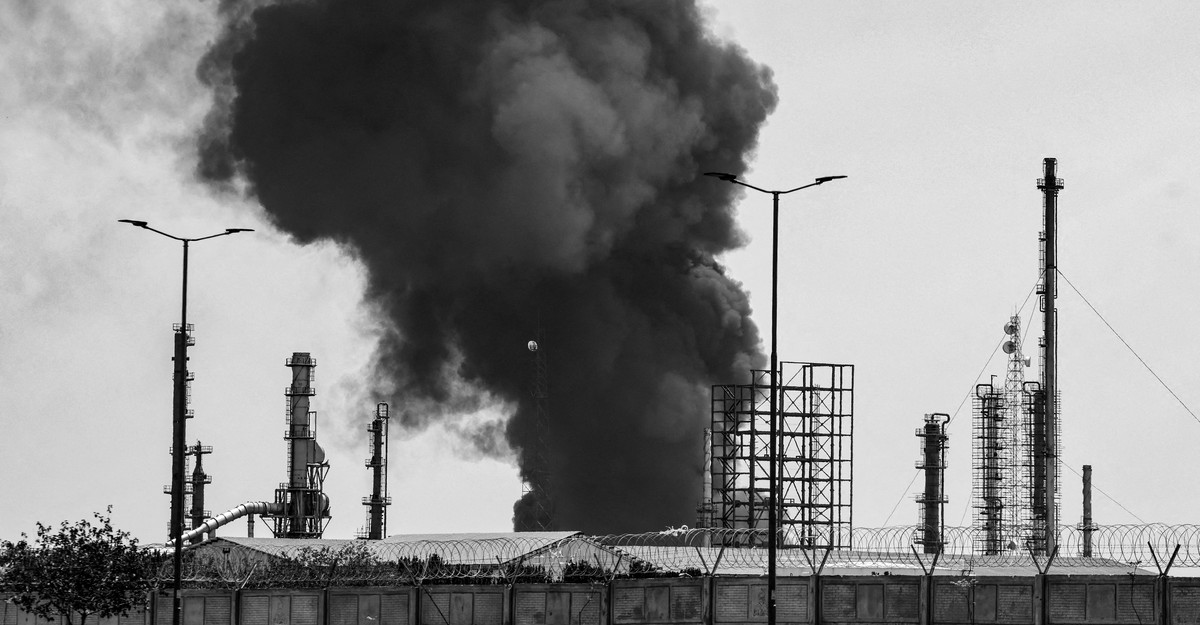
Wrecking oil infrastructure is easy. It has no legs; it cannot run away or be hidden underground until danger passes. It is filled with materials at high temperatures and pressures, and some of them can be set on fire. In a 2019 attack that presaged the current war, a fleet of drones and a barrage of cruise missiles hit Saudi Arabia’s Abqaiq and Khurais oil fields. Abqaiq is the world’s most important oil field. Direct strikes on crude-stabilization columns and gas-oil separation tanks reduced Saudi oil output by half. Saudi Arabia accused Iran of launching the attacks, and Crown Prince Mohammed bin Salman told me in 2022 that the U.S. was ready to punish Iran for the attack, but had held back to avoid “escalation.”
Rebuilding that same infrastructure is hard. A single well-aimed strike can set back a whole operation for a very long time. On March 18, Iran attacked Ras Laffan, Qatar’s main site for liquefied-natural-gas production, and Qatar estimated that repairs would take three to five years.
Taylor Coleman, an oil-and-gas operations expert at CapturePoint, told me that pipelines are relatively easy to fix, but refinery equipment is another matter. Hydrocrackers—which heat up and pressurize heavy oils, to convert them to lighter fuel products—are made of metal that is a foot thick, and built to withstand temperatures reaching thousands of degrees. “There are only two or three foundries that can even make castings and forgings for some of those vessels, and delivery times can be two, three, even four years,” he said. This equipment is too expensive to stock spares. “We don’t keep an entire plant laid down in a yard somewhere, just in case one blows up.” The insatiable electricity needs of AI means that if an oil processing plant—which is also hungry for electricity—loses its transformers, it has to bid against, and get in line behind, technology companies that have already been waiting years for fulfillment.
Iran has attacked not only Qatar but also Saudi facilities at Ras Tanura and even Yanbu, all the way in the west, on the Red Sea. Perhaps these were Iran’s best attempts at obliteration, and they were mostly thwarted. (Ras Laffan was the most ruinous hit. Both Ras Tanura and Yanbu were hit by debris from downed drones, and not fatally damaged.)
But there is also a strategic consideration that might keep Iran from using maximum force. The logic of a devastating attack on oil and gas infrastructure is uncomfortably similar to mutually assured destruction: If Iran wipes out Saudi oil production, the immediate annihilation of its own infrastructure is nearly certain. The two countries rely about equally on oil and gas as shares of their exports, so such an attack by Iran would be tantamount to economic murder-suicide. It would also end all polite remonstrance from Iran’s neighbors, who have suggested that Iran’s regime might survive the war, if it forswears attacks, blockades, and terrorism. A direct attack on the oil fields would force the conclusion that the regime must fall. Destroying energy production in the Persian Gulf would also deal a grievous blow to Iran’s ally China, which devours both Arab and Iranian oil and would be left energy-hungry for years.
Shane Harris: A turning point in the Iran war
The final reason these attacks have not yet happened is probably the most important. Although Iran and the Gulf Arabs can mutually assure each other’s destruction, only the Arab oil-and-gas fields are assured to be reconstructed. Decades of sanctions and isolation have left Iran’s facilities ragged and corroded. If the regime somehow survives the war, no relief for this decrepitude will be forthcoming—whereas the Kuwaitis, Qataris, and Saudis will be overrun with technical experts and showered with financing. And that reconstruction will be combined with redoubled efforts to cripple Iran’s ability to attack the fields again. The Ras Laffan attacks show that some constraints are physical and metallurgical, and even ultra-rich Qatar will have to spend years rebuilding. But cooperation of rich allies can work wonders. After the 2019 Abqaiq attack, Saudi oil was flowing at pre-attack levels within a matter of weeks, in part because when the U.S. and China both want your oil, they will defy economic and physical laws to obtain it.
The purpose of the Iranian military was never to win a war—there is no “winning” a war with a military as advanced as America’s—but to deter and punish anyone who started a war with it. This logic of deterrence bought Iran decades, which is why it can boast a glorious past of successful resistance against American power. The same logic now would lead to escalation beyond Iran’s ability to manage, and could cost it an equally boastworthy future.
Facts Only
Aramco, Saudi Arabia’s state oil company, operates a high-tech emergency command center monitoring pipelines, valves, and other infrastructure.
In 2019, drones and cruise missiles attacked Saudi Arabia’s Abqaiq and Khurais oil fields, halving Saudi oil output.
Saudi Arabia accused Iran of the 2019 attack; Crown Prince Mohammed bin Salman stated the U.S. considered retaliation but avoided escalation.
On March 17, Israel attacked Iran’s South Pars gas field, prompting Iran to threaten five oil-and-gas facilities in Qatar, the UAE, and Saudi Arabia.
On March 18, Iran attacked Qatar’s Ras Laffan LNG plant, with repairs estimated to take three to five years.
Iran has also targeted Saudi facilities at Ras Tanura and Yanbu, though damage was limited.
Former U.S. President Donald Trump threatened to destroy Iranian power plants if Iran did not open the Strait of Hormuz within 48 hours, later extending the deadline to April 6.
Oil infrastructure is highly vulnerable due to its fixed nature and reliance on high-pressure, high-temperature materials.
Rebuilding damaged refinery equipment, such as hydrocrackers, can take years due to specialized manufacturing requirements.
Iran’s economy relies heavily on oil and gas exports, similar to Saudi Arabia and other Gulf states.
Sanctions and isolation have left Iran’s oil infrastructure outdated and difficult to repair.
After the 2019 Abqaiq attack, Saudi Arabia restored oil production within weeks with international support.
Executive Summary
Full Take
The strongest version of this narrative highlights the precarious balance of deterrence in the Persian Gulf, where Iran’s threats against oil infrastructure are met with U.S. and regional counter-threats. The article effectively illustrates the strategic dilemmas: Iran’s capacity to disrupt global energy markets is countered by the certainty of devastating retaliation and the long-term economic consequences for itself. The piece also underscores the asymmetry in reconstruction capabilities, favoring U.S.-allied Gulf states over sanctioned Iran. This framing aligns with a realist perspective on geopolitical conflict, where mutual vulnerability and economic interdependence shape behavior.
Pattern scan: The narrative avoids overt manipulation but leans into a framing of Iran as a rational actor constrained by self-interest rather than ideological or expansionist motives. This could subtly reinforce a "lesser evil" argument for U.S. policy, where Iran’s restraint is portrayed as pragmatic rather than coerced. The focus on mutual assured destruction (MAD) logic may also downplay other factors, such as internal Iranian politics or the role of proxy forces. No clear distortion or bad faith is detected, but the emphasis on economic rationality risks oversimplifying a complex conflict.
Root cause: The paradigm here is classic deterrence theory, where states avoid escalation due to the certainty of catastrophic consequences. The unstated assumption is that all actors prioritize economic survival over ideological or territorial goals—a debatable premise in Middle Eastern geopolitics. Historically, this echoes Cold War-era brinkmanship, where proxy conflicts and limited strikes replaced direct warfare.
Implications: Human agency is constrained by structural vulnerabilities—oil dependence, sanctions, and military asymmetry. The primary beneficiaries of this standoff are global energy consumers (e.g., China) who rely on Gulf stability, while the costs are borne by civilians in conflict zones and economies dependent on oil revenues. Second-order consequences include prolonged energy market volatility and accelerated efforts to diversify away from fossil fuels.
Bridge questions: How might Iran’s domestic politics influence its willingness to escalate beyond economic rationality? What role do proxy forces (e.g., Houthis, Hezbollah) play in this deterrence calculus? Would a shift in U.S. policy—such as lifting sanctions—alter Iran’s strategic calculations?
Counterstrike scan: A coordinated influence campaign would likely amplify fears of regional instability to justify military intervention or energy market manipulation. The article does not match this pattern; it presents a measured analysis of constraints rather than stoking panic or advocating for escalation.