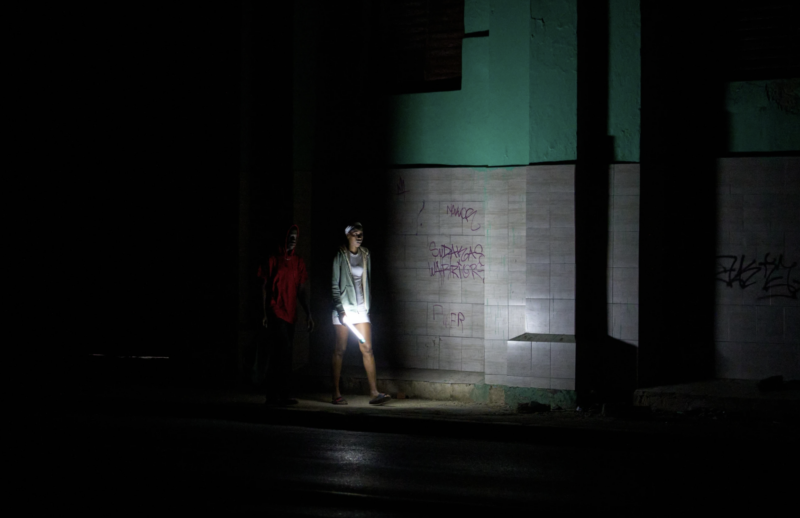
Havana is unusually quiet. A city normally buzzing with traffic and nightlife lies still, dark, and silent. The Trump administration’s economic strangulation of the island has led to frequent and extended blackouts across the country, creating an economic crisis and uncertainty about the future.
“I can do anything I want with Cuba,” President Trump said recently. “I think something will happen with Cuba pretty quickly,” he added. The country’s electrical grid, public transportation systems, hospitals, schools, and stores run on imported fuel. And now that Trump and Secretary of State Marco Rubio have threatened the world into complying with their agenda, including ending fuel shipments, Cuba is suffering.
Many stores and markets are empty, not because the island does not produce food, but because there is no way to transport it from the countryside to the cities. The United Nations has warned of a possible “humanitarian collapse,” due to the economic war. Havana-based journalist Luis de Jesus Reyes labeled it an attempted genocide in the making.
The Cruelty is the Point
Successive administrations have attempted to crush Cuba’s Communist Revolution through embargoes and blockades. A declassified Eisenhower-era State Department memo describes the goal of these unilateral coercive measures as “denying money and supplies” to the island, in order to bring about “hunger, desperation and overthrow of government.”
Trump, however, has made this policy a matter of urgency. On January 29, he declared Cuba an “unusual and extraordinary threat” to U.S. national security, and declared that any nation selling it oil would receive giant tariffs.
Cuban-American Secretary of State Marco Rubio, meanwhile, has long dreamed of overthrowing the government in Havana, and has made it a central goal of his political platform to do so.
The ratcheting up of pressure has included intimidating more than a dozen poor nations into suspending medical ties with Cuba, which will see Cuban doctors treating poor and underserved communities across Latin America and the Caribbean forcibly repatriated to their own country.
Trump and Rubio have found allies in right-wing governments throughout the region, including those led by Javier Milei in Argentina, Daniel Noboa in Ecuador, and Nayib Bukele in El Salvador.
Their intention is to take Cuba back to where it was in 1958: a U.S. client state where American corporations ran free and the local population was docile, downtrodden, and hyper-exploited like its neighbors, not unlike Haiti and the Dominican Republic are today.
Moreover, the plan to crush Cuba fits into a wider U.S. dream of dominating the Americas. This wish that goes back to the 1820s and the famous Monroe Doctrine, which stated that the entire hemisphere was effectively a U.S. domain. Following his attack on Venezuela and his kidnapping of President Nicolás Maduro, Trump stated plainly: “Under our new national security strategy, American dominance in the Western Hemisphere will never be questioned again.”
Turning The Screw
The result is the slow asphyxiation of Cuba, as economic life grinds to a halt. A stronger, hyper-militarized power forcing an entire people to live under intensely difficult conditions has led many to draw comparisons to other international events. “The Gaza-ification of Cuba, in order to starve millions of people, is unfolding before our very eyes,” wrote Argentinian analyst, Bruno Sgarzini.
Trump, with characteristic confidence, predicts an imminent victory. Earlier this week, he stated:
“Cuba is a failed nation. And I think that pretty soon we will make a deal or do whatever we have to do. We have a lot of great people who happened to vote for Trump (not that that matters) but we have a lot of great people from Cuba who were violently and viciously thrown out of that country, and worse, their families were killed. So, we are talking to Cuba, but we are going to do Iran before Cuba.”
Nevertheless, there are rays of optimism for the revolutionaries on the island. For one, Cuba has already endured worse. After the fall of the Soviet Union, Washington tightened its economic noose, leading to a protracted decade of stagnation and suffering locals call the Special Period. Oil was extremely scarce, and calorific intake islandwide fell by a third. The era only came to an end with the assistance of Venezuela and Russia.
Despite much encouragement from the U.S. and from corporate media, there have so far only been sporadic anti-government protests.
Moreover, Trump’s actions have triggered a massive, worldwide solidarity network attempting to break the embargo and bring much needed supplies into Cuba. One of those figures traveling to Cuba is climate activist Greta Thunberg, who, explaining her decision to take part, said:
“As the Trump administration is waging illegitimate wars across the world, killing countless people, deliberately, openly and methodically. The pedophile Trump himself bragged about it, saying there’s an embargo, there’s no oil, there’s no money. There is no anything.”
“This is not an accident, or an unfortunate side effect of some policy disagreement. This is the intended outcome,” she added.
Cuba has built up enormous amounts of global public goodwill, thanks to its medical humanitarianism. Its doctors have traveled to over 160 countries, and performed lifesaving procedures across the world. Cuban doctors fought Ebola in West Africa, battled the COVID-19 pandemic in Europe and Latin America, and restored the sight of some two million people in 35 countries for free.
Thus, some say, while the United States exports death, Cuba exports life. “We cannot stay silent about this. Cuba did not stay silent when the world needed it… Cuba stood up for the world, and now it is time or the world to stand up for Cuba,” Thunberg said.
Therefore, considering what is in store for them if they do, for so many in Cuba, no matter how hard life gets, surrendering to Washington is simply not an option.
Facts Only
Havana is experiencing frequent and extended blackouts due to economic sanctions.
The Trump administration declared Cuba an "unusual and extraordinary threat" to U.S. national security on January 29.
The U.S. has imposed tariffs on nations selling oil to Cuba.
Secretary of State Marco Rubio has advocated for overthrowing the Cuban government.
Cuba’s electrical grid, transportation, hospitals, and stores rely on imported fuel, which is now scarce.
Stores and markets are empty due to transportation disruptions, not food production shortages.
The UN has warned of a potential "humanitarian collapse" in Cuba.
Over a dozen poor nations have suspended medical ties with Cuba under U.S. pressure.
Cuban doctors providing healthcare in Latin America and the Caribbean are being repatriated.
Right-wing governments in Argentina, Ecuador, and El Salvador support U.S. efforts against Cuba.
The U.S. aims to restore Cuba as a client state, similar to pre-1959 conditions.
Trump has stated a goal of ensuring "American dominance in the Western Hemisphere will never be questioned again."
Cuba endured a decade of economic hardship after the Soviet Union’s fall, known as the "Special Period."
Greta Thunberg and other activists are organizing solidarity efforts to break the embargo.
Cuban doctors have provided medical aid in over 160 countries, including during the Ebola and COVID-19 crises.
Executive Summary
Full Take
The narrative presents a strong case that U.S. sanctions against Cuba are deliberately designed to induce suffering as a means of political coercion, framing it as an extension of historical U.S. interventionism in Latin America. The strongest version of this argument highlights the tangible humanitarian consequences—blackouts, food shortages, and healthcare disruptions—while contextualizing them within a broader pattern of U.S. foreign policy aimed at regime change. The inclusion of declassified documents and historical parallels (e.g., the Eisenhower-era memo, the Monroe Doctrine) lends credibility to the claim that economic strangulation is a calculated strategy.
However, the piece employs emotional framing, particularly in describing the crisis as "genocide in the making" and comparing it to Gaza, which may risk oversimplifying complex geopolitical dynamics. The focus on Trump and Rubio as primary antagonists, while factually supported, could be seen as a form of personalization that distracts from systemic critiques. The article also leans heavily on activist voices (e.g., Thunberg) to bolster its moral argument, which, while compelling, may not fully account for counter-perspectives on U.S. policy justifications or Cuba’s internal governance challenges.
Rooted in Cold War-era paradigms, this narrative assumes that U.S. actions are primarily motivated by ideological opposition to socialism rather than other strategic interests (e.g., countering Chinese or Russian influence). The unstated assumption is that Cuba’s resilience is solely a function of external solidarity, downplaying potential internal dissent or economic mismanagement. Historically, this echoes patterns of U.S. intervention in Latin America, where economic pressure has been used to destabilize leftist governments, often with mixed outcomes.
The implications for human dignity are stark: ordinary Cubans bear the brunt of sanctions, while the U.S. and its allies pursue geopolitical objectives. The second-order effects include weakened regional stability and the erosion of Cuba’s medical diplomacy, which has been a soft power asset. The solidarity movements, while heartening, may not offset the structural damage inflicted by the embargo.
Bridge questions: How might Cuba’s internal policies (e.g., economic reforms, political repression) influence the effectiveness of U.S. sanctions? What alternative frameworks could explain U.S. policy beyond ideological opposition to socialism? Would evidence of Cuban government corruption or human rights abuses shift the moral calculus of this narrative?
Counterstrike scan: A coordinated influence campaign would likely amplify emotional language (e.g., "genocide," "starvation"), personalize blame (Trump/Rubio as villains), and suppress counter-narratives (e.g., Cuban government failures). While the article uses some of these tactics, it also provides verifiable facts and historical context, mitigating the risk of outright manipulation. The alignment with a hypothetical attack playbook is partial but not structural.
Patterns detected: ARC-0024 Ambiguity (emotional framing without full context), ARC-0043 Motte-and-Bailey (broad claims of "genocide" vs. specific policy critiques).
Sentinel — Human
The article shows strong signs of human authorship, including a distinct ideological voice, historical context, and unpolished direct quotes, though some vague attributions and rhetorical flourishes warrant moderate scrutiny.