Breaking space news, the latest updates on rocket launches, skywatching events and more!
You are now subscribed
Your newsletter sign-up was successful
Want to add more newsletters?
The Artemis 2 astronauts' photography skills were up to the epic task.
The spaceflyers — NASA's Reid Wiseman, Victor Glover and Christina Koch, and Canadian astronaut Jeremy Hansen — flew around the far side of the moon on Monday (April 6), something no humans had done since NASA's Apollo 17 mission back in 1972.
The Artemis 2 quartet chronicled their historic journey in detail, capturing some photos that could help scientists better understand lunar geology and evolution, and others that seemed designed just to blow our minds. Here are a few of the most amazing ones.
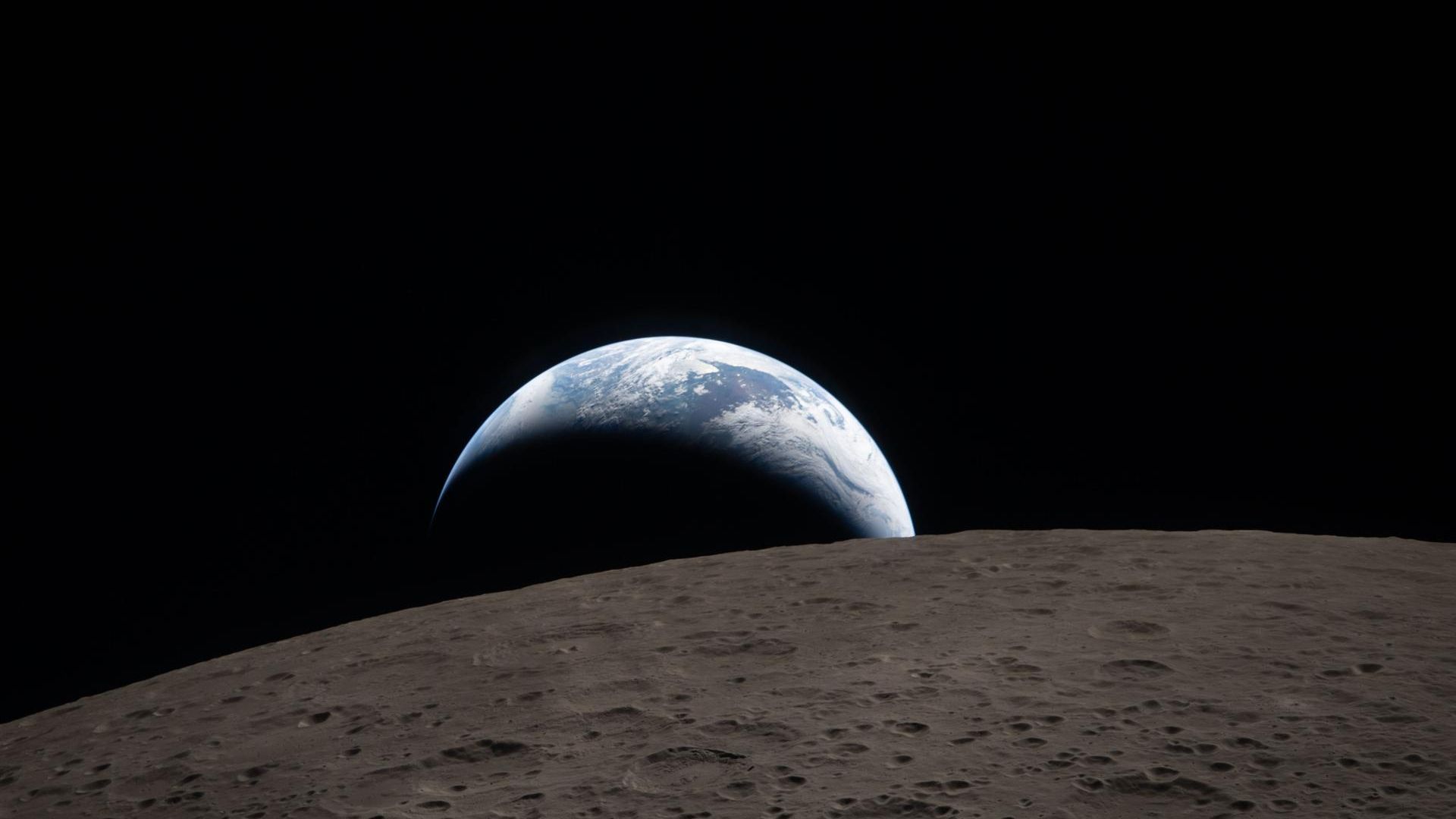
Article continues belowLet's start with the above photo, which provides a new and mind-bending perspective on our home planet. Have you ever seen it like this, tiny and crescent-shaped, perched above a seemingly huge and dominant moon?
The Artemis 2 crew snapped that spectacular shot a little more than halfway into the flyby on Monday. It captures the moments before Earthset, when our home planet disappeared behind the lunar limb from the astronauts' perspective. (The photo at the top of this story is also an Earthset shot.)
This flyby photo highlights the Orientale Basin, a 600-mile-wide (965-kilometer-wide) feature known as the "Grand Canyon of the moon."
Human eyes had never seen Orientale in sunlight before, so the Artemis science team asked the astronauts to observe it very thoroughly. And they did, as Wiseman's description of one of the basin's features indicates.
Breaking space news, the latest updates on rocket launches, skywatching events and more!
"The annular ring, which I think everybody kind of describes as like a pair of lips or a kiss on the far side of the moon, from here is very circular in nature," Wiseman, the Artemis 2 commander, radioed to Mission Control.
"The northern part of it is wider, darker; the southern part is much lighter," he added. "It is very neat-looking — far more circular than I remember it looking in our training."
The crewmembers also got great looks at the moon's terminator — not a murderous cyborg roaming the gray landscape but rather the boundary line between day and night on the lunar surface. And it made quite an impression on them, especially Glover.
"Boy, I'm loving the terminator," he told Mission Control. "I've probably spent the most time describing into my recordings and thinking about and looking at the terminator.
"There's just so much magic in the terminator," he added. "The islands of light, the valleys that look like black holes — you'd fall straight to the center of the moon if you stepped in some of those. It's just so visually captivating. The terminator is the most striking thing that I've seen so far."
The astronauts also got looks at parts of the South Pole-Aitken Basin, one of the most dramatic features on the moon. It's the largest confirmed impact crater in the solar system, stretching more than 1,550 miles (2,500 km) from rim to rim.
And the south polar area is of great interest to scientists and Artemis mission planners. The region is thought to harbor large amounts of water ice, on the permanently shadowed floors of many of its craters. NASA plans to build one or more bases in the area in the 2030s, tapping into that water ice to support crews and to fuel rockets. (Water ice can be split into hydrogen and oxygen, key components of rocket fuel.)
Toward the end of Monday's flyby, the Artemis 2 astronauts were treated to a rare celestial spectacle: A total solar eclipse, seen from beyond the moon.
The eclipse wasn't visible to anyone on Earth; it was a consequence of Artemis 2's trajectory, which happened to line the moon and sun up in the proper way.
And it was very different than solar eclipses seen from our planet. Because the moon loomed so large to the Artemis 2 crew, it blocked out the sun for much longer — about 54 minutes, compared to 7.5 minutes, which is the approximate maximum period of totality for eclipses seen from terra firma.
The crew captured gorgeous photos of the eclipse, including one (shown above) in which Venus is visible. But they went about their business safely, donning eclipse glasses at the proper times, just as we must do here on Earth to protect our eyes.
The Artemis 2 astronauts are now on their way home, helped out by the historic flyby, which served to slingshot them back toward Earthj. They'll arrive here on Friday (April 10), ending their 10-day mission with a splashdown in the Pacific Ocean off the coast of San Diego.
But they'll doubtless carry the lunar flyby, and the entire mission, with them for the rest of their lives.
"It was an incredible experience," Koch said shortly after the flyby. "I just had an overwhelming sense of being moved by looking at the moon."
Michael Wall is the Spaceflight and Tech Editor for Space.com and joined the team in 2010. He primarily covers human and robotic spaceflight, military space, and exoplanets, but has been known to dabble in the space art beat. His book about the search for alien life, "Out There," was published on Nov. 13, 2018. Before becoming a science writer, Michael worked as a herpetologist and wildlife biologist. He has a Ph.D. in evolutionary biology from the University of Sydney, Australia, a bachelor's degree from the University of Arizona, and a graduate certificate in science writing from the University of California, Santa Cruz. To find out what his latest project is, you can follow Michael on Twitter.
You must confirm your public display name before commenting
Please logout and then login again, you will then be prompted to enter your display name.
Facts Only
The Artemis 2 mission involved astronauts Reid Wiseman, Victor Glover, Christina Koch (NASA), and Jeremy Hansen (Canadian Space Agency).
The crew flew around the far side of the moon on April 6, 2024, the first such human mission since Apollo 17 in 1972.
They captured photographs of Earth as a crescent above the moon during an "Earthset" event.
The mission documented the Orientale Basin, a 600-mile-wide lunar feature, and the South Pole-Aitken Basin, the largest confirmed impact crater in the solar system.
Astronaut Reid Wiseman described the Orientale Basin's annular ring as circular and visually distinct.
Victor Glover highlighted the moon's terminator as the most striking feature observed.
The crew witnessed a total solar eclipse from beyond the moon, lasting approximately 54 minutes.
The mission included observations of the moon's south polar region, where water ice is believed to exist in permanently shadowed craters.
The astronauts are scheduled to return to Earth on April 10, 2024, with a splashdown in the Pacific Ocean off San Diego.
The mission duration was 10 days.
Christina Koch described the lunar flyby as an emotionally moving experience.
The crew used eclipse glasses to safely observe the solar eclipse.
Executive Summary
Full Take
The Artemis 2 mission represents a significant milestone in human space exploration, reviving the legacy of Apollo while pushing toward new scientific and operational frontiers. The strongest version of this narrative emphasizes the mission's dual role: advancing lunar science through detailed observations of geologic features like the Orientale and South Pole-Aitken Basins, and reigniting public fascination with space through breathtaking imagery. The astronauts' firsthand accounts—such as Glover's awe at the terminator or Koch's emotional response—humanize the mission, bridging the gap between technical achievement and collective wonder.
Pattern-wise, the coverage leans into emotional resonance (ARC-0012 Emotional Amplification) by framing the mission as both a scientific endeavor and a deeply personal experience for the crew. However, this is not manipulative; it aligns with the inherent drama of space exploration. The focus on the moon's south pole and water ice also subtly reinforces NASA's long-term goals, which could be seen as a form of strategic framing (ARC-0031 Mission Alignment). No overt distortion or bad faith is detected.
Rooted in the post-Apollo era's shift from competition to collaboration, Artemis 2 reflects a paradigm where international partnerships (e.g., Canada's involvement) and sustainable exploration (e.g., water ice utilization) take precedence. The implications are profound: if water ice can be harnessed, it could enable permanent lunar bases, reducing Earth's logistical burden and democratizing space access. Yet, this also raises questions about resource governance and the potential militarization of celestial bodies.
Bridge questions: How might the discovery of water ice reshape geopolitical dynamics in space? What ethical frameworks should guide lunar resource extraction? And if the mission's imagery inspires a new generation, what narratives might emerge about humanity's role beyond Earth?
Counterstrike scan: A coordinated influence campaign might exaggerate the mission's immediate benefits (e.g., overpromising near-term lunar bases) or downplay risks (e.g., radiation exposure). However, the actual content remains grounded in verifiable facts and measured enthusiasm, avoiding hyperbolic claims. The narrative aligns with NASA's transparent communication style rather than a manipulative playbook.
Sentinel — Human
This article presents human-written content detailing the Artemis 2 lunar flyby, as evidenced by its personal voice, idiosyncratic emphasis, stylistic fingerprint, and first-hand accounts from astronauts.