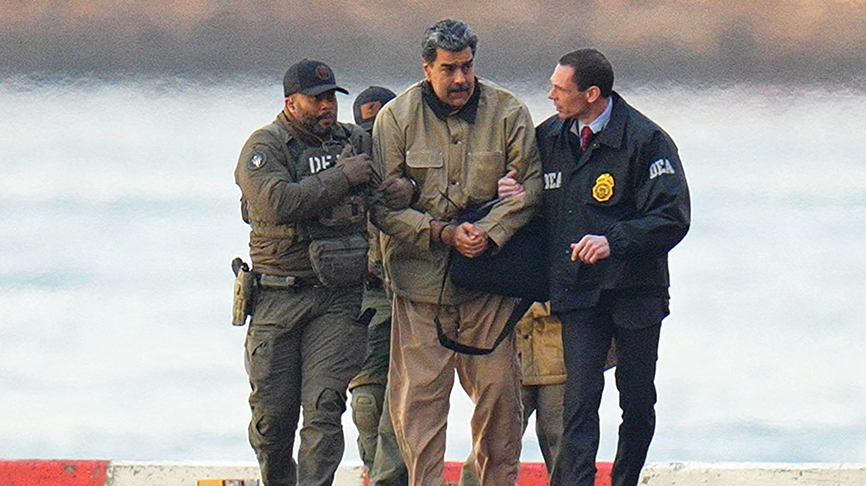
Nicolás Maduro returned to a New York federal court on Thursday for a pre‑trial hearing, facing U.S. charges of narcoterrorism, cocaine trafficking, and weapons offenses.
It was the second court appearance of the ousted Venezuelan leader since his capture alongside his wife, Cilia Flores, on January 3, 2026, from a military compound in Caracas. Both pleaded not guilty two days after their capture, with Maduro describing himself as a “prisoner of war.”
The hearing was a procedural step ahead of any potential trial, where the court will consider pre‑trial motions. Maduro’s defense attorney asked the court to drop the case citing the U.S. blocking payments to the former president’s lawyers.
One of the central issues at the moment is legal funding for Maduro and Flores. The couple say they don’t have the personal resources to cover their legal fees. Their lawyers argue that U.S. sanctions are blocking them from accessing Venezuelan government funds to pay for their defense — and that this restriction prevents them from choosing their own attorneys, a right guaranteed by the U.S. Constitution.
Judge Alvin K. Hellerstein questioned the prosecution over the blockage of funds, which the U.S. argues are related to sanctions on Venezuela’s government.
Both Maduro and Flores are on the U.S. sanctions list. Current regulations generally prohibit a sanctioned government from paying the legal fees of sanctioned individuals without a specific license. That means, for now, Caracas cannot cover their legal bills without special permission from Washington.
While Maduro argues he is Venezuela’s legitimate president, the United States did not recognize his claim to office at the time of his arrest. But it has since recognized Delcy Rodríguez as interim president, a close ally of Maduro’s who had served as vice president.
Maduro had led Venezuela since 2013, following the death of Hugo Chávez, as head of the socialist, anti‑imperialist chavismo movement. Critics say Maduro’s government became increasingly authoritarian. His claimed victory in the 2024 presidential election was disputed, with voting tallies collected by the opposition indicating their candidate had won.
He faces four federal counts, including conspiracy to participate in narcoterrorism, conspiracy to import cocaine into the United States, and offenses related to possession and conspiracy to possess machine guns and destructive devices. His wife, Cilia Flores, faces related charges.
Groups of both pro and anti-Maduro protesters gathered outside on Thursday, some calling for the release of Maduro and Flores. Others however, sang the Venezuelan national anthem and expressed their satisfaction that he was going through a judicial process in the U.S.
Some Maduro supporters gathered in central Caracas watched the scene outside court on a large screen. Maduro and Flores’ son, Nicolás Maduro Guerra who is also a politician, was also at the rally.
The case unfolds as Washington balances sanctions enforcement with ongoing engagement with Caracas, including in the energy and mining sectors.
Featured image: Nicolás Maduro arrives on a New York helipad ahead of his first court appearance on January 5, 2026.
Facts Only
Nicolás Maduro appeared in a New York federal court on Thursday for a pre-trial hearing.
He faces U.S. charges of narcoterrorism, cocaine trafficking, and weapons offenses.
This was his second court appearance since his capture on January 3, 2026, in Caracas.
Maduro and his wife, Cilia Flores, pleaded not guilty two days after their capture.
The hearing addressed pre-trial motions, including a defense request to drop the case.
Maduro’s lawyers argue U.S. sanctions block access to Venezuelan government funds for legal fees.
Judge Alvin K. Hellerstein questioned the prosecution about the blockage of funds.
U.S. regulations prohibit sanctioned governments from paying legal fees for sanctioned individuals without a license.
Maduro claims to be Venezuela’s legitimate president, though the U.S. did not recognize his 2024 election victory.
The U.S. now recognizes Delcy Rodríguez as interim president, a former Maduro ally.
Maduro faces four federal counts, including conspiracy to import cocaine and possession of machine guns.
Protesters, both supporting and opposing Maduro, gathered outside the courthouse.
Executive Summary
Nicolás Maduro, the former Venezuelan leader, appeared in a New York federal court on Thursday for a pre-trial hearing on charges of narcoterrorism, cocaine trafficking, and weapons offenses. This marks his second court appearance since his capture in Caracas on January 3, 2026, alongside his wife, Cilia Flores, both of whom pleaded not guilty. The hearing focused on procedural matters, including pre-trial motions, with Maduro’s defense arguing that U.S. sanctions prevent them from accessing Venezuelan government funds to pay legal fees, violating their constitutional right to counsel. The U.S. maintains that sanctions block such payments without a specific license, as both Maduro and Flores remain on the sanctions list.
The case unfolds against a backdrop of political complexity. Maduro, who led Venezuela since 2013, claims legitimacy as president, though the U.S. did not recognize his 2024 election victory, which was disputed by opposition tallies. Washington has since recognized Delcy Rodríguez as interim president, a Maduro ally. Outside the courthouse, protesters both supported and opposed Maduro, reflecting deep divisions. The trial also intersects with U.S. policy toward Venezuela, balancing sanctions enforcement with ongoing engagement in energy and mining sectors.
Full Take
The strongest version of this narrative highlights a clash between U.S. legal procedures and geopolitical realities. Maduro’s defense raises a legitimate constitutional concern—access to counsel—while the U.S. enforces sanctions designed to pressure his regime. The case underscores the tension between judicial fairness and foreign policy objectives, where legal rights collide with economic coercion. The article presents both sides: Maduro’s claim of being a "prisoner of war" and the U.S. position that sanctions are lawful. The inclusion of protester voices adds texture, showing the case’s symbolic weight beyond the courtroom.
Pattern scan: The framing leans toward procedural neutrality but risks subtle distortion by omitting deeper context. For instance, the article notes Maduro’s disputed 2024 election without exploring the broader history of U.S. involvement in Venezuelan politics or the opposition’s credibility. The protester dichotomy (pro/anti-Maduro) could oversimplify nuanced perspectives. However, no overt manipulation patterns are detected—just the inherent complexity of reporting on a polarized issue.
Root cause: This narrative reflects the broader paradigm of U.S. interventionism versus sovereign immunity. The unstated assumption is that U.S. courts have jurisdiction over foreign leaders, a contentious premise in international law. Historically, this echoes Cold War-era prosecutions of deposed leaders, where legal processes serve as extensions of political power.
Implications: For human agency, the case tests whether legal systems can fairly adjudicate cases where defendants are politically targeted. The sanctions blocking legal fees raise questions about due process—if Maduro cannot mount a defense, does the trial become performative? The second-order consequences include potential chilling effects on diplomatic relations and precedent for future extraditions of foreign officials.
Bridge questions: How might this trial reshape international norms around sovereign immunity? What alternative mechanisms could ensure due process for sanctioned individuals? Would the U.S. apply the same legal standards to allies accused of similar offenses?
Counterstrike scan: If this were part of a coordinated campaign, the playbook might emphasize Maduro’s villainy while downplaying U.S. policy contradictions. The actual content avoids overt propaganda, though the lack of historical context could serve a narrative of U.S. moral authority. No structural alignment with manipulation is detected—just the expected framing of a contentious legal case.
Patterns detected: none