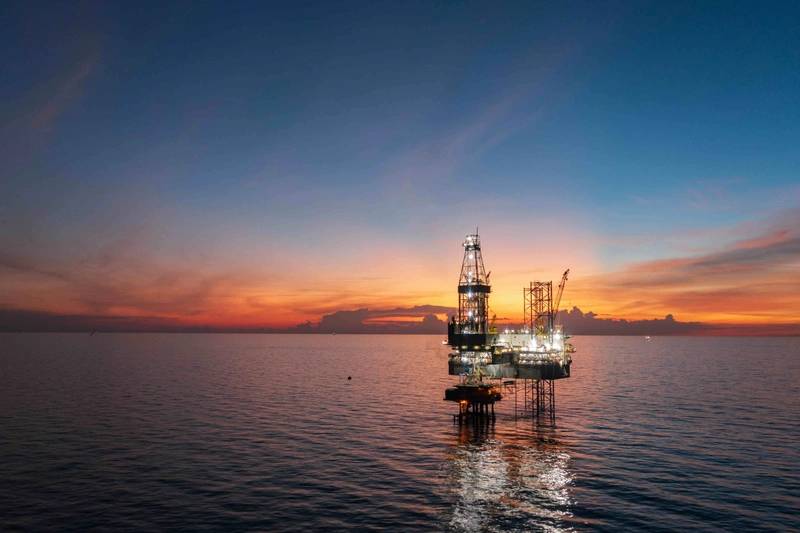
Slovakia is interested in receiving gas from Romania's Neptun Deep offshore project, with its supplies of Russian deliveries set to end next year, Slovak Prime Minister Robert Fico said on Friday.
"We expressed interest and said that if Romania intends to export this gas outside its own territory - that is, not use it only for its own consumption - Slovakia offers to use existing infrastructure and we will be interested in this gas on a commercial basis," Fico said in a televised briefing with Romanian Prime Minister Ilie Bolojan in Bucharest.
Hungary and Germany also are among the countries interested in gas from the Black Sea project, a Romanian official said last month, although it is hoped that the Romanian economy would use up as much of it as possible.
Neptun Deep is one of the European Union's most significant gas deposits, with an estimated 100 billion cubic metres of recoverable gas.
Jointly owned by Romanian oil and gas group OMV Petrom and state-owned gas producer Romgaz, the project is on track to deliver its first gas in 2027.
Slovakia has remained reliant on Russian oil and gas supplies despite EU efforts to end its energy dependence on Moscow, following Russia's 2022 invasion of Ukraine.
The EU is planning to phase out Russian gas imports by late 2027.
Slovakia took about a third of its gas from Russia last year, but is seeking to boost that level before the EU ban takes effect.
(Reuters)
Facts Only
Slovakia has expressed interest in importing gas from Romania’s Neptun Deep offshore project.
Slovak Prime Minister Robert Fico made the announcement during a televised briefing with Romanian Prime Minister Ilie Bolojan in Bucharest.
The Neptun Deep project is estimated to contain 100 billion cubic meters of recoverable gas.
The project is jointly owned by Romanian oil and gas group OMV Petrom and state-owned gas producer Romgaz.
First gas from Neptun Deep is expected in 2027.
Hungary and Germany have also shown interest in gas from the project.
Romania aims to prioritize domestic consumption of the gas.
Slovakia sourced about a third of its gas from Russia last year.
The EU plans to phase out Russian gas imports by late 2027.
Slovakia is seeking to secure alternative gas supplies before the EU ban takes effect.
Executive Summary
Slovakia has expressed interest in importing natural gas from Romania’s Neptun Deep offshore project, as its reliance on Russian gas is set to end next year. Slovak Prime Minister Robert Fico announced this during a meeting with Romanian Prime Minister Ilie Bolojan in Bucharest, emphasizing Slovakia’s readiness to use existing infrastructure for commercial gas imports. The Neptun Deep project, one of the EU’s largest gas deposits with an estimated 100 billion cubic meters of recoverable gas, is co-owned by OMV Petrom and Romgaz and is expected to begin production in 2027. Romania aims to prioritize domestic consumption but has acknowledged interest from other countries, including Hungary and Germany. Slovakia, which still sourced about a third of its gas from Russia last year, is seeking alternative supplies ahead of the EU’s planned phase-out of Russian gas imports by late 2027. The discussions highlight broader European efforts to diversify energy sources amid geopolitical tensions.
The situation reflects a strategic shift in Central and Eastern Europe’s energy landscape, with countries balancing domestic needs against regional cooperation. While Romania’s priority is to meet its own demand, the potential for cross-border gas trade underscores the economic and political stakes of energy security in the post-Ukraine invasion era. The timeline for Neptun Deep’s production aligns with the EU’s deadline to end Russian gas dependence, though uncertainties remain about whether the project can fully offset regional supply gaps.
Full Take
The strongest version of this narrative frames Slovakia’s interest in Neptun Deep as a pragmatic response to the EU’s energy transition, emphasizing regional cooperation and market-driven solutions. The article credibly highlights the geopolitical and economic pressures driving Slovakia’s pivot away from Russian gas, while acknowledging Romania’s dual role as both a potential supplier and a nation prioritizing its own energy security. The inclusion of Hungary and Germany as additional interested parties underscores the broader European scramble for alternative energy sources, a trend accelerated by the Ukraine war.
However, the narrative leans heavily on the assumption that Neptun Deep will be a seamless replacement for Russian gas, without interrogating potential bottlenecks—such as infrastructure limitations, production delays, or domestic political resistance in Romania to exporting its resources. The framing also subtly reinforces a "business-as-usual" tone, downplaying the systemic risks of over-reliance on a single new supplier or the environmental trade-offs of offshore gas extraction. The EU’s 2027 deadline for ending Russian gas imports is presented as a fixed constraint, though its feasibility remains debated among energy analysts.
At its core, this story reflects the tension between national sovereignty and collective energy security—a paradigm that has defined European energy policy since the Cold War. The unstated assumption is that market mechanisms and existing infrastructure will suffice to bridge supply gaps, yet history suggests such transitions are rarely smooth. The second-order implications are significant: if Neptun Deep fails to meet expectations, Slovakia and other Central European states may face energy shortages or renewed pressure to extend Russian contracts under the guise of "pragmatism." Meanwhile, Romania’s leverage as a gas producer could reshape regional power dynamics, potentially straining relations if domestic needs clash with export ambitions.
Bridge questions: How might Romania’s domestic politics—such as public opposition to resource extraction or debates over energy pricing—affect the viability of exports to Slovakia? What contingency plans exist if Neptun Deep’s production is delayed or underperforms? Could this push for regional gas trade inadvertently deepen dependencies on a new set of suppliers, replicating past vulnerabilities?
Counterstrike scan: A coordinated influence campaign might amplify the narrative of "seamless energy transition" to downplay risks, using selective data (e.g., emphasizing Neptun Deep’s potential while omitting infrastructure challenges) to create false confidence in EU energy independence. The actual content does not match this pattern, as it acknowledges uncertainties and competing interests. No structural alignment with manipulation tactics is detected.
Sentinel — Human
The article appears to be a human-written news piece about Slovakia's interest in purchasing gas from Romania, based on quotes attributed specifically to the country's Prime Minister Robert Fico.