Corporate accelerators have become commonplace, but relatively few consistently turn startup pilots into long-term commercial partnerships.
Aviation presents an even tougher test, where safety, regulation and operational complexity mean promising technologies can quickly unravel in practice.
Over the past decade, IAGi, the innovation arm of International Airlines Group (IAG), has developed a model designed to bridge that gap, helping startups validate technologies inside airlines including British Airways, Iberia, Aer Lingus and Vueling before scaling successful projects across the Group.
I spoke to Nisha Basson-Mugnier, innovation leader at International Airlines Group (IAG) to learn more.
Founded in 2016, IAGi has evolved into a multi-track innovation platform that supports startups from early validation through to commercial deployment. Working across six strategic areas — AI, automation and robotics, sustainability and mobility, experiential platforms, connectivity and next-generation computing, and cybersecurity — the programme connects emerging technologies with real business problems and priorities across the Group.
At its core is the IAGi Accelerator, an open innovation programme that pairs startups with IAG business units to run pilots in areas ranging from airport operations and customer experience to AI, robotics and sustainability.
Complementing the accelerator is IAG Ventures, the Group's corporate venture capital arm. Launched in March 2025, it plans to invest up to €200 million in high-potential startups over the coming years whose technologies have long-term strategic relevance to aviation — making it one of the largest corporate aviation venture funds globally and the biggest established by a European airline group.
Beyond the accelerator and investment activities, the innovation team works closely with IAG's airlines to identify business challenges, scout promising startups globally, and help successful pilots become commercial deployments across the Group.
Airlines decide, IAGi enables
Unlike many corporate innovation programmes, however, IAGi does not decide which startups move forward. The airlines themselves select which companies they want to work with, ensuring every pilot begins with a clearly defined operational need.
According to Basson-Mugnier, the programme is about finding the real challenges their airlines have.
“We work with the airlines to identify those problems, then we scout globally for startups that can solve them. We handle all scouting and invite the strongest startups to present at a series of Pitch Week sessions.
The airlines themselves decide which startups they want to work with. From there, we support those collaborations to help determine whether the startups can successfully solve those challenges.”
The IAGi Accelerator operates across two distinct tracks, designed to support startups at different stages of maturity. Deploy is a 12-week programme for companies with market-ready products, working directly with IAG's airlines and operating businesses to run proof-of-value projects in live operational environments.
Discover, meanwhile, is aimed at earlier-stage deeptech startups whose technologies are not yet ready for commercial deployment. Over a six-month programme, founders receive technical and commercial guidance from IAG and industry experts, helping them validate technologies such as sustainable aviation fuel, carbon removal and fuel-efficiency solutions before they reach the market.
When does a pilot become a commercial deployment?
I’m always interested in how many accelerator-style programs translate into financial opportunities rather than simply pilots. Basson-Mugnier asserts that across the aviation industry, proof-of-concept conversion rates tend to sit around 30 to 40 per cent. But she admits that while they are always thinking of how to improve these numbers, it's difficult to know what the ideal number should be.
“If our conversion rate was 80 per cent, I'd probably question whether we were genuinely testing innovation or simply acting as another procurement route.
Success for us isn't measured by the number of pilots we run. It's measured by the value we create for the airlines and how many proofs-of-concepts ultimately convert into longer-term collaborations.”
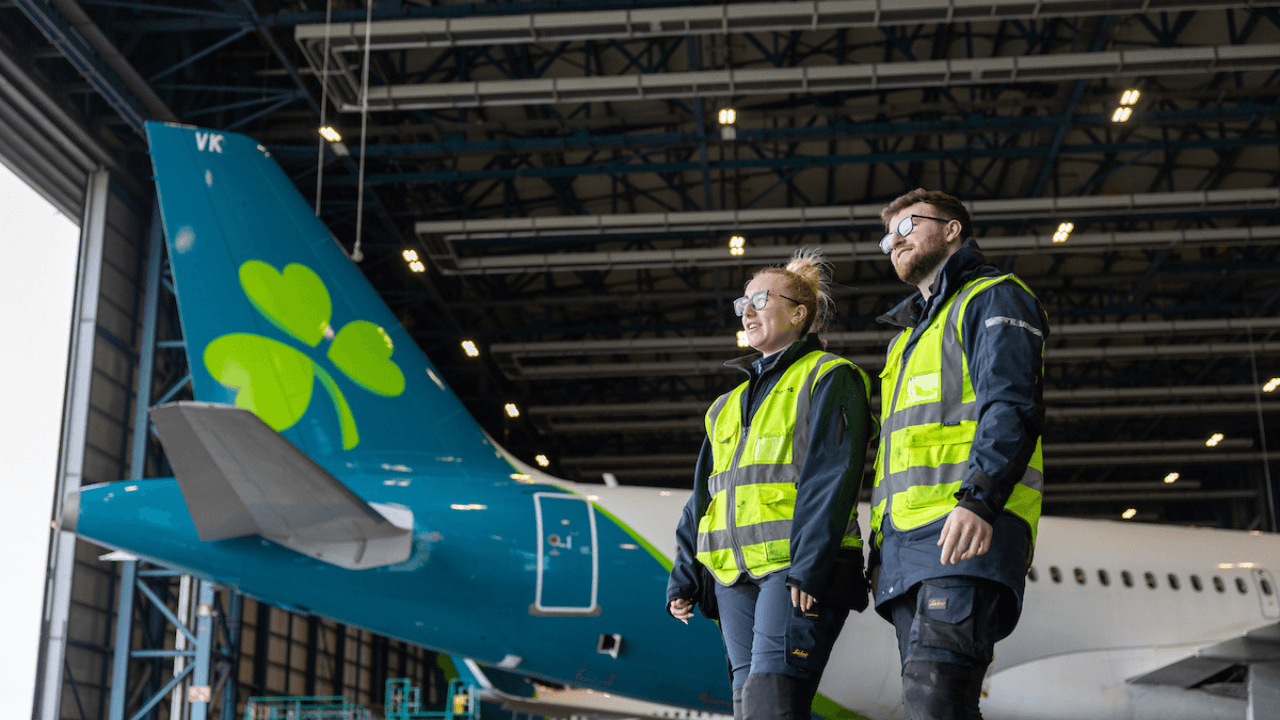
One success story, AISmartPlan joined IAG’s accelerator in 2025, partnering with Aer Lingus to test its technology in a live airline environment. Its platform replaces manual maintenance production planning with an intelligent, automated system that pulls together key operational data; from flight schedules and aircraft availability to workforce constraints, to generate optimised plans.
In just three months, the start-up transformed its platform from proof of concept into a working solution and is now part of Aer Lingus airline’s maintenance production planning.
Not every startup becomes an investment
Commercial deployment, however, doesn't automatically translate into venture investment.
While the accelerator team works closely with IAGi's venture arm, not every accelerator company is suitable for investment. Only around 10 per cent of accelerator startups receive investment from the Fund.
Basson-Mugnier explained:
“The Ventures team looks not only for financial returns but also for strategic value. They ask whether a company can solve meaningful problems for the airlines. There isn't always overlap between those objectives.”
Among the companies that have made that transition is Norwegian startup Wastefront , a tyre-to-fuel company, which plans to turn used tyres into Sustainable Aviation Fuel (SAF). The SAF will be made by converting waste tyres into tyre-derived oil, which is then refined into road fuels and SAF. The SAF produced is expected to give life cycle carbon emission savings of over 80 per cent versus fossil fuels.
Another is Swiss company Assaia, which uses computer vision to optimise aeroplane turnarounds, enabling more effective planning across airside operations. The company received investment from IAG post-accelerator completion and went on to raise $26.6 million Series B in 2025.
Hydrogen aviation company ZeroAvia followed a similar path. The company participated in IAG’s Hangar 51 accelerator to explore how hydrogen-powered aircraft can play a leading role in the future of sustainable flying. British Airways subsequently invested in ZeroAvia’s Series A round in 2021, followed by IAG investing in their Series B round in 2022.
Scaling across an airline group
In terms of scaling startup tech, the program thinks about whether a technology can solve multiple problems within a single airline. Another is whether it can solve the same problem across multiple airlines within the IAG group. She explained:
“A startup might pilot a solution with one airline and then expand to the others.
For example, British Airways might lead a pilot while the other airlines participate through project reviews, midpoint assessments or demonstration sessions before deciding whether to adopt the solution themselves.”
Ten years of lessons in aviation innovation
IAGi Accelerator is now in its tenth year. Looking back, Basson-Mugnier believes the early years were driven largely by excitement around technology itself as solutions were trialled that were interesting but were never really going to scale or deliver significant business impact.
“There was a lot of experimentation with things like VR headsets and improving premium cabin experiences, but ultimately those weren't solving major operational needs.”
She believes that the biggest lesson has been that “everything we do needs to address a meaningful business problem, with solutions which fit into airline operations.
“Airline operations are extremely complex. Sometimes a technology appears to be an excellent fit, but once you get into the operational details you uncover complexities that make adoption more difficult,” she explained.
She also cites proactiveness as a marker of successful teams:
“They spend time with the business, stay closely involved throughout the project and make the most of having direct access to subject matter experts within the airlines. That combination of strong solution fit and engaged founders makes a significant difference.”
Where IAGi sees the next wave of aviation technology
Those lessons are now shaping where IAGi is focusing its attention. Rather than experimenting for experimentation's sake, the team is prioritising technologies that can address measurable operational challenges. Operational AI, robotics, and fuel and flight efficiency are the biggest areas of interest right now.
Basson-Mugnier explained that beyond consumer-facing AI, startups are applying AI to very specific aviation problems and integrating directly into the software and systems airlines already use.
“Disruption management is a good example. When major disruptions occur, rebuilding a flying schedule is incredibly complex.
AI has huge potential to optimise those recovery processes by evaluating many scenarios much more quickly than people can.”
IAGi is also seeing increased activity around fuel optimisation and flight efficiency, and automation and robotics are another major focus.
“Those are longer-term deep-tech opportunities that naturally take longer to deploy, but they're foundational technologies that airlines will need in the future,” she shared.
How startups can apply
In terms of applications, Basson-Mugnier explained that the team is trying to understand “the technology, what makes it proprietary, what the development team is building, and most importantly, where the founders believe their solution can create value for an airline. That's really the conversation we want to have.”
With more than 70 active business challenges across the Group, Basson-Mugnier says startups don't need to wait for the next formal accelerator cohort if their technology addresses a genuine need for airlines.
Lead image: AISmartPlan partnering with Aer Lingus to test its technology in a live airline environment.
Would you like to write the first comment?
Login to post comments
Sentinel — Human
This text reads as high-quality, context-aware business journalism, skillfully synthesizing proprietary information and expert opinion on corporate innovation within the aviation sector.