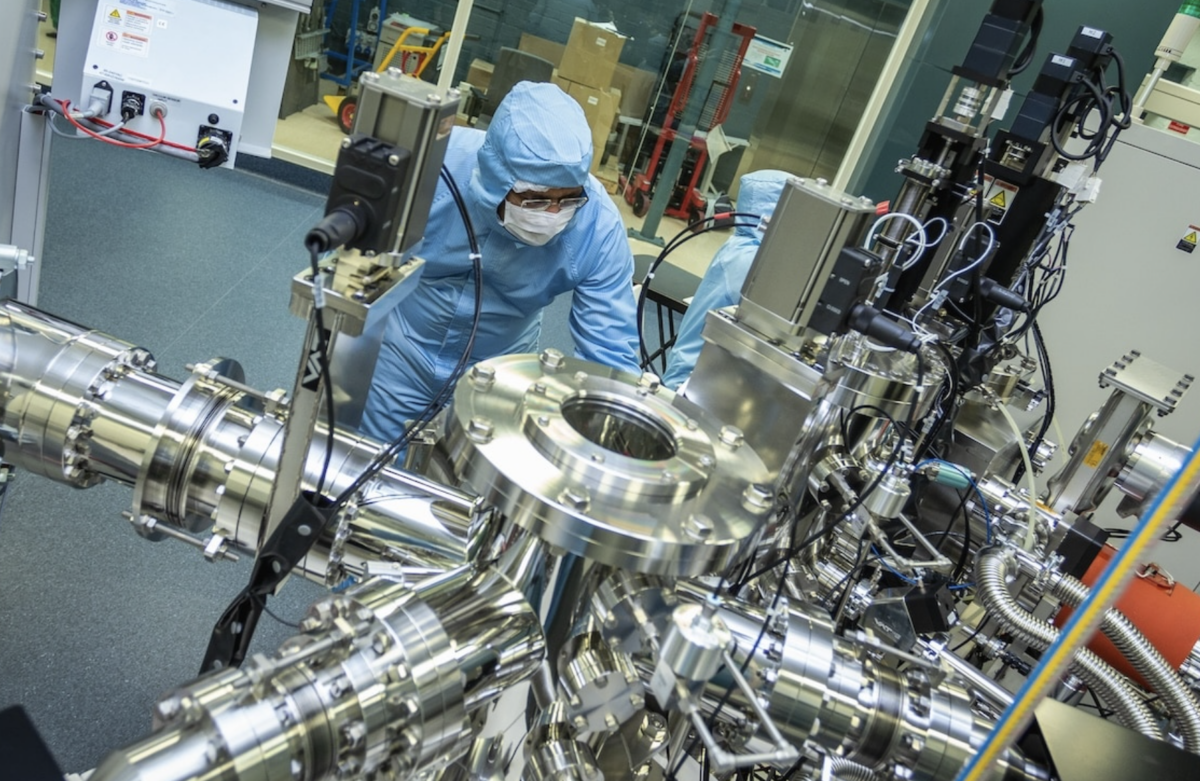
Scientists from CSIRO – Australia’s national science agency – in cooperation with RMIT University and the University of Melbourne, have developed the first proof-of-concept quantum battery, that demonstrates the potential for rapid, scalable charging and energy storage based on the principle of collective quantum effects.
Similar to conventional batteries, the quantum version charges, stores and discharges energy – and is the first to do so. Though far from commercial grade, it could one day transform how energy is stored and used.
Research lead, CSIRO quantum science and technical science head Dr James Quach said his ultimate ambition is a future where electric cars charge much faster than fuel petrol cars, or charge devices over long distances wirelessly.
“Our findings confirm a fundamental quantum effect that’s completely counterintuitive: quantum batteries charge faster as they get larger. Today’s batteries don’t function like that,” Quach said. “The research validates the exciting potential of quantum batteries for unprecedented efficient and rapid energy storage.”
The CSIRO describes the prototype as the world’s first fully functioning proof-of-concept quantum battery engineered by CSIRO and collaborators, The University of Melbourne and RMIT.
Unique properties
CSIRO said quantum batteries leverage unique properties of quantum mechanics such as superposition and entanglement, while contemporary batteries typically rely on chemical reactions.
“The battery the researchers engineered has a multi-layered organic microcavity and is wirelessly charged with a laser,” CSIRO said. “The team used advanced spectroscopy techniques to confirm the prototype’s charging behaviour, which showed it retained stored energy for six orders of magnitude longer than it took to charge.”
In an article authored by Quach in The Conversation, he explained a counterintuitive twist to quantum battery storage unit behavior, where the units charge faster together than if they were charging alone.
“Let’s say your quantum battery has N storage units, and each unit takes one second to charge. Collective effects mean that if all units are charged at once, each unit will take only 1∕√N seconds to charge,” Quach wrote.
The research also demonstrates rapid, scalable charging and energy storage at room temperature, laying the groundwork for next-generation energy solutions.
“While there’s still much work to be done in quantum battery research, we’ve made an important move towards realising the possibilities,” Quach said. “The next step for quantum batteries right now is extending their energy storage time. If we can overcome that hurdle, we’d be that bit closer to commercially viable quantum batteries.”
The research findings are published in the Light: Science and Applications journal, titled “Superextensive electrical power from a quantum battery.”
CSIRO is seeking interest from potential development partners.
Dr James Quach, CSIRO’s quantum battery research lead
Image: CSIRO
This content is protected by copyright and may not be reused. If you want to cooperate with us and would like to reuse some of our content, please contact: editors@pv-magazine.com.
By submitting this form you agree to pv magazine using your data for the purposes of publishing your comment.
Your personal data will only be disclosed or otherwise transmitted to third parties for the purposes of spam filtering or if this is necessary for technical maintenance of the website. Any other transfer to third parties will not take place unless this is justified on the basis of applicable data protection regulations or if pv magazine is legally obliged to do so.
You may revoke this consent at any time with effect for the future, in which case your personal data will be deleted immediately. Otherwise, your data will be deleted if pv magazine has processed your request or the purpose of data storage is fulfilled.
Further information on data privacy can be found in our Data Protection Policy.
Facts Only
* CSIRO, RMIT University, and the University of Melbourne collaborated on the project.
* The research resulted in a proof-of-concept quantum battery.
* The battery demonstrates charging based on collective quantum effects.
* Charging speed increases as the battery size grows.
* The prototype uses a multi-layered organic microcavity and is wirelessly charged with a laser.
* Spectroscopic techniques confirmed the charging behaviour.
* The battery retains stored energy for six orders of magnitude longer than it takes to charge.
* The prototype is the world's first fully functioning proof-of-concept quantum battery of this type.
* The research is published in Light: Science and Applications journal.
* CSIRO is seeking development partners.
* Dr. James Quach is the research lead.
Executive Summary
Full Take
The article presents a cautiously optimistic assessment of a nascent technology – quantum batteries – utilizing a classic “big is better” scaling effect observed in quantum systems. The core narrative is framed around a technological leap, particularly in the context of electric vehicle charging, leveraging familiar desires for speed and convenience. This immediately invokes ARC-0043 Motte-and-Bailey – presenting a seemingly radical claim (faster charging as size increases) while subtly grounding it in established quantum principles, diminishing perceived skepticism. The focus on "unprecedented efficient and rapid energy storage" is a classic attempt to create a compelling vision, potentially masking the considerable technological hurdles that remain. The lengthy charging retention time (six orders of magnitude) is a deliberate hyperbole designed to generate excitement, a tactic frequently deployed in early-stage technology narratives. The reliance on "quantum mechanics" is a critical framing device; the term itself is often used as a synonym for “advanced science,” carrying inherent prestige and obscuring the underlying complexity. The emphasis on "wireless charging" taps into broader trends and desires for seamless connectivity, further amplifying the appeal. The shift to Dr. Quach’s “Conversation” article highlighting the counterintuitive charging behavior suggests a deliberate effort to pre-emptively address potential criticism or misunderstanding, anticipating questions before they arise. Finally, the call for “development partners” represents a standard strategic move to attract investment and accelerate the commercialization process, subtly shifting the narrative towards a future shaped by industry collaboration.
Patterns detected: ARC-0043 Motte-and-Bailey, ARC-0024 Ambiguity, ARC-0018 Vision-Building
Sentinel — Human
This article presents a research update on the development of a quantum battery prototype, highlighting its potential benefits. The writing style is carefully constructed and relies heavily on attribution, suggesting a human-authored piece rather than AI-generated content, although the level of detail could be increased to improve the analysis.