Introduction
The number of people living with dementia globally is expected to reach 150 million by 2050, of whom two-thirds will live in the low- and middle-income countries (LMICs).1 Risk of dementia is declining in some high-income countries (HICs) (eg, Europe and USA), but stable or increasing elsewhere.2 The potential for prevention in LMICs is large. In an analysis of cross-sectional data, Mukadam and collaborators3 found that the overall proportion attributable fraction—the proportion of disease cases that would not occur if certain risk factors were eliminated—for dementia related potentially modifiable risk factors was 39.5% for China, 41.6% for India and 55.8% in Latin America.
The cost of dementia care globally has been estimated to be around US$1.3 trillion, with informal care representing 49.6% of total costs.4 In the case of LMICs, this percentage is higher, reaching 58% of total care costs.5 A recent review estimated that dementia care in these regions can cost from US$479.0 to US$66 143.6 PPP (dollar purchasing power parities) per year for a single patient.6
Despite promising results from trials of disease modifying treatments for prodromal and mild Alzheimer’s disease, dementia risk reduction and prevention is the mainstay of national and international policies, including the G8 and WHO, to reduce the global dementia burden.7
Dementia is often preceded by a prodromal stage of subjective cognitive complaints (SCCs)—where people perceive a decline in their cognitive performance, and/or mild cognitive impairment (MCI), where there is an objective cognitive impairment not meeting criteria for dementia diagnosis.8 In LMICs, prevalence of MCI varies between 6.1% and 30.4%, with approximately 23.8% of people with MCI at risk of Alzheimer’s disease over 3.0–5.8 years of follow-up.9 10 McGrattan highlighted the importance of identifying individuals with cognitive impairment who are at highest risk of dementia in LMICs in order to target risk reduction strategies. A previous systematic review highlighted the moderate effectiveness of lifestyle interventions in reducing cognitive decline, particularly in people with MCI.11
The Finnish Geriatric Intervention Study to Prevent Cognitive Impairment and Disability (FINGER) trial demonstrated significantly improved cognition in participants aged between 60 and 77 years with vascular risk factors, who received a multicomponent intervention (diet, exercise, cognitive training, vascular risk monitoring) relative to a control group over 2 years.12 These findings are not yet replicated, and no currently available interventions, with proven efficacy, have been demonstrated to reduce dementia cases or to be scalable to whole populations.13 This intervention was intensive and complex; only 37% of intervention arm participants adhered to at least half of planned activities across four domains (exercise, diet, vascular and cognitive training components). As greater baseline cognitive impairment predicted intervention non-adherence, the authors suggest that additional tailored support for participants at risk of low adherence, which would include those with cognitive concerns, may improve outcomes.14
There are increasing efforts to adapt and test multi-modal prevention interventions focusing on lifestyle changes for people at risk of dementia developed in HICs across LMICs. For example, the global ‘World-Wide FINGERS’ initiative is implementing the FINGER multimodal intervention model in Latin America, Africa and China, in people at risk of dementia with and without cognitive symptoms, though there is evidence needs of these groups may differ.15 Economic disparities directly affect access to preventive healthcare, making solutions difficult to design.16 Optimism regarding dementia prevention is mitigated by the challenges of large-scale implementation, especially in countries with limited resources,17 where socio-economic contexts often hamper implementation of preventive strategies.18
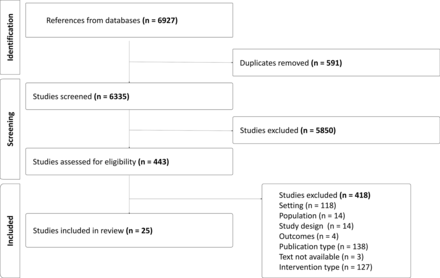
Interventions are more likely to be implemented successfully if the contexts in which they are to be used are considered throughout the development process. We systematically reviewed randomised controlled trials (RCTs) evaluating non-pharmacological interventions in individuals with MCI and subjective cognitive decline (SCC) in LMICs.
Sentinel — Human
This text functions as a high-level academic synthesis, characterized by structured argument and grounded statistical reference, strongly suggesting human authorship or expert structuring rather than pure synthetic generation.