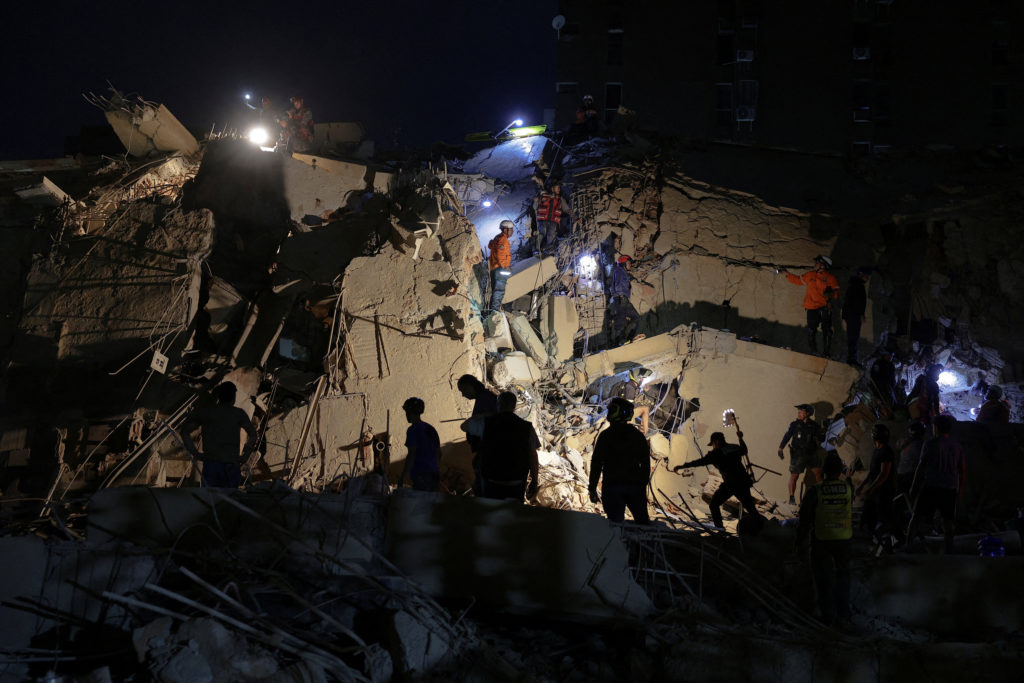
By — Regina Garcia Cano, Associated Press Regina Garcia Cano, Associated Press Leave your feedback Share Copy URL https://www.pbs.org/newshour/world/back-to-back-powerful-earthquakes-slam-venezuela-collapsing-buildings-in-the-capital-of-caracas Email Facebook Twitter LinkedIn Pinterest Tumblr Share on Facebook Share on Twitter Back-to-back powerful earthquakes slam Venezuela, collapsing buildings in the capital of Caracas World Jun 24, 2026 9:44 PM EDT CARACAS, Venezuela (AP) — Back-to-back powerful earthquakes slammed Venezuela on Wednesday evening, collapsing buildings in the capital of Caracas and leaving residents shaken. The U.S. Geological Survey said the first earthquake had a magnitude of 7.1 and its epicenter was west of the community of Morón, located along the country's Caribbean coast, about 168 kilometers (104 miles) west of Caracas. The quake had a depth of 22 kilometers. The USGS reported an even larger 7.5-magnitude earthquake just a minute later. The second quake had a depth of 10 kilometers and its epicenter was 16 kilometers (10 miles) southwest of Morón. The quakes are among the strongest to strike Venezuela in more than a century. The earthquakes struck shortly after 6 p.m. local time. People evacuated swaying buildings in Caracas and remained outside, many visibly shocked as they saw entire walls that had collapsed, making furniture visible from the street. Dust columns could also be seen in two neighborhoods of the capital, where restaurants and other businesses are typically busy. People remained on the streets after sunset. Some sat on the ground hugging their pets as dust gathered around them. "It started off gently and then gradually grew, and in the end, we all had to leave our houses, go outside and gather together," Caracas resident Hector Ricci said. Interior Minister Diosdado Cabello said the quake could be felt in several states. The Altamira neighborhood in Caracas had "alarming situations" with collapsed homes and buildings, he said, suggesting people were injured in the earthquake and asking motorists to give way to ambulances and other emergency vehicles. "We understand that some people may be desperate, but we are acting according to protocols to activate aid and rescue efforts to help those who need it most," Cabello said on state television. "Be very careful with children and the elderly; call each other and check that no one has been harmed." He also urged people to remain outside as aftershocks could further damage some structures. "The building really shook from side to side. Unreal. The force was incredibly strong," Caracas resident Roberto Gamas said. "We were walking and it was tossing us around. Everything in the apartment fell. Well, thank God we were able to get out." The U.S. Pacific Tsunami Warning Center issued a tsunami alert for Virgin Islands. Authorities in the Dominican Republic also issued one for the island. Another alert for Puerto Rico was quickly lifted. Strong earthquakes are unusual in Venezuela. While the country sits near multiple fault lines, its position straddling the South American and Caribbean plates makes earthquakes much less common than in other parts of Latin America. Along the Pacific coast — in Mexico and Chile, for example — earthquakes are frequent; the two countries sit along the seismically active tectonic belt known as the "Pacific Ring of Fire," responsible for 90% of earthquakes, according to the USGS. Garcia Cano reported from Bogota, Colombia. Anna-Catherine Brigada contributed from Mexico City. A free press is a cornerstone of a healthy democracy. Support trusted journalism and civil dialogue. Donate now By — Regina Garcia Cano, Associated Press Regina Garcia Cano, Associated Press
CARACAS, Venezuela (AP) — Back-to-back powerful earthquakes slammed Venezuela on Wednesday evening, collapsing buildings in the capital of Caracas and leaving residents shaken. The U.S. Geological Survey said the first earthquake had a magnitude of 7.1 and its epicenter was west of the community of Morón, located along the country's Caribbean coast, about 168 kilometers (104 miles) west of Caracas. The quake had a depth of 22 kilometers. The USGS reported an even larger 7.5-magnitude earthquake just a minute later. The second quake had a depth of 10 kilometers and its epicenter was 16 kilometers (10 miles) southwest of Morón. The quakes are among the strongest to strike Venezuela in more than a century. The earthquakes struck shortly after 6 p.m. local time. People evacuated swaying buildings in Caracas and remained outside, many visibly shocked as they saw entire walls that had collapsed, making furniture visible from the street. Dust columns could also be seen in two neighborhoods of the capital, where restaurants and other businesses are typically busy. People remained on the streets after sunset. Some sat on the ground hugging their pets as dust gathered around them. "It started off gently and then gradually grew, and in the end, we all had to leave our houses, go outside and gather together," Caracas resident Hector Ricci said. Interior Minister Diosdado Cabello said the quake could be felt in several states. The Altamira neighborhood in Caracas had "alarming situations" with collapsed homes and buildings, he said, suggesting people were injured in the earthquake and asking motorists to give way to ambulances and other emergency vehicles. "We understand that some people may be desperate, but we are acting according to protocols to activate aid and rescue efforts to help those who need it most," Cabello said on state television. "Be very careful with children and the elderly; call each other and check that no one has been harmed." He also urged people to remain outside as aftershocks could further damage some structures. "The building really shook from side to side. Unreal. The force was incredibly strong," Caracas resident Roberto Gamas said. "We were walking and it was tossing us around. Everything in the apartment fell. Well, thank God we were able to get out." The U.S. Pacific Tsunami Warning Center issued a tsunami alert for Virgin Islands. Authorities in the Dominican Republic also issued one for the island. Another alert for Puerto Rico was quickly lifted. Strong earthquakes are unusual in Venezuela. While the country sits near multiple fault lines, its position straddling the South American and Caribbean plates makes earthquakes much less common than in other parts of Latin America. Along the Pacific coast — in Mexico and Chile, for example — earthquakes are frequent; the two countries sit along the seismically active tectonic belt known as the "Pacific Ring of Fire," responsible for 90% of earthquakes, according to the USGS. Garcia Cano reported from Bogota, Colombia. Anna-Catherine Brigada contributed from Mexico City. A free press is a cornerstone of a healthy democracy. Support trusted journalism and civil dialogue. Donate now
Facts Only
* A 7.1-magnitude earthquake occurred first, with its epicenter west of Morón, 168 kilometers from Caracas.
* The first quake had a depth of 22 kilometers.
* A second, larger earthquake of magnitude 7.5 occurred one minute later.
* The second quake had a depth of 10 kilometers and was located 16 kilometers southwest of Morón.
* The quakes struck shortly after 6 p.m. local time in Caracas.
* Buildings in Caracas collapsed, making furniture visible on the streets.
* Dust columns were observed in two neighborhoods of Caracas.
* Interior Minister Diosdado Cabello reported "alarming situations" and urged people to remain outside due to potential aftershocks.
* Residents reported strong shaking and structural failure.
* The U.S. Pacific Tsunami Warning Center issued alerts for the Virgin Islands, Dominican Republic, and Puerto Rico.
* The earthquakes are among the strongest in Venezuela in more than a century.
Executive Summary
Sentinel — Human
This text exhibits the clear hallmarks of professional journalistic reporting, utilizing diverse source material and human voices to convey factual events and emotional impact.