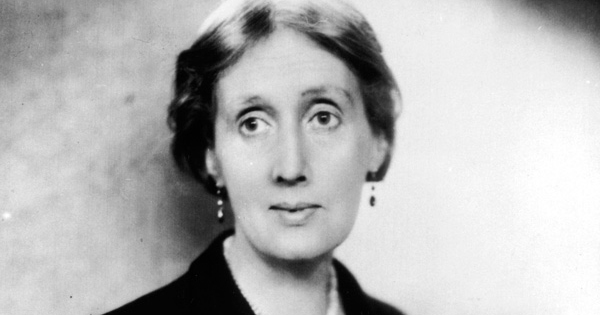
By Maria Popova
It is an ongoing mystery: What makes you and your childhood self the same person. Across a lifetime of physiological and psychological change, some center holds. Eudora Welty called it “the continuous thread of revelation.” Walt Whitman saw it as something “independent, lifted out from all else, calm, like the stars, shining eternal.” Complexity theory traces it to the quantum foam.
The best shorthand we have for it is soul.
“One can’t write directly about the soul. Looked at, it vanishes,” Virginia Woolf (January 25, 1882–March 28, 1941) lamented in her diary. But writing directly about the soul, and with tremendous insight, is precisely what she does in a wonderful essay about the essays of Montaigne — his epochal “attempt to communicate a soul,” a “miraculous adjustment of all these wayward parts that constitute the human soul” — included in her classic Common Reader (public library).
Contemplating the soul — that most private part of us — as “so complex, so indefinite, corresponding so little to the version which does duty for her in public,” she writes:
Beyond the difficulty of communicating oneself, there is the supreme difficulty of being oneself. This soul, or life within us, by no means agrees with the life outside us. If one has the courage to ask her what she thinks, she is always saying the very opposite to what other people say.
That courage is what Whitman celebrated when he decreed to “dismiss whatever insults your own soul, and your very flesh shall be a great poem.” Only by listening to the voice of the soul — a voice by definition nonconformist, rising above the din of convention and expectation and should — do we become fully and happily ourselves. To be aware of ourselves is to hear that voice. To be content in ourselves is to listen to it. Woolf writes:
The man* who is aware of himself is henceforward independent; and he is never bored, and life is only too short, and he is steeped through and through with a profound yet temperate happiness. He alone lives, while other people, slaves of ceremony, let life slip past them in a kind of dream. Once conform, once do what other people do because they do it, and a lethargy steals over all the finer nerves and faculties of the soul. She becomes all outer show and inward emptiness; dull, callous, and indifferent.
Observing that the souls we most wish to resemble “are always the supplest” — for “a self that goes on changing is a self that goes on living” — Woolf arrives at what it takes to be fully oneself:
Let us simmer over our incalculable cauldron, our enthralling confusion, our hotch-potch of impulses, our perpetual miracle — for the soul throws up wonders every second. Movement and change are the essence of our being; rigidity is death; conformity is death: let us say what comes into our heads, repeat ourselves, contradict ourselves, fling out the wildest nonsense, and follow the most fantastic fancies without caring what the world does or thinks or says.
Complement with E.E. Cummings on the courage to be yourself, Tracy K. Smith’s short, splendid poem “The Everlasting Self,” and the poetic science of how we went from cells to souls, then revisit Woolf on self-knowledge, the remedy for self-doubt, the relationship between loneliness and creativity, what makes love last, the consolations of growing older, and her epiphany about the meaning of creativity.
—
Published March 28, 2026
—
https://www.themarginalian.org/2026/03/28/virginia-woolf-soul/
—
ABOUT
CONTACT
SUPPORT
SUBSCRIBE
Newsletter
RSS
CONNECT
Facebook
Twitter
Instagram
Tumblr
Facts Only
Virginia Woolf was born on January 25, 1882, and died on March 28, 1941.
Woolf wrote an essay about the essays of Montaigne, included in her book *The Common Reader*.
Montaigne's work is described as an "attempt to communicate a soul."
Woolf's essay discusses the difficulty of communicating and being oneself.
She describes the soul as complex and often contradictory to external expectations.
Woolf argues that listening to one's inner voice leads to independence and happiness.
She states that conformity dulls the soul and leads to emptiness.
Woolf believes the self is dynamic and should embrace change and spontaneity.
The article references Walt Whitman's idea of dismissing what insults the soul.
It also mentions E.E. Cummings and Tracy K. Smith as thinkers who explored similar themes.
The piece was published on March 28, 2026, on *The Marginalian*.
Woolf's other works cited include her thoughts on self-knowledge, creativity, and aging.
Executive Summary
Virginia Woolf's reflections on the soul and selfhood, drawn from her essay on Montaigne's work, emphasize the challenge of both understanding and expressing one's inner self. She describes the soul as a complex, ever-changing entity that often contradicts societal expectations, requiring courage to acknowledge and follow. Woolf argues that true happiness and independence come from listening to this inner voice, while conformity leads to a hollow, unfulfilled existence. She celebrates the dynamic nature of the self, urging individuals to embrace their contradictions and spontaneous thoughts without fear of judgment. The piece also references other thinkers like Walt Whitman and E.E. Cummings, who similarly championed the importance of self-trust and authenticity. Woolf's perspective aligns with broader philosophical and literary traditions that view self-knowledge as essential to a meaningful life, though the article does not explore counterarguments or alternative views on the nature of the soul or selfhood.
The discussion is framed within Woolf's broader body of work, which often explores themes of identity, creativity, and the human condition. While the article presents her ideas as timeless and universally applicable, it does not address potential critiques, such as whether the concept of the soul is culturally or historically contingent. The focus remains on the individual's struggle to remain true to themselves amid external pressures, a theme that resonates across literature and philosophy.
Full Take
This analysis of Virginia Woolf's ideas on the soul and selfhood presents a compelling case for the importance of inner authenticity, but it also invites deeper scrutiny. The strongest version of this narrative is its emphasis on individual agency and the courage to resist conformity, a theme that resonates across philosophical and literary traditions. Woolf's argument that the soul is a dynamic, nonconformist force aligns with existentialist and humanist ideals, offering a powerful counter to societal pressures that demand uniformity. However, the piece does not engage with potential critiques, such as whether the concept of the soul is culturally specific or whether selfhood is as fluid as Woolf suggests.
Pattern scan: The article leans heavily on emotional appeal, using evocative language to celebrate the soul's "perpetual miracle" and the dangers of conformity. While this is not inherently manipulative, it risks oversimplifying the complexities of identity and self-expression. The lack of counterarguments or alternative perspectives could be seen as a form of selective framing, though it does not rise to the level of a formal manipulation pattern. No clear A.R.C. patterns are detected, as the piece appears to be a genuine exploration of Woolf's ideas rather than a coordinated influence campaign.
Root cause: The narrative is driven by a humanist paradigm that prioritizes individualism and self-discovery. It assumes that the soul is a coherent, knowable entity and that societal expectations are inherently stifling. This echoes Romantic and transcendentalist traditions, which often position the individual against oppressive social structures. However, it does not address whether these structures might also provide necessary frameworks for meaning and connection.
Implications: The emphasis on inner authenticity could empower individuals to resist oppressive norms, but it might also overlook the ways in which identity is shaped by community and context. Who benefits? Those who have the privilege to define themselves outside societal constraints. Who bears costs? Potentially those who rely on shared norms for stability or belonging. Second-order consequences could include a further atomization of society, where individualism trumps collective responsibility.
Bridge questions: How might Woolf's ideas apply in cultures where the self is defined more relationally than individually? What role do external structures play in shaping a meaningful life, and can they coexist with inner authenticity? What evidence would challenge the assumption that the soul is a fixed or knowable entity?
Counterstrike scan: If this were part of a coordinated influence campaign, the playbook might involve amplifying individualism to undermine collective action or social cohesion. However, the content does not match this pattern, as it appears to be a sincere engagement with Woolf's philosophical ideas rather than a strategic manipulation.
Sentinel — Human
The analyzed text shows signs of a human author. The erratic sentence length variance and the presence of idiosyncratic emphasis and personal voice indicate that the article is likely to be human-written.