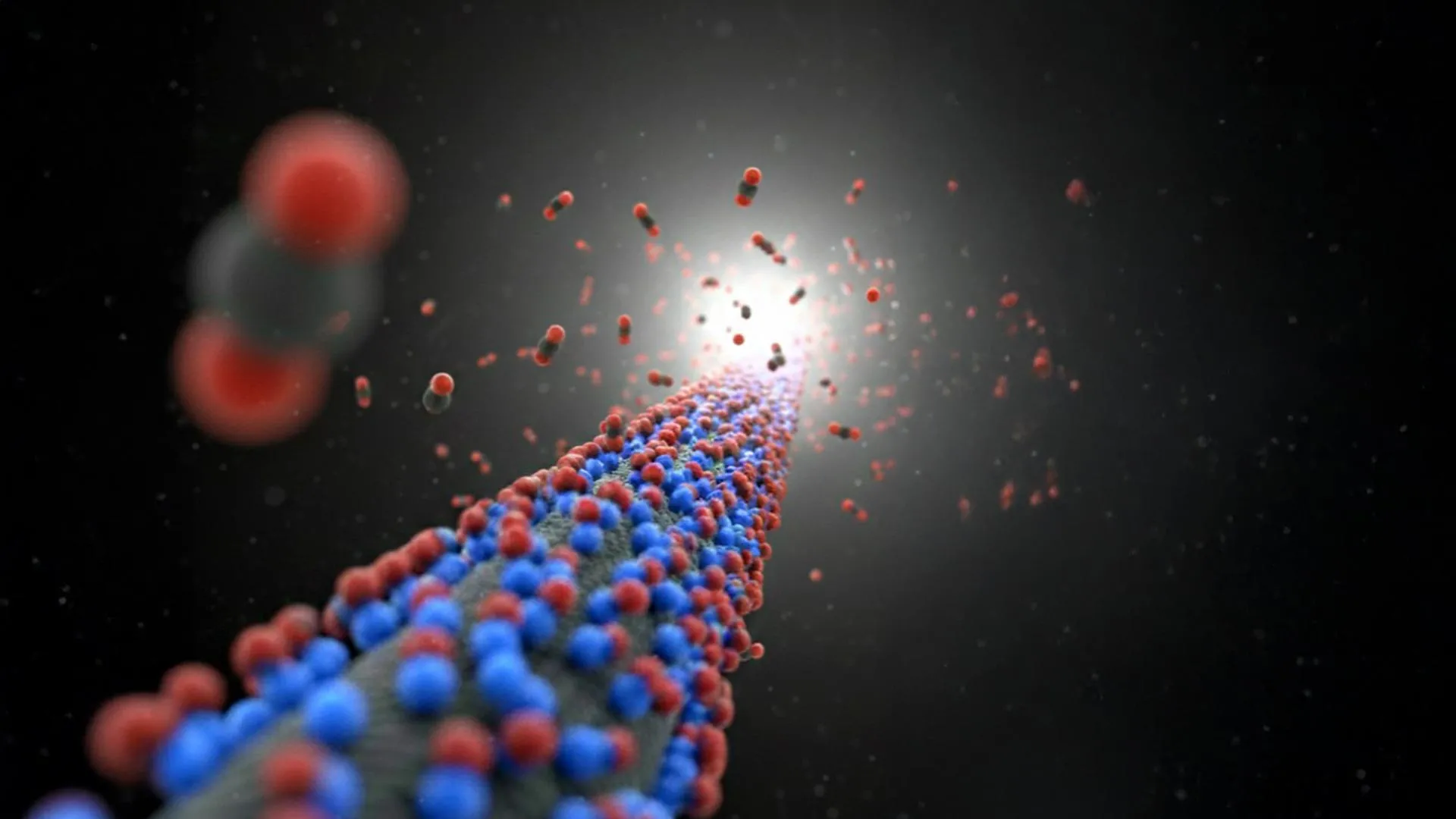
A cleverly redesigned carbon material could make capturing CO2 far cheaper by releasing it with minimal heat.
- Date:
- March 28, 2026
- Source:
- Chiba University
- Summary:
- Scientists have created a new kind of carbon material that could make carbon capture much cheaper and more efficient. By carefully controlling how nitrogen atoms are arranged, they found certain structures capture CO2 better and release it using far less heat. One version works at temperatures below 60 °C, meaning it could run on waste heat instead of costly energy. The discovery offers a powerful new blueprint for next-generation climate technology.
- Share:
Stopping carbon dioxide (CO2) before it enters the atmosphere is a critical way to cut greenhouse gas emissions. While carbon capture has been around for many years, it has not been widely adopted because most systems are costly and inefficient. A common industrial approach, aqueous amine scrubbing, requires heating large amounts of liquid to temperatures above 100 °C to release the captured CO2 and reuse the solution. This high energy demand drives up operating costs and makes large-scale use difficult.
Solid carbon materials have gained attention as a more practical option. These materials are relatively inexpensive and have a large surface area that allows them to trap CO2. They can also release the gas using less heat, especially when they contain nitrogen-based functional groups. However, there has been a key limitation. Traditional manufacturing methods place these nitrogen groups randomly across the material, making it hard to pinpoint which specific arrangements lead to better performance.
To address this challenge, a research team led by Associate Professor Yasuhiro Yamada from the Graduate School of Engineering and Associate Professor Tomonori Ohba from the Graduate School of Science at Chiba University, Japan, developed a new type of carbon material called 'viciazites.' These materials are designed with nitrogen groups positioned next to each other in a controlled way. The study, published in the journal Carbon, was co-authored by Mr. Kota Kondo, also from Chiba University.
Building Viciazites With Controlled Nitrogen Pairing
The researchers created three different versions of viciazites, each with a unique type of neighboring nitrogen configuration. To produce adjacent primary amine groups (-NH2 groups), they first heated a compound called coronene, then treated it with bromine, followed by ammonia gas. This three-step method achieved 76% selectivity, meaning most of the nitrogen atoms were placed in the intended positions.
Two additional materials were produced using different starting compounds. One featured adjacent pyrrolic nitrogen with 82% selectivity, while the other contained adjacent pyridinic nitrogen with 60% selectivity.
Verifying Structure and Testing Performance
Each material was applied to activated carbon fibers to create usable samples. The team confirmed the precise placement of nitrogen groups using techniques such as nuclear magnetic resonance spectroscopy, X-ray photoelectron spectroscopy, and computational modeling. These methods verified that the nitrogen atoms were positioned side by side rather than randomly distributed.
When tested, the materials showed clear performance differences. Samples with adjacent -NH2 groups and pyrrolic nitrogen captured more CO2 than untreated carbon fibers. In contrast, the pyridinic nitrogen configuration offered little improvement.
Low-Temperature CO2 Release Could Cut Energy Use
The most notable finding involved how easily the materials released CO2. "Performance evaluation revealed that in carbon materials where NH2 groups are introduced adjacently, most of the adsorbed CO2 desorbs at temperatures below 60 °C. By combining this property with industrial waste heat, it may be possible to achieve efficient CO2 capture processes with substantially reduced operating costs," highlights Dr. Yamada.
The material containing pyrrolic nitrogen required higher temperatures to release CO2, but it may offer better long-term stability due to its stronger chemical structure.
A New Path Toward Cost-Effective Carbon Capture
This work shows that arranging nitrogen groups in specific adjacent patterns can be done reliably, providing a clear strategy for designing improved carbon capture materials. "Our motivation is to contribute to the future society and to utilize our recently developed carbon materials with controlled structures. This work provides validated pathways to synthesize designer nitrogen-doped carbon materials, offering the molecular-level control essential for developing next-generation, cost-effective, and advanced CO2 capture technologies," concludes Dr. Yamada.
Beyond capturing CO2, these viciazite materials could also be used for other applications, including removing metal ions or serving as catalysts, thanks to their customizable surface properties.
Funding and Support
This work was supported by Mukai Science and Technology Foundation, Japan Society for the Promotion of Science (JSPS KAKENHI Grant Number JP24K01251), and the "Advanced Research Infrastructure for Materials and Nanotechnology in Japan (ARIM)" of the Ministry of Education, Culture, Sports, Science and Technology (MEXT) under Grant Number JPMXP1225JI0008.
Story Source:
Materials provided by Chiba University. Note: Content may be edited for style and length.
Journal Reference:
- Kota Kondo, Ayane Uchizono, Lizhi Pu, Itsuki Takahashi, Ryoshin Suzuki, Sota Nakamura, Kai Kan, Kazuma Gotoh, Tetsuro Soejima, Satoshi Sato, Tomonori Ohba, Yasuhiro Yamada. Viciazites: Carbon materials with adjacent nitrogen functionalities for advanced CO2 capture. Carbon, 2026; 254: 121405 DOI: 10.1016/j.carbon.2026.121405
Cite This Page:
Facts Only
Researchers at Chiba University in Japan developed a new carbon material called "viciazites."
The study was led by Associate Professor Yasuhiro Yamada and Associate Professor Tomonori Ohba.
The research was published in the journal *Carbon* in 2026.
Three versions of viciazites were created, each with different adjacent nitrogen configurations.
One version achieved 76% selectivity for adjacent primary amine (-NH₂) groups.
Another version featured adjacent pyrrolic nitrogen with 82% selectivity.
A third version contained adjacent pyridinic nitrogen with 60% selectivity.
Materials with adjacent -NH₂ groups released CO₂ at temperatures below 60°C.
The pyrrolic nitrogen configuration required higher temperatures for CO₂ release.
The pyridinic nitrogen configuration showed minimal improvement in CO₂ capture.
The study was funded by the Mukai Science and Technology Foundation, JSPS KAKENHI, and MEXT.
The research team included Kota Kondo, Ayane Uchizono, and other collaborators from Chiba University.
Executive Summary
Full Take
This development in carbon capture technology presents a compelling case for how material science can address climate challenges. The strongest version of this narrative is that targeted molecular design—specifically, controlling nitrogen atom placement in carbon materials—can drastically reduce the energy costs of CO₂ capture, making it more scalable. The researchers deserve credit for demonstrating a clear link between structural precision and performance, offering a reproducible method for creating these materials.
However, several questions remain. While the lab results are promising, real-world deployment will face challenges in scaling production, maintaining performance over time, and integrating with existing industrial systems. The article highlights the potential for waste heat utilization, but it doesn’t address the economic or logistical hurdles of retrofitting facilities. Additionally, the focus on nitrogen configurations is a technical breakthrough, but it’s worth asking whether this approach can compete with other emerging carbon capture methods, such as direct air capture or electrochemical systems.
The paradigm driving this narrative is one of technological optimism—where scientific innovation is positioned as a key solution to climate change. This assumes that cost and efficiency are the primary barriers to adoption, rather than political, regulatory, or infrastructural challenges. Historically, similar breakthroughs in energy and environmental tech have struggled to transition from lab to market due to these broader systemic factors.
For human agency, this research empowers engineers and policymakers with a new tool, but it also risks overshadowing the need for behavioral and systemic changes in emissions reduction. Who benefits? Industries with high CO₂ emissions could adopt this tech to meet regulations more affordably. Who bears costs? Taxpayers or consumers may fund development, and communities near capture sites might face unforeseen environmental impacts.
Bridge questions: How would the energy savings from this method compare to the embodied energy of producing viciazites at scale? What policy frameworks would be needed to incentivize adoption over cheaper, dirtier alternatives? And if this tech proves viable, how might it interact with carbon pricing or emissions trading schemes?
Counterstrike scan: A bad actor pushing this narrative might exaggerate the immediacy of its impact, downplaying scalability issues to secure funding or public support. However, the article itself presents the findings as a promising but early-stage development, without overpromising. No manipulation patterns are detected—it remains a straightforward report on scientific progress.
Patterns detected: none