The documentaries “Ghost in the Machine” and “The AI Doc” both end in calls to action, but arrive there in different ways.
After a year when chatbots have infiltrated virtually every aspect of our social consciousness, it wasn’t a surprise to see that AI was a big theme in the 2026 Sundance Film Festival programming. On top of over a dozen industry panels and artist talks addressing uses of AI in storytelling, the festival — the last to be held in Park City, its historic home — also included not one, but two feature documentaries directly grappling with today’s AI discourse. Viewed together, these two films provide a thorough survey of the pervading anxieties and wide-ranging attitudes surrounding AI.
In Ghost in the Machine (2026), filmmaker Valerie Veatch — who also directed Love Child (2014) and Me @ the Zoo (2012), both of which premiered at Sundance and explore how technology shapes human behavior — takes a deep dive into the eugenicist origin of AI research. Weaving rich historical archives and Zoom interviews with over 30 journalists, researchers, and scholars in fields ranging from linguistics and cognitive science to history and philosophy, Veatch produces a damning cinematic treatise that cuts through AI hype and empowers viewers with the history and language to combat an insidious culture of techno-optimism.
From the start, the film sets the record straight by pointing out that “artificial intelligence” is a marketing term that sells a promise rather than a scientific term for a specific technology. And that promise is grounded in a racist tradition of intelligence research, the ideological basis of which is the belief that it can be quantified by a set of arbitrary metrics such as processing speed, memory, conversational abilities, and, more controversially, skull size. In the words of mid-century American scientist Robert Jastrow, quoted in the film, the computer helped realize a dream in which humans can play god and create “not the child of the loin but the child of the brain.”
Today’s AI culture inherits much of this patrilineal world. Take a glance at the hottest entrepreneurs in Silicon Valley and you will see the picture of a boys’ club not so different from the American Eugenics Society, whose ideas and “racial betterment” agenda were espoused by early Silicon Valley leaders like William Shockley. Through this archival research, Veatch convincingly demonstrates the long history of techno-fascism in America, where, in 2025, tech titans coddled up to the increasingly racist and authoritarian Trump administration. One of the film’s more shocking revelations comes when we see how intimately Hitler corresponded with and praised early 20th-century American eugenicists — a timely historical reminder that Nazi Germany’s fascist agenda was not a cultural aberration but a latent tendency inherent in America, too.
Veatch’s skillful editing of quotations, interviews, and archival materials quietly and fluidly brings a sinister picture into focus. The sheer quantity and density of material means the film may be better experienced through a streaming platform, when one can pace oneself, pause and rewind as desired or — most likely — needed. Ghost is altogether a sobering Molotov cocktail of a documentary against unregulated AI development as well as a tech-solutionist futurte.
In comparison, Daniel Roher and Charlie Tyrell’s film, The AI Doc: Or How I Became an Apocaloptimist (2026), provides more measured engagement — sometimes to a pandering effect. Using co-director Roher as a stand-in for the average audience member — concerned, confused, and curious — the film walks us through the doomer and boomer views towards AI before landing on a cautiously optimistic stance about the continuation of humanity and a detailed list of action items to combat unfettered AI power and human egotism.
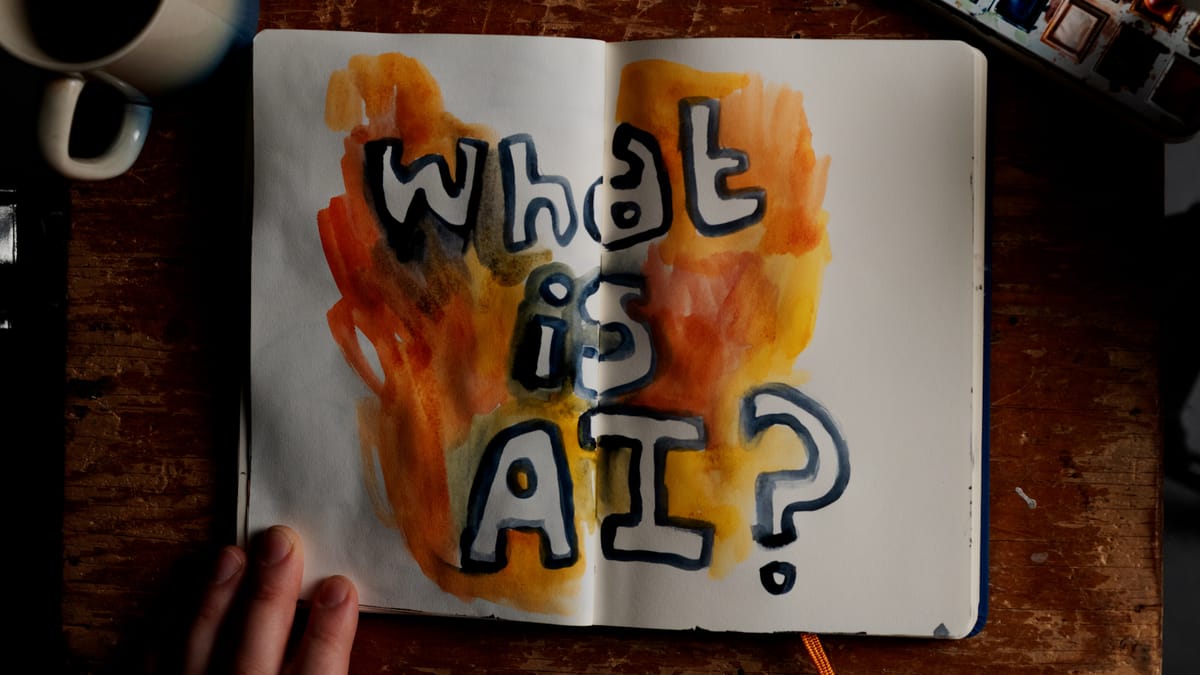
While Veatch deliberately excludes interviews with CEOs and professionals who have direct interests in AI industries, Roher and Tyrell lean into their intentions and reflections to paint a picture of the state of AI today. Roher’s on-screen persona is that of an earnest, anxious father-to-be, whose emotional and occasionally comedic presence would surprise those who only know him as the sharp and serious filmmaker who directed Navalny (2022). Caroline Lindy, a fellow filmmaker and Roher’s wife, provides the voice-over for a brief history of computers and Roher’s life and serves as his interlocutor in real-time conversations while he works on the film. The playful, handmade collage animations that illustrate their intimate conversations offer a brilliant counterpoint to the inhumanity of AI tools. As much as The AI Doc is a film examining the promises and perils of AI, it is also a tender personal documentary about an artist’s insistence on the uniqueness of human life.
A film that attempts to standardize the language of something as complex — if not altogether elusive — as AI should be admirable by itself, but too often, The AI Doc tries to dumb itself down in a way that precludes any chance for cogent critiques. It is a particular letdown when Roher lands sit-down interviews with CEOs including Dario Amodei and Sam Altman, yet presses them on nothing significant — not the environmental devastation, the labor inequities, the rampant misinformation and deepfakes hurting public trust and democracy — choosing instead to congratulate Altman on his impending fatherhood, which mirrors Roher’s own. By the end, we are told that the good and the bad come hand in hand and are introduced to the million-dollar word, “apocaloptimist,” a false equivalence that unfortunately undermines the finale.
What the filmmakers of Ghost and The AI Doc agree on is that we should be concerned with how much money and power there is in AI today. Both films end in a call to action, insisting that we are not completely powerless and presenting alternatives: refuse AI, unionize one’s workplace, advocate for fair labor practices, or call on one’s congressperson to demand transparency from AI companies. Change doesn't happen overnight, and every small action matters.
Ghost in the Machine (2026), directed by Valerie Veatch, is streaming online and screening at various locations through August 30. The AI Doc: Or How I Became an Apocaloptimist (2026), directed by Daniel Roher and Charlie Tyrell, is currently screening in select theaters.
Facts Only
"Ghost in the Machine" (2026) directed by Valerie Veatch
"The AI Doc: Or How I Became an Apocaloptimist" (2026), co-directed by Daniel Roher and Charlie Tyrell
Documentaries discussed at the 2026 Sundance Film Festival
Valerie Veatch, filmmaker of Love Child (2014) and Me @ the Zoo (2012)
Over 30 journalists, researchers, and scholars interviewed in "Ghost in the Machine"
American scientist Robert Jastrow quoted in "Ghost in the Machine"
Silicon Valley characterized as a boys' club in the article
American Eugenics Society and early Silicon Valley leaders like William Shockley mentioned
Hitler's correspondence with 20th-century American eugenicists revealed
Tech titans coddled up to the Trump administration in 2025
"The AI Doc" features Daniel Roher, co-director of Navalny (2022) and his wife Caroline Lindy
Dario Amodei and Sam Altman interviewed in "The AI Doc"
Executive Summary
Full Take
In the face of rising concern over AI and its influence on society, two documentaries presented at the 2026 Sundance Film Festival offer different perspectives. "Ghost in the Machine" takes a critical approach, tracing the eugenicist roots of AI research and exposing the long history of techno-fascism in America. By contrast, "The AI Doc: Or How I Became an Apocaloptimist" presents a more measured examination of AI, ultimately advocating for cautious optimism about humanity's future. Both films share a call to action, urging viewers to address the power dynamics surrounding AI development and take steps towards transparency and accountability.
By delving into the history of AI research and its connection to eugenics, "Ghost in the Machine" sheds light on the insidious influence of racism and techno-fascism in Silicon Valley. The film's critique of the quantification of intelligence is timely, as AI continues to permeate various aspects of our lives. However, it remains to be seen how effective this documentary will be in empowering viewers and combating the pervasive culture of techno-optimism.
"The AI Doc," on the other hand, takes a more personal approach, using co-director Daniel Roher's journey as an artist and impending father to explore the promises and perils of AI. While the film offers important insights into the state of AI today, its attempt to simplify complex ideas may limit its ability to provide cogent critiques or spark meaningful discussions about the implications of AI for humanity.
Together, these two documentaries offer a comprehensive overview of the anxieties and attitudes surrounding AI, highlighting the need for critical examination and thoughtful engagement with this rapidly evolving technology. As AI continues to shape our world, it is essential that we remain vigilant and proactive in shaping its development and ensuring that it serves the greater good.
Sentinel — Human
The article is likely human-written. It shows a human touch with its personal voice and specific historical references. The writing style exhibits variation in sentence length and transition use, while maintaining lexical diversity and sophistication.