Iran, the Shrunken Arsenal of Democracy, & Ukraine & Its hard-won know-how & know-what...
The constraint is not money; it’s steel, people, throughput—and our own procurement theology; if we were semi-rational and truly serious, Ukrainian engineers would already be running shell plants in Scranton and Tucson…
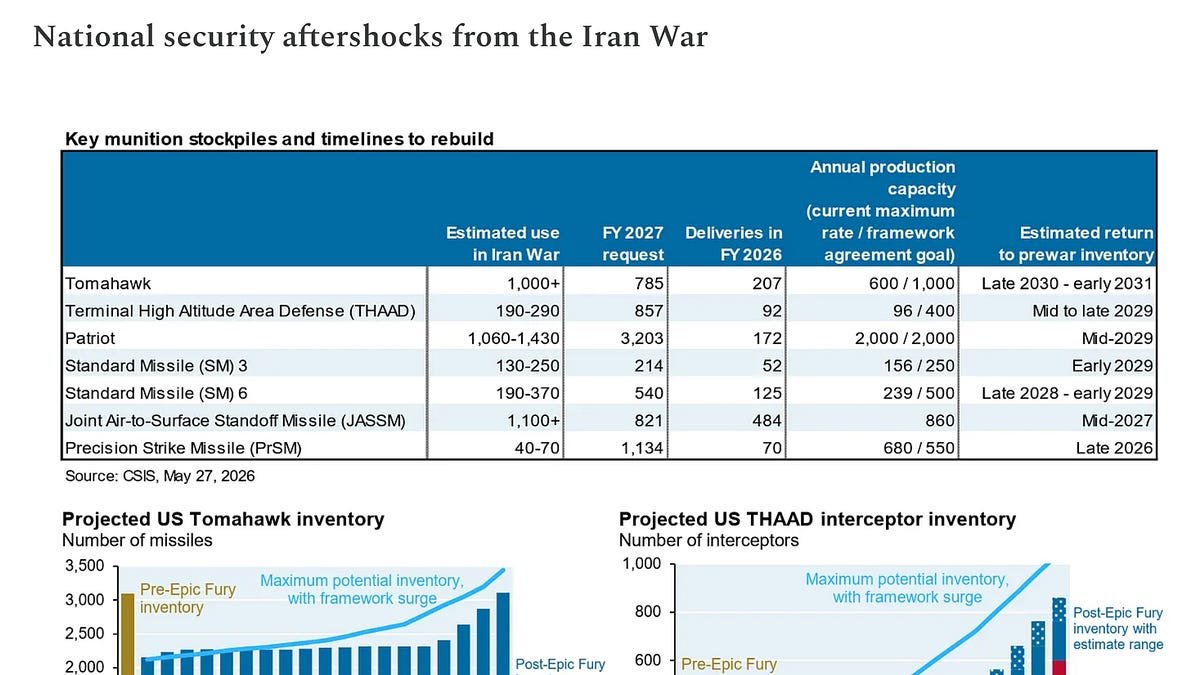
Yes, Trump’s attack on and then surrender of the Strait of Hormuz to Iran has left the U.S. military is massively weaker in a good deal of the areas that are likely to be most relevant in future near-term conflicts:
Source: JPM <https://assets.jpmprivatebank.com/content/dam/jpm-pb-aem/global/en/documents/eotm/semiquincententacles.pdf> via Adam Tooze <https://adamtooze.substack.com/p/top-links-1150-has-the-debasement>
Trump killed a lot of Iranian civilians. Trump destroyed a lot of Iranian military capabilities. But Trump lost the war, as Iran attritted the US military a lot more than the US attritted Iran. And other potential adversaries of the US military are now in much stronger positions.
My view? We need to start fixing this. And we need to start fixing it now. And we are going about it all wrong.
Think of it: Right now, Ukraine is scrambling to build a military-industrial production complex in a war zone, western defense contractors are debating whether to build up plants in Ukraine, and the pentagon is improvising “friend-shoring” arrangements and relaxing tech-transfer rules. Meanwhile, the U.S. defense-industrial base is still trying to climb out of the post–Cold War just‑in‑time, single‑source, boutique‑production trap it has dug for itself over thirty years. If we were sane, we would right now be spending money like water to build the Arsenal of Democracies on U.S. soil—with Ukrainian defense firms and their hard-won expertise as anchor tenants.
Sentinel — Human
This text displays the characteristics of human-written, polemical commentary with a distinct voice and clear argumentative intent.