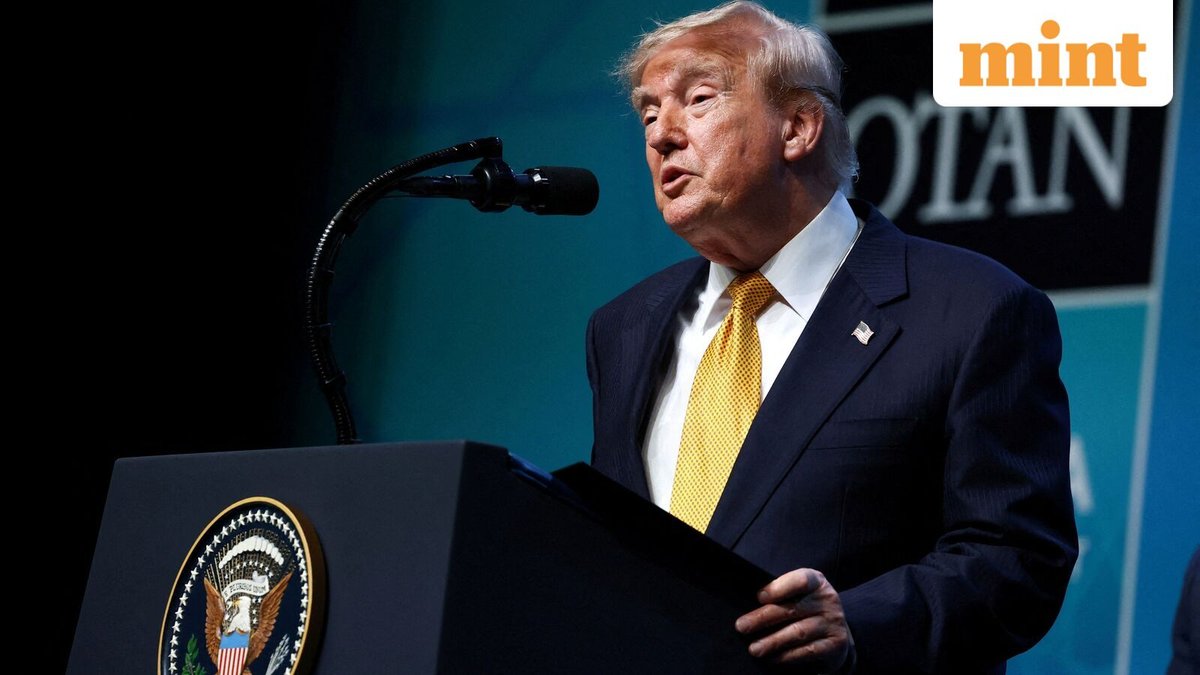
US President Donald Trump has ousted members of the bipartisan Election Assistance Commission (EAC) after they resisted his push to require proof of US citizenship for voter registration. The White House confirmed the executive action on Friday, marking the president's latest effort to consolidate influence over federal election oversight.
It justified the removals by citing a recent Supreme Court ruling, the Slaughter-House decision, which expanded the president's authority to fire members of independent agency boards.
In a statement to the AP, the White House said the president reserves the right to remove individuals who are not “totally aligned” with the administration's goals for election security.
“The President, and head of the Executive Branch, reserves the right to remove individuals that may not be totally aligned with the important task of securing America's elections and ensuring every legal vote is counted. The Slaughter decision gives the President precedence to do so,” the White House said in a statement to AP.
The president removed the commission's two Democratic members, Thomas Hicks and Benjamin Hovland. The panel's Republican member, Christy McCormick resigned. Former Republican commissioner Donald Palmer already had left his post voluntarily earlier this year.
The changes were first reported by VoteBeat, a news outlet that covers elections and voting across the US.
While the White House statement did not offer a specific reason for Trump's action, the commission has previously declined to change the national voter registration form to require documentation of an applicant's US citizenship, as Trump urged in a sweeping March 2025 executive order on US elections.
A federal judge blocked the order, ruling it exceeds the president's authority since the US Constitution grants authority over elections management and oversight to Congress and the states. The administration has indicated it will appeal.
It was not clear whether Trump planned to nominate new members immediately or leave the positions vacant - a move that, months ahead of midterm elections, could prevent the agency from distributing new grants to state or local elections offices and, at the least, complicate its role in overseeing testing and certification of voting systems around the country.
"The Administration from the start has been working across all agencies and local partners to safeguard elections from fraud and abuse, and investing in a strong infrastructure to sustain that mission, especially in the midterm elections," the White House said.
Congress created the four-member commission as part of the Help America Vote Act, a bipartisan law signed by Republican President George W Bush in 2002. The act requires the commission to include two Democrats and two Republicans, nominated by the president and confirmed by the Senate. Hicks and McCormick were appointed by President Barack Obama. Trump appointed Hovland during his first presidency.
According to VoteBeat, Hicks and Hovland were notified of their removal by an email signed by Morgan DeWitt Snow, the deputy director of presidential personnel in the Executive Office of the President.
For about a decade, Livemint—News Desk has been a credible source for authentic and timely news, and well-researched analysis on national news, business, personal finance, corporates, politics and geopolitics. We bring the latest updates on all the listed companies on BSE and NSE, startups, mutual funds, Union ministries, geopolitics, and untapped human interest stories from around the world, helping our readers to stay informed on the latest developments around the globe. Our Coverage Areas 1. Companies: Comprehensive news and analysis on listed and unlisted companies, corporate announcements, corporate chatter, C-suite, business trends, hiring alerts, layoffs, work-life balance, world's top billionaires and richest and more. 2. Personal finance: Insights into mutual funds, small savings schemes like - PPF, SSY, post office savings scheme, stock to watch, personal loans, credit cards, top bank FDs, real estate, income tax and more. 3. Politics: Comprehensive coverage of general elections, state elections and bypolls, Lok Sabha, Vidhan Sabha, Parliament, PMO, PIB, finance ministry, home ministry, among other union ministries and government departments. 4. National News: From metro cities like Delhi, Mumbai, and e to untapped stories from rural India, we cover human interest, health, education, crime and courts, and law and order, among other areas of public interest. 5. Economy: In-depth analysis of India's macro and micro-economic indicators like- GDP, inflation, forex, fiscal deficit, current account deficit, interest rate cycle, economic recovery, RBI circulars, indirect taxes, GST, Insolvency and Bankruptcy imports, exports and everything that impacts Indian economy. 6. Geopolitics: Well-rounded and deeply researched coverage on US News, Oval Office European Union, Ukraine Russia War, middle-east crisis, royal families and global leaders like - Donald Trump, Vladimir Putin, Kim Jong Un, Xi Jinping and premiers of other leading economies in the world. Meet the Team 1. Gulam Jeelani, Political Affairs Editor 2. Sugam Singhal, Senior Assistant Editor 3. Chanchal, Assistant Editor 4. Sanchari Ghosh, Chief Content Producer 5. Pratik Prashant Mukane, Chief Content Producer 6. Sayantani Biswas, Chief Content Producer 7. Ravi Hari, Deputy Chief Content Producer 8. Garvit Bhirani, Deputy Chief Content Producer 9. Akriti Anand, Senior Content Producer 10. Jocelyn Felix Fernandes, Senior Content Producer 11. Swastika Das Sharma, Content Producer 12. Mausam Jha, Content Producer 13. Riya R Alex, Trainee Content Producer
Oops! Looks like you have exceeded the limit to bookmark the image. Remove some to bookmark this image.
Facts Only
* US President Donald Trump ousted members of the Election Assistance Commission (EAC).
* The removal occurred after resistance to requiring proof of US citizenship for voter registration.
* The justification cited the Slaughter-House Supreme Court ruling, which expanded presidential authority over firing members of independent agency boards.
* Thomas Hicks and Benjamin Hovland were removed, who were Democratic members.
* Christy McCormick, a Republican member, resigned.
* Former Republican commissioner Donald Palmer had voluntarily left his post earlier in the year.
* The White House stated the President reserves the right to remove individuals not totally aligned with election security goals.
* The commission previously declined to change voter registration forms to require US citizenship.
* A federal judge blocked an executive order attempting to mandate citizenship documentation for voting, citing constitutional authority resting with Congress and states.
Executive Summary
Full Take
Sentinel — Human
The core narrative appears grounded in verifiable political events, but the inclusion of a lengthy, irrelevant source description strongly indicates an error or synthetic assembly of disparate content.