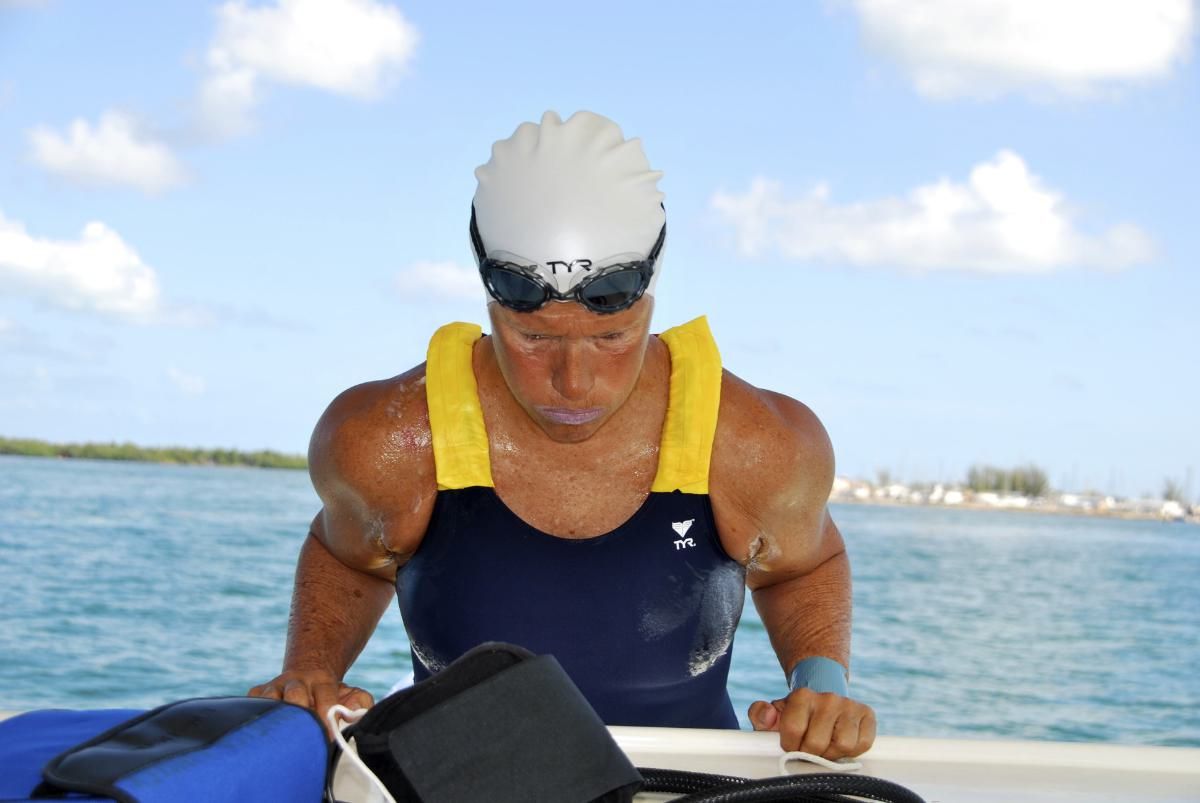
She swam from Cuba to Florida — and says she’s stronger than ever at 76
A recent study of older adults found that nearly half of people improve after 65, cognitively or physically or both
When Diana Nyad was 60, she set her sights on an audacious goal: swimming 110 miles from Cuba to Florida. She succeeded four years later, the first person to do it without a shark cage. During the 53-hour swim, she never exited the water.
She tried and failed the swim when she was younger (the first time at 28) and said when she returned to training in her 60s, she found new strengths that surprised her.
“I was much less selfish or self-absorbed than in my 20s,” Nyad said.
She didn’t fully understand, as a young athlete, that the people around her were critical to her success, in particular the boat team that accompanied her during her open-water swim.
“I changed by the time I was in my 60s,” said Nyad, now 76. “We were in a true team.”
A recent study of older adults found that, contrary to stereotypes, nearly half of people improve after 65 cognitively or physically or both. Nyad is an extraordinary example, but researchers argue that many of us are capable of achieving better fitness and cognitive function later in life. A positive attitude is key.
Nyad talked with The Washington Post about her record-breaking swim and how she continues to grow her strength and energy more than a decade later. This interview has been edited for length and clarity.
You attempted the swim from Cuba to Florida several times and succeeded on your fifth try. Did you feel more capable at 64 than in your 20s?
I don’t know if capable is the right word, but I was more joyful, more eyes-wide-open. In my 60s, I trained in the Caribbean, and we’d go out for a 16-hour day in the ocean. That’s not a fun, easy day. [But] sometimes I would look up at the stars at night and think of the majesty of the universe. I’m not a religious person, I’m an atheist, but I would look across the expanse of this blue planet that we live on with such awe. You wouldn’t have heard me talk like that in my 20s.
How else do you feel you’ve changed as you’ve gotten older?
I’m a lot nicer. I’m not a sweet little easygoing wallflower, but I’m more forgiving of people. And my friends would say I’m nicer.
Did you always have positive ideas about aging?
I didn’t know old people. I never knew any grandparent. But one thing that is different about me, I always had a pressing worry about the passage of time. When I was in sixth grade I made a speech to the class, and said: “Okay, we’re 11 now. If you looked at all of our genetics, probably we all have about 70 years to live. That’s all we’ve got. We’ve got to become doctors. We’ve got to help people. We’ve got to learn languages. We’ve got to travel the world, help the poor. We have to be the best we can be.” I’ve had this sense, all the time, that the clock is ticking, and as you get older it seems to tick faster. It’s not that I’ve always thought aging is going to be graceful or peaceful or wise. I just know that every minute, no matter what age you are, is fleeting. I just want to grab on to all of it.
Are you still swimming?
I swim some because I do fundraisers for charities by swimming. I’ve gotten into tennis in a big way. I do badass gym workouts that I guarantee a lot of 25-year-olds couldn’t do.
What do you make of this new research that found so many people get stronger and sharper with age?
I meet 65-year-olds who are half dead already, and I just met a 92-year-old last week who is still playing tennis, still does the New York Times crossword puzzle on Sunday in under an hour. She’s really sharp and she will probably be sharp until her last day.
There are other studies that talk about how as you get older, your connection with people is what means everything. When I’m out and traveling I like to be engaged. If I’m on a city bus, I’m going to know the woman next to me, I’m going to know her life story. I want to embrace the chaos. I want to be engaged as I go. And I think that’s a lot of keeping your mind young.
I wonder if you have any messages for people who are your age or older and aren’t feeling that kind of energy?
I just met with a friend and her mother because her mother had just lost her husband, and has lost a lot of friends. We went down the list of, what does she like to do? She said, it sounds kind of crazy, but when I grew up in Brooklyn, shuffleboard was my game. And so we found out there’s a shuffleboard place near her assisted living. She’s going to start playing shuffleboard, and I think it’s literally going to change her life. I bet they start going out to coffee afterward and call each other on the phone. It’s not just the game, she’s got a group.
So basically just find something that you enjoy doing and go for it?
It’s not only that – because people love to read, for instance, and I value reading, but it’s solitary. I think it’s more as people get older, don’t lose your friends. Make yourself be sociable. Get a card game going, go to the movies together, go out for a meal together.
Anything else you want to add?
I said when I did that swim, which was 12 years ago, that that was the prime of my life. And honestly, at 76, I’m even better now than I was then. As long as I keep this energy and this positive gratitude toward this life, as long as I’m this atheist in awe, things have gotten better and better.
Our website is the place for the latest breaking news, exclusive scoops, longreads and provocative commentary. Please bookmark nationalpost.com and sign up for our daily newsletter, Posted, here.
Postmedia is committed to maintaining a lively but civil forum for discussion. Please keep comments relevant and respectful. Comments may take up to an hour to appear on the site. You will receive an email if there is a reply to your comment, an update to a thread you follow or if a user you follow comments. Visit our Community Guidelines for more information.
Facts Only
Diana Nyad swam 110 miles from Cuba to Florida at age 64, completing the journey in 53 hours without a shark cage.
She first attempted the swim at age 28 and failed.
Nyad trained in the Caribbean for the swim, including 16-hour days in the ocean.
She is now 76 years old and continues to swim, play tennis, and engage in intense gym workouts.
A recent study found that nearly half of older adults improve cognitively or physically after age 65.
Nyad describes herself as more forgiving, sociable, and appreciative of teamwork in her 60s compared to her younger years.
She met a 92-year-old woman who plays tennis and completes the New York Times Sunday crossword puzzle in under an hour.
Nyad advises older adults to stay socially engaged, citing activities like shuffleboard, card games, and group outings.
She has no religious beliefs but expresses awe for the universe and life.
Nyad has participated in charity swim fundraisers.
She lost her husband and several friends, which she acknowledges as a challenge for older adults.
Nyad has always been conscious of time’s passage, giving a speech in sixth grade about making the most of life.
Executive Summary
Diana Nyad, now 76, achieved a historic feat at age 64 by becoming the first person to swim 110 miles from Cuba to Florida without a shark cage, completing the journey in 53 hours. She had previously attempted the swim at 28 and failed, but her later success was attributed to a shift in mindset—greater appreciation for teamwork, reduced self-absorption, and a deeper sense of awe for life. Nyad’s experience aligns with recent research suggesting that nearly half of older adults improve cognitively or physically after 65, challenging stereotypes about aging. She emphasizes the importance of social engagement, physical activity, and maintaining a positive attitude, citing her own continued strength and energy through swimming, tennis, and intense gym workouts. Nyad also highlights the role of community, urging older adults to stay socially active to preserve mental sharpness and joy. Her story underscores the potential for growth and resilience in later life, though individual experiences vary widely.
The narrative contrasts Nyad’s extraordinary achievements with broader societal perceptions of aging, suggesting that while not everyone will set records, many can defy decline through intentional habits. The discussion also touches on the psychological shift Nyad experienced—from urgency about time’s passage to gratitude for the present—offering a nuanced perspective on aging beyond physical capability.
Full Take
**Steelman:** Diana Nyad’s story is a compelling counter-narrative to ageist stereotypes, demonstrating that physical and cognitive vitality can flourish in later life. The article strengthens its case by citing research that nearly half of older adults improve after 65, framing Nyad as an extreme but illustrative example. It avoids hyperbole by acknowledging individual variability—some 65-year-olds are "half dead," while others thrive—and emphasizes actionable advice: social engagement, physical activity, and mindset shifts. The piece also humanizes Nyad by highlighting her personal growth, from youthful self-absorption to gratitude and teamwork, making her achievements relatable rather than purely aspirational.
**Pattern Scan:** The narrative leans into inspirational framing, which could risk emotional exploitation (e.g., "you too can achieve this!"), but it stops short of prescriptive overreach. The inclusion of research and Nyad’s self-awareness about her privileges (e.g., access to training, social networks) mitigates this. No overt distortion or bad faith is detected; the article presents Nyad’s perspective as one of many, not a universal truth. The focus on individual agency ("find something you enjoy") could inadvertently downplay systemic barriers (e.g., healthcare access, socioeconomic factors), but this is a common blind spot in motivational storytelling, not a deliberate manipulation.
**Root Cause:** The paradigm here is the "successful aging" model, which prioritizes individual effort and positive psychology. Unstated assumptions include the idea that aging is a problem to be "solved" through personal discipline, which may overlook structural inequities. Historically, this echoes the American self-help tradition, where exceptional stories are used to inspire rather than represent typical experiences.
**Implications:** For human agency, Nyad’s story empowers those who can access resources like training or social networks but may alienate others facing limitations. The cost of this narrative is the potential to stigmatize those who don’t "age successfully." Second-order consequences could include increased pressure on older adults to perform, masking deeper societal failures in elder care.
**Bridge Questions:**
How might this narrative differ if it centered older adults with chronic illnesses or limited mobility?
What role do socioeconomic factors play in the ability to "improve" with age, and how could this be addressed?
If Nyad’s story were used to argue against elder care funding (e.g., "see, they don’t need help!"), how would you counter that?
**Counterstrike Scan:** A bad actor pushing this narrative might amplify Nyad’s story while omitting systemic context, using it to argue that aging is purely a matter of personal responsibility. They might also cherry-pick research to imply universal applicability, ignoring outliers. The actual article avoids this by balancing Nyad’s story with broader research and acknowledging variability. No structural alignment with manipulation is detected.
**Patterns detected:** None.