What’s next: Defending Birthright Citizenship at SCOTUS
Our work continues — and the ACLU has a very big week ahead of us.
On April 1, we'll be at the Supreme Court challenging President Trump's unconstitutional executive order that seeks to deny U.S. citizenship to many babies born in the United States in our landmark case, Trump v. Barbara. And our National Legal Director, Cecillia Wang, will be arguing the case. Check back here on Wednesday morning for live coverage of oral arguments.
8 Million+ Strong
Thank you to everyone who joined us for today's No Kings rallies. The power of the people is stronger than the people in power.
A message from Robert De Niro
President Trump has to answer to the people.
A message from Washington D.C.
Your charge today is to recommit yourself to the fight for civil rights.
A message from New York City
Our communities are under attack — we won't stop showing up.
Our democracy belongs to all of us
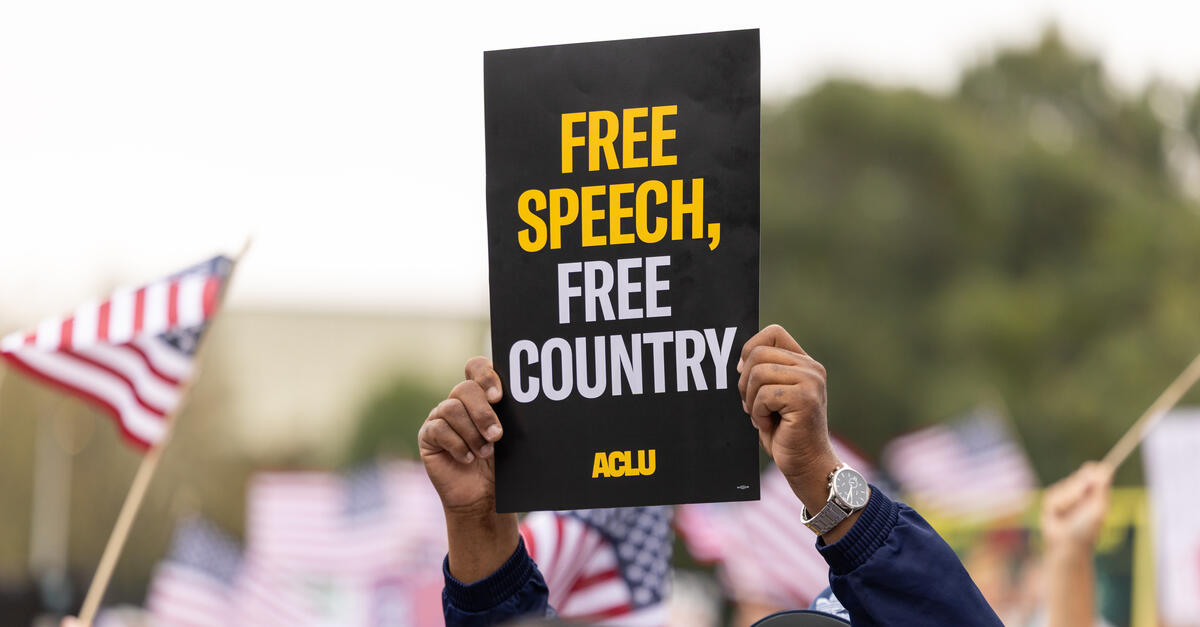
If President Trump thought he could shut us up with his attacks on free speech, he should think again.
We're reminding President Trump what it means to be born in the U.S.A.
Did you catch Bruce Springsteen at the No Kings Minnesota rally?
We're honored that the Boss trusted us with use of his iconic anthem ahead of our landmark Supreme Court case Trump v. Barbara, where we’re challenging President Trump's attempt to take away the constitutional right to birthright citizenship.
A message from the ACLU of Idaho
Power belongs to the people.
A Message from the ACLU of San Diego and Imperial Counties
This moment requires us to be courageous, to act with conviction, and to join together in solidarity. We'll see you at your local No Kings rally!
Watch Live: No Kings Flagship Rally at the Minnesota State Capitol
If you can't join a rally today, join us to watch the No Kings flagship rally live from the Minnesota State Capitol.
How to defend against police surveillance at protests
The following are basic tips to protect your privacy before, during, and after a protest. Protecting your privacy will help keep yourself, your information, and other protesters safe.
- Fully encrypt the data on your phone. If your device is confiscated by police, or if it is lost or stolen, full-disk encryption can help protect the information on your phone.
- Disable face and fingerprint recognition. Disabling both face and fingerprint recognition make it more difficult for officers to physically force you to unlock your device with your face or fingerprint and see information about yourself, your family, and the people that you care about.
- Put your phone on airplane mode. Enabling airplane mode when you are not communicating reduces the amount of radio signals your device transmits while you are protesting and limits your location from being tracked.
- Leave your car at home. Police use automated license plate readers to track protestors. If you can, ride a bicycle or walk to the protest to prevent your license plate being tracked.
- Be mindful of posting photos and videos of other protesters. If you post photos or videos online where protesters’ faces, tattoos, or unique clothing are identifiable, police may track down, arrest, or harass those protesters. Blur faces and these identifiers before posting online. If live-streaming, avoid capturing people's faces.
- Scrub metadata from your photos. Metadata allow police to figure out the exact time and location a photo was taken, the model of the device the photo was taken on, and even your name. Transfer the photo to your computer and take a screenshot. Post the screenshot, not the original photo.
- Back up your data. If the police take away your phone, you may not get it back easily. Back up your data regularly and store that backup in a safe place.
Today is the 3rd No Kings National Day of Action
Good morning — it's time to hit the streets for the third No Kings National Day of Action!
If you haven't already, find a local event near you and RSVP now. (This link takes you to a third-party site, mobilize.us. Indivisible will know you came from us, and their privacy policy applies.)
Before you head out, read our Know Your Rights: Protest Rights resource to brush up on your rights.
If you can't join us in person, we'll be sharing a livestream from the flagship rally at the Minnesota State Capitol, along with more live coverage from rallies across the country.
Share Your Protest Rights
Are you planning on attending a No Kings rally this weekend with family, friends, or neighbors? Make sure everyone knows about their right to peacefully protest.
We've created graphics outlining your protest rights that you can download and share on group chats, text messages, or social media!
This collection also includes a graphic that you can download to your phone and save as your lockscreen background — so you can easily see your rights during a protest without unlocking your phone.
Conozca Sus Derecheos
Conozca sus derechos antes de las protestas de "No Kings" (No a los reyes) este sábado.
En este taller, los participantes aprenderán sobre el derecho constitucional a protestar de manera pacífica y sobre las mejores prácticas para minimizar riesgos al asistir a manifestaciones.
Know Your Protest Rights
If you're going to a rally on Saturday, make sure you're prepared to protest safely and powerfully.
Read our Know Your Rights: Protest Rights resource to brush up on how the First Amendment protects your right to assemble and express your views through protest.
If you missed our live Know Your Rights training earlier this week, you can watch a recording below to learn more about your right to peacefully protest — and about best practices for reducing risks when attending protests.
Although the right to protest is protected by the Constitution, law enforcement and ICE have disregarded our constitutionally protected rights in the past. We hope that these resources will help you and your community advocate for your rights, but keep in mind that even when the law is clear, it isn't always followed in practice. It's important to know your rights around peaceful and lawful protest, and also to know your risks.
Join Us for the Third No Kings National Day of Action
Tomorrow, March 28, is the third No Kings National Day of Action. We're taking to the streets again to condemn President Trump's escalating abuses of power.
President Trump has unconstitutionally taken us to war in Iran. At his direction, ICE has detained thousands of people in inhumane conditions and deported thousands more. He's sent armed agents into our neighborhoods to attack immigrants and protesters alike.
But we, the people, aren't going anywhere, and we won't be silenced.
Power belongs to the people, and the people will hold power to account. We're mobilizing in communities across the country, connecting people with direct actions they can take and building a movement that President Trump can't silence. And we need you with us.
Join us in peaceful protest: Find a local event near you and RSVP now.
(This link takes you to a third-party site, mobilize.us. Indivisible will know you came from us, and their privacy policy applies.)
A core principle behind all No Kings events is a commitment to nonviolent and lawful action. We expect all participants to de-escalate any potential confrontation with those who disagree with our values and to act lawfully at these events. Weapons of any kind, including those legally permitted, should not be brought to events.
Facts Only
The ACLU is organizing a National Day of Action called "No Kings" on March 28.
The event includes rallies across the U.S., with a flagship rally at the Minnesota State Capitol.
The ACLU will argue *Trump v. Barbara* before the Supreme Court on April 1, challenging an executive order on birthright citizenship.
Cecillia Wang, the ACLU’s National Legal Director, will present the oral arguments.
Public figures like Robert De Niro and Bruce Springsteen have participated in or endorsed the rallies.
The ACLU provides protest rights resources, including tips on digital privacy and legal protections.
Recommendations include encrypting phones, disabling biometric unlocks, and avoiding license plate tracking.
The ACLU advises protesters to blur faces in shared media and scrub metadata from photos.
The movement opposes President Trump’s immigration policies, ICE actions, and alleged attacks on free speech.
The ACLU emphasizes nonviolent, lawful protest and discourages bringing weapons to events.
The organization directs participants to third-party sites like mobilize.us for event details.
The "No Kings" campaign frames its mission as defending constitutional rights and democratic participation.
Executive Summary
The ACLU is leading a National Day of Action called "No Kings" to protest President Trump's policies, including his executive order challenging birthright citizenship. On April 1, the ACLU will argue the case *Trump v. Barbara* before the Supreme Court, with National Legal Director Cecillia Wang presenting the challenge. The rallies, held across the country, emphasize nonviolent protest and civil rights, with participation from public figures like Robert De Niro and Bruce Springsteen. The ACLU provides resources on protest rights and digital privacy to protect demonstrators from surveillance and legal risks. The movement frames itself as a defense of constitutional rights against executive overreach, particularly targeting immigration policies, ICE actions, and attacks on free speech. The tone is one of grassroots mobilization, with a focus on legal and peaceful resistance.
The article blends advocacy with practical guidance, urging participation while acknowledging risks. It presents a unified narrative of resistance but does not engage with counterarguments or alternative perspectives on the issues at hand. The emphasis on celebrity endorsements and mass mobilization suggests an effort to amplify visibility and legitimacy, though the legal and logistical details of the Supreme Court case remain secondary to the call to action.
Full Take
**STEELMAN:** The ACLU’s "No Kings" campaign presents a compelling narrative of grassroots resistance against perceived executive overreach. By centering the Supreme Court case *Trump v. Barbara* alongside mass mobilization, it bridges legal advocacy with public pressure, a classic dual strategy in civil rights movements. The inclusion of celebrity endorsements and practical protest guides strengthens its appeal, making participation feel both urgent and accessible. The framing of "power belongs to the people" taps into deep democratic ideals, positioning the movement as a defender of constitutional norms.
**PATTERN SCAN:** The article employs several persuasive techniques worth noting. The use of celebrity voices (De Niro, Springsteen) leverages **ARC-0012 Borrowed Credibility**, lending emotional weight to the cause. The repeated emphasis on "unconstitutional" actions and "attacks on free speech" could be read as **ARC-0024 Ambiguity**, as it assumes a shared interpretation of these terms without addressing counterarguments (e.g., executive authority debates). The call to action is framed as a moral imperative ("we won’t be silenced"), which risks **ARC-0043 Motte-and-Bailey**—where the "motte" (defending constitutional rights) is defensible, but the "bailey" (partisan opposition) is more contentious. The privacy tips, while practical, also subtly reinforce a narrative of systemic surveillance, which may amplify **ARC-0031 Fear Appeals**.
**ROOT CAUSE:** The paradigm here is one of institutional distrust, where legal and political systems are framed as under siege by authoritarian tendencies. The unstated assumption is that judicial and legislative checks have failed, necessitating direct action. This echoes historical patterns of civil disobedience, from the Civil Rights Movement to anti-war protests, where marginalized groups bypass traditional power structures. However, the lack of engagement with opposing viewpoints (e.g., arguments for executive discretion on immigration) suggests a closed-loop narrative.
**IMPLICATIONS:** For human agency, the movement empowers individuals to act collectively, but it also risks polarizing discourse by framing the conflict as binary ("the people" vs. "the powerful"). The second-order consequences could include normalized protest surveillance (ironically, the very thing the ACLU warns against) or a backlash against judicial activism if the Supreme Court case fails. The focus on digital privacy is a double-edged sword—it protects protesters but also implies a world where dissent requires evasion, not just expression.
**BRIDGE QUESTIONS:**
How might this movement’s tactics differ if it engaged with opponents’ legal arguments (e.g., the scope of executive power) rather than framing them as inherently unconstitutional?
What historical precedents exist for successful movements that balanced mass mobilization with legal challenges—and where have such strategies fallen short?
If the Supreme Court rules against the ACLU in *Trump v. Barbara*, how might the "No Kings" narrative adapt—or would it risk losing momentum?
**COUNTERSTRIKE SCAN:** A coordinated influence campaign pushing this narrative would likely amplify emotional triggers (e.g., "our democracy is under attack"), use celebrity endorsements to manufacture consensus, and frame opposition as anti-democratic. The actual content aligns with some of these tactics—particularly the moral urgency and borrowed credibility—but stops short of outright manipulation. The ACLU’s transparency about protest risks and legal strategies suggests a genuine advocacy effort rather than a disinformation play. The closest red flag is the binary framing, but it’s a common feature of activist messaging, not necessarily a sign of bad faith.