Earlier this month, we analyzed hundreds of millions of transactions across Stripe to identify first-party fraud trends. One of the biggest findings: free trial abuse is rapidly accelerating. From November 2025 to February 2026, our models detected 6.2x more abusive free trials across Stripe’s network.
Free trial abuse isn’t new, but users are increasingly targeting AI companies and driving much of the increase we’re seeing today. These businesses run on expensive compute resources and rely on free trials to acquire customers, making them a target for abuse.
Bad actors have become as sophisticated at stealing compute as they have money, cycling through trials or signing up with invalid payment methods without ever converting to paid subscriptions. This puts AI companies at risk of losing hundreds of thousands of dollars. AI startups are particularly impacted: those that offer free trials with self-serve signups and direct API access see 10x more attempted abuse than enterprise AI companies.
However, these fraud patterns aren’t limited to just one industry. We’re seeing similar free trial abuse across SaaS platforms, marketplaces, and other businesses that offer free trials.
Helping prevent free trial abuse in one click
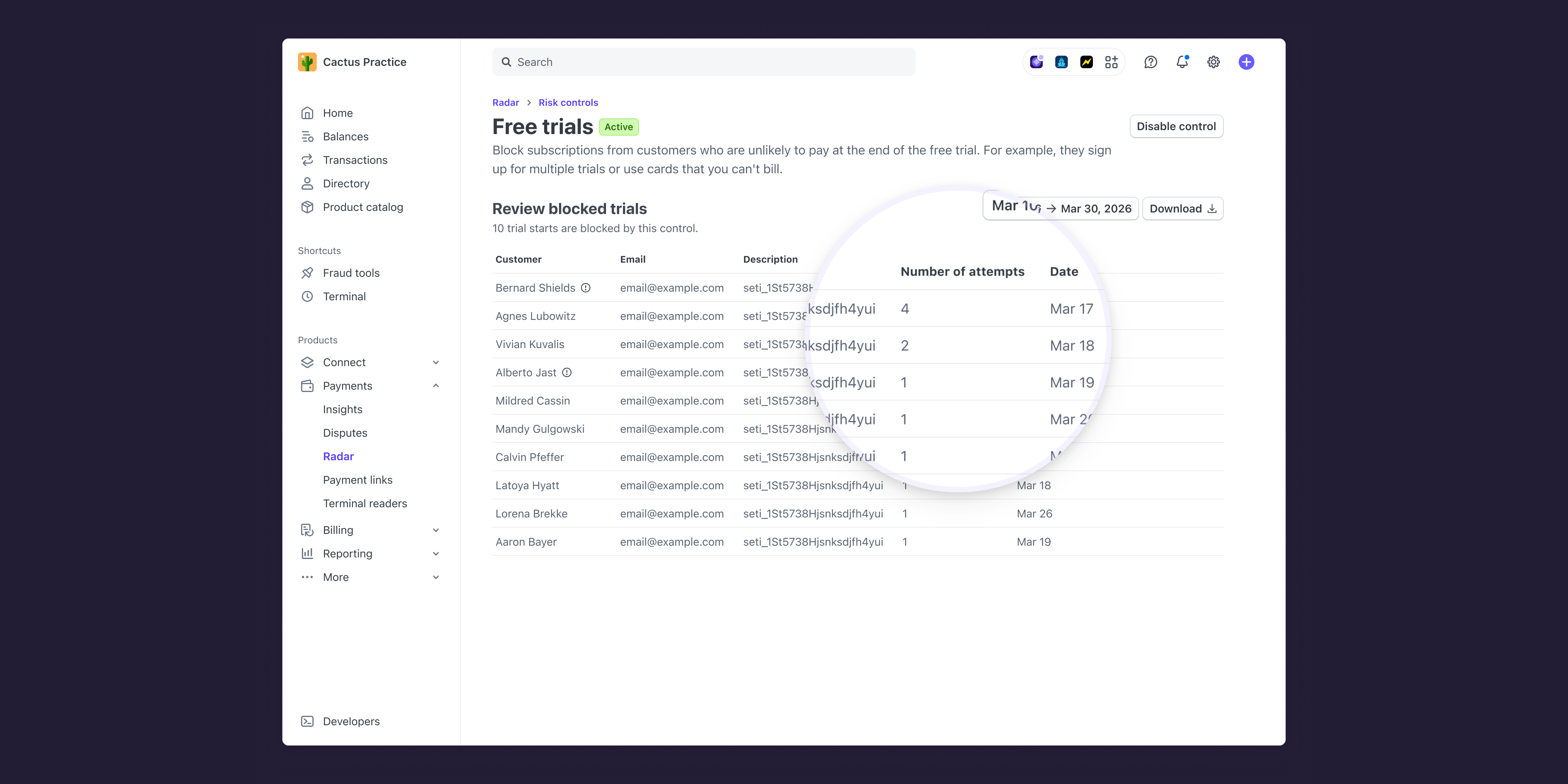
Stripe Radar, our AI-powered fraud tool, now helps prevent free trial abuse with just one click. When enabled, Radar predicts the presence of abusive behavior that violates common trial terms, such as repeated trial signup or missed cancellations, with 90% accuracy. We also introduced a new analytics page that shows all high-risk payments that are blocked. For businesses that have not yet enabled the control, the analytics page shows which payments would have been blocked.
Our free trial abuse solution is powered by a new AI model trained on payment instrument (such as cards), device, and payment history across the entire Stripe ecosystem. For example, we can see if a certain card has been used on converted free trials before, and whether that card has led to a successful or failed charge. We have an industry-leading understanding of bank identification number (BIN) ranges, which helps us identify virtual card brands, and we know if email domains are new or temporary. This information helps us detect high-risk patterns including suspicious session timing and card characteristics that correlate with nonpayment.
AI companies such as Cursor are already using Radar to prevent free trial abuse. By identifying fraudulent actors at signup, the Cursor team can block high-risk trials before bad actors drive up their compute costs.
In the first 2 months, across 4 high-growth AI businesses, we blocked more than 550,000 free trials with a high risk of abuse, preventing an estimated $4.4 million in downstream losses from compute costs.
Identifying first-party fraud for all industries
Our free trial abuse solution is available to all businesses, making Radar more effective at identifying and blocking first-party fraud regardless of your industry or business model.
If you are interested in using our free trial abuse control, email us at trial-abuse-prevention@stripe.com for early access. To hear more about how Radar is adapting to additional fraud types, join us at Stripe Sessions.
Facts Only
Stripe Radar is an AI-powered fraud tool that helps prevent free trial abuse with 90% accuracy.
Free trial abuse has increased significantly, especially targeting AI companies, due to bad actors cycling through trials and using invalid payment methods without converting to paid subscriptions.
Stripe's new solution is powered by an AI model trained on payment instrument, device, and payment history across the entire Stripe ecosystem.
In the first 2 months, across 4 high-growth AI businesses, Stripe blocked more than 550,000 free trials with a high risk of abuse, preventing an estimated $4.4 million in downstream losses from compute costs.
Executive Summary
Full Take
Stripe's Radar tool is designed to help businesses prevent free trial abuse, which has been rapidly increasing and particularly impacting AI companies. The new solution uses advanced AI techniques to predict abusive behavior and block high-risk payments with 90% accuracy. However, it's essential to consider the broader context of this development:
1. **Steelman:** Stripe's focus on preventing free trial abuse is a proactive step to protect businesses from financial loss caused by fraudulent activities during the trial period.
2. **Pattern scan:** None detected (this article presents factual information about the new service offered by Stripe)
3. **Root cause:** The increase in free trial abuse can be attributed to bad actors taking advantage of the common practice of offering free trials, particularly in industries that rely on expensive compute resources like AI companies.
4. **Implications:** By blocking high-risk free trials, businesses can save significant amounts of money that would otherwise be spent on compute costs for non-converted users. This development could potentially lead to more responsible use of resources by AI companies and improved financial sustainability within the sector.
5. **Bridge questions:** How does Stripe's new solution impact different industries, and what are the potential long-term effects on the AI industry? What measures can be taken to further prevent free trial abuse in other sectors?
Sentinel — Human
This article is likely human-written, as indicated by its stylometric signals, coherence, coordination, and lack of fabrication. The content provides an informative discussion on free trial abuse in the context of AI companies using Stripe's Radar tool for prevention.