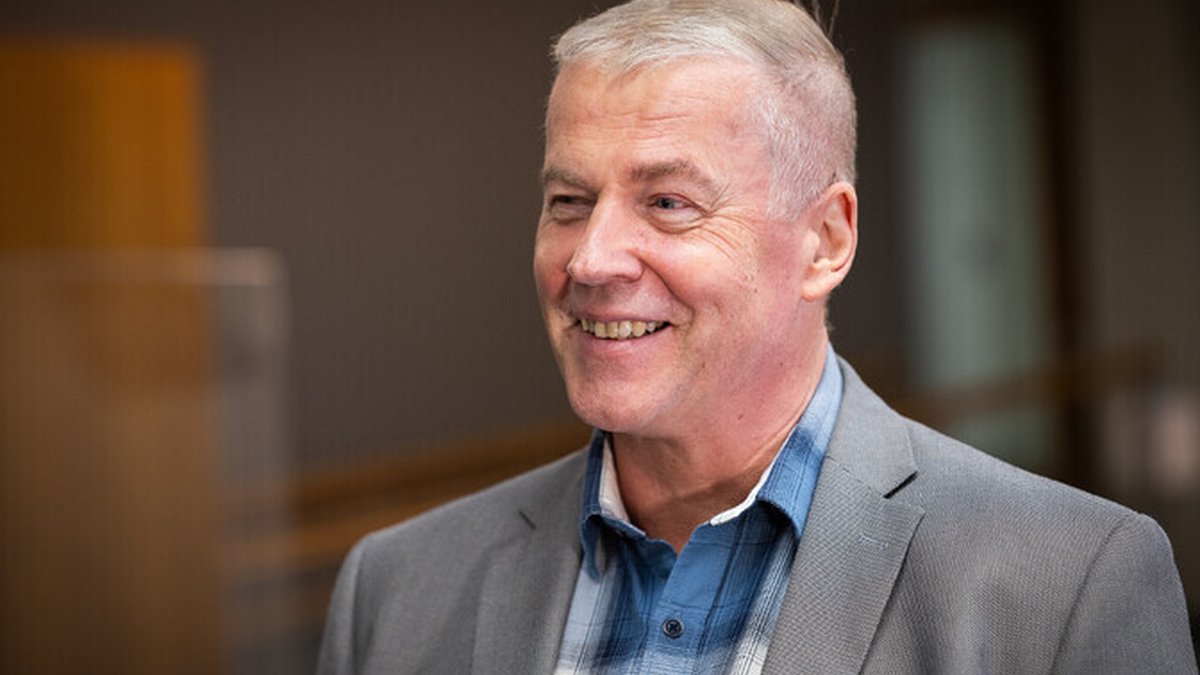
Retired Maj. Gen. Riho Ühtegi, floated Friday by a group of public figures as a potential presidential candidate, says he considers himself a conservative and believes foreign policy has its place in the president's work, but that ensuring national unity is the job's most important task.
When you look at the names of the people who issued the appeal — are these people your friends, acquaintances, like‑minded individuals?
Yes, more like acquaintances in the sense that I've spoken with all of them. I know them all — some better, some less. What connects us is a similar understanding of what is happening in Estonia today and what the problems are.
How did this idea start moving? Did you meet, discuss, and eventually conclude that you could try to become Estonia's president?
Various people have talked to me about this for some time. But I didn't take it very seriously, because we all hoped Alar Karis would continue. Until then, it was mostly theoretical talk.
But now, after Alar Karis announced on Victory Day that he would not continue as president, I had a phone call with Raivo Vare. He asked whether I was ready to continue the theoretical discussion we had earlier and to run. I said yes.
So Raivo Vare is the one who gathered the signatures and is essentially your campaign manager?
I've spoken personally with all of these people. I've known them for some time, though I wouldn't say we're very close. We've met at various events. And ideologically we share a lot. But yes, Raivo Vare can be called the campaign lead.
You said you were disappointed that Alar Karis announced he wouldn't run again. Looking at Estonia's presidents since independence, which one do you resemble most? Are you closest to Karis ideologically?
Karis left behind a very important guideline — a direction we should focus on. In his speech he said we must look inward and fix our domestic situation first. I fully agree, because today we have a divide in society. We need to talk to people, bring them together again, and restore national unity, which is now somewhat — or even quite seriously — limping.
So you disagree with President Toomas Hendrik Ilves, who said the president does not need to face the people right now, but should face other world leaders because the times are so turbulent?
I'm not entirely sure what you mean by "other world leaders," but the president must face the people. Ultimately, the president's duty is to safeguard Estonia and national unity.
Ilves meant that the president's most important function is foreign relations — that in critical times, foreign‑policy experience, networks, English proficiency and so on matter greatly.
Of course foreign policy has its place, and it is important for every country. But foreign policy is not conducted only by the president. In a democratic, parliamentary state like Estonia, foreign policy is led primarily by the government. The president's main duty is constitutional oversight and ensuring national unity.
Are you ideologically a conservative? How would you position yourself?
Yes, rather conservative. That's how it is.
You once skipped a President's Rose Garden reception because [Estonian poet and cultural critic] Sveta Grigorjeva was present. How does such behavior suit a future president?
That was years ago, first of all. Second, at that time I had no intention of becoming president. For me, August 20 is a national holiday — in 1991 we were ready to die for the birth of the Republic of Estonia. And knowing what kind of speech was coming, I felt it necessary not to attend.
In Estonia's society and democracy, it's normal to have very different opinions. Even national holidays are viewed differently. How would you, as president, deal with people who disagree with you?
As I said, at that moment I was not the president. And I had the right to decide whether to attend the event or not. Attendance was not mandatory. At that time I simply chose to meet with my old comrades with whom I stood on the barricades in 1991.
Have you spoken with party leaders or other politicians?
Over the years I've spoken with various people who belong to political parties. But I haven't spoken with the parties themselves.
Given your worldview, it would be logical to call Urmas Reinsalu, since Isamaa's role is small in the Riigikogu but large in the electoral college. If the election goes to the electoral college, Isamaa becomes one of the key parties.
I know Urmas Reinsalu personally. We've communicated for quite a long time at different points. But for me this situation is still quite fresh — I knew the statement would be made, but not exactly when.
Besides, I'm not a candidate today — I'm just one of the proposed names, like many others. Candidates will be decided by the Riigikogu Council of Elders, which, as I understand, will meet only in August. So I still have time to talk to people. Now that my name is out there, I must do that. But today it's a bit early to talk about all of this.
If you receive positive feedback, will you start campaigning? You are known, but not so well known that voters and MPs fully understand your worldview and positions. Would you need to campaign?
Well, yes — we'll see.
--
Editor: Urmet Kook, Argo Ideon
Sentinel — Human
The text exhibits strong human characteristics consistent with an interview setting, demonstrating a personalized, reflective, and idiosyncratic voice rather than patterned, synthesized writing.