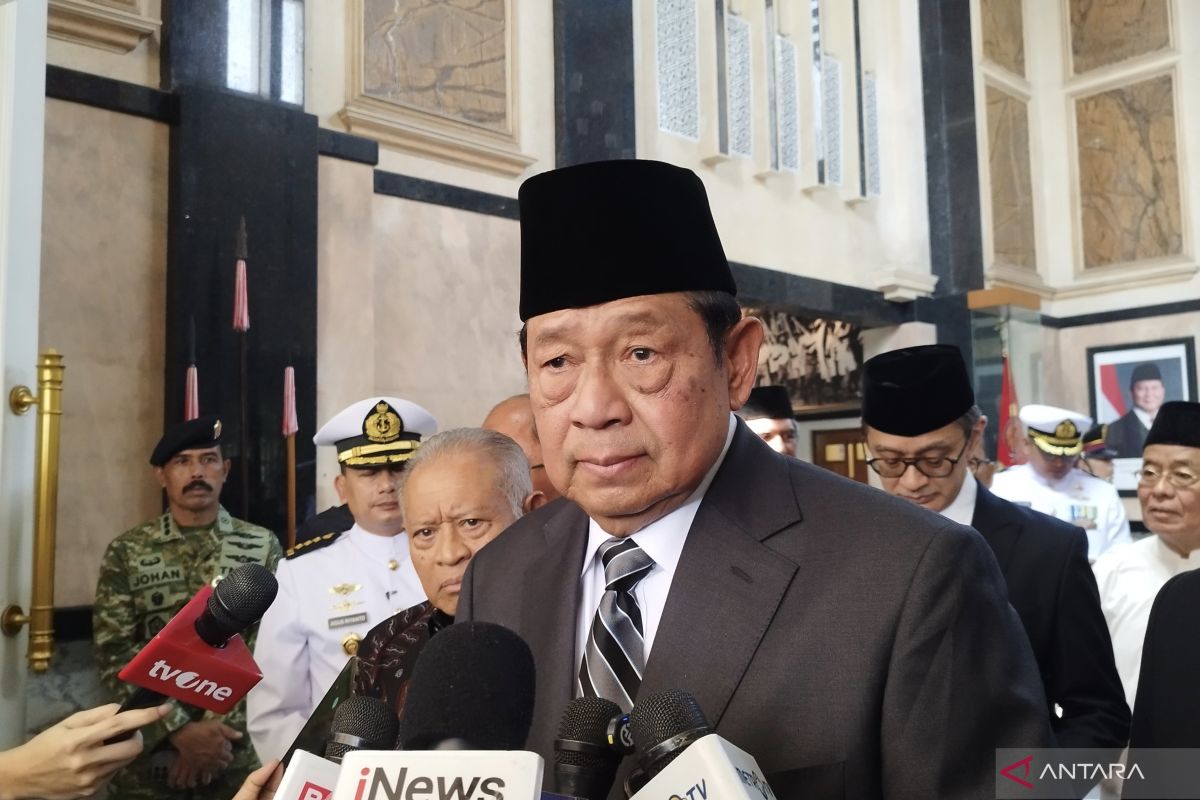
Speaking after paying his respects at the Defense Ministry headquarters, SBY remembered Sudarsono as a University of Indonesia scholar whose insights enriched discussions on international relations and defense.
"Mr. Juwono shared my conviction that the military should return to its proper role as a dependable defense institution, not engaging in political affairs, during my military service in the 1998 era," he told the press on Sunday.
The former president highlighted that their relationship dated back to his duty as a junior officer at the Staff and Command School of the Indonesian Army. He described Sudarsono as a discussion partner at the time.
He added that their shared perspectives eventually led him to appoint Sudarsono as defense minister under his administration from 2004 to 2009. It was Sudarsono's second non-consecutive term after becoming the first civilian to hold the post under the fourth president, Abdurrahman Wahid.
SBY went on to say that the former defense minister focused his second term on modernizing Indonesia's defense posture by developing systems and equipment. The two figures agreed that Indonesia's military must continue advancing at the regional level.
Highlighting diplomatic prowess, he lauded Sudarsono for initiating peacekeeping missions aimed at strengthening Indonesia's capacity to address crises both at home and abroad.
"His service was of great help because I placed both defense and diplomacy as equally important during my administration," SBY said.
On that note, the ex-president called on the wider public to follow in Sudarsono's steps in mastering both defense and diplomacy, stressing that matters related to Indonesia's security extend beyond military responsibilities.
Juwono Sudarsono passed away at Pondok Indah Hospital in Jakarta on Saturday (March 28). He received a military funeral with full honors at the Kalibata Heroes' Cemetery in the capital on Sunday. Defense Minister Sjafrie Sjamsoeddin presided over the ceremony.
Related news: Former defense minister Juwono Sudarsono passed away aged 84
Related news: Azyumardi Azra buried at Kalibata Heroes Cemetery
Related news: President pays respects to heroes interred at Kalibata Heroes Cemetery
Translator: Bagus Ahmad, Tegar Nurfitra
Editor: Azis Kurmala
Copyright © ANTARA 2026
Facts Only
Juwono Sudarsono died on March 28 at Pondok Indah Hospital in Jakarta.
He was buried with full military honors at Kalibata Heroes' Cemetery on March 29.
Defense Minister Sjafrie Sjamsoeddin presided over the funeral ceremony.
Sudarsono served as Indonesia's defense minister under President Abdurrahman Wahid and later under President Susilo Bambang Yudhoyono (SBY) from 2004 to 2009.
He was the first civilian to hold the defense minister position under Wahid.
SBY spoke after paying respects at the Defense Ministry headquarters.
SBY and Sudarsono first interacted when SBY was a junior officer at the Indonesian Army's Staff and Command School.
Sudarsono's second term as defense minister focused on modernizing Indonesia's defense systems and equipment.
He initiated peacekeeping missions to strengthen Indonesia's crisis response capabilities.
SBY emphasized Sudarsono's belief in the military's role as a non-political defense institution.
SBY appointed Sudarsono as defense minister due to their shared perspectives on military reform.
The funeral and tributes highlight Sudarsono's contributions to defense and diplomacy.
Executive Summary
Juwono Sudarsono, a former Indonesian defense minister and scholar, passed away on March 28 at Pondok Indah Hospital in Jakarta. He was buried with full military honors at the Kalibata Heroes' Cemetery, with Defense Minister Sjafrie Sjamsoeddin presiding over the ceremony. Sudarsono served as defense minister twice, first under President Abdurrahman Wahid as the first civilian in the role and later under President Susilo Bambang Yudhoyono (SBY) from 2004 to 2009. SBY, who spoke after paying respects at the Defense Ministry headquarters, highlighted Sudarsono's contributions to modernizing Indonesia's defense posture, emphasizing his role in advancing military systems and equipment. He also praised Sudarsono's diplomatic efforts, particularly in initiating peacekeeping missions to strengthen Indonesia's crisis response capabilities. SBY described their long-standing professional relationship, noting shared views on the military's role as a non-political defense institution. The former president urged the public to follow Sudarsono's example in mastering both defense and diplomacy, stressing the broader scope of national security beyond military matters.
Sudarsono's career spanned academia and government, with SBY recalling their early interactions during his time as a junior officer at the Indonesian Army's Staff and Command School. His second term as defense minister focused on regional military advancement and diplomatic engagement, reflecting a belief in the equal importance of defense and diplomacy. The funeral and tributes underscore his significance in Indonesia's defense and foreign policy circles, with SBY's remarks framing his legacy as a bridge between military reform and international relations.
Full Take
The narrative surrounding Juwono Sudarsono's legacy presents a strong case for his influence on Indonesia's defense and diplomatic policies. His career, spanning academia and government, is framed as a model of civilian leadership in military affairs, particularly his role in modernizing defense systems and advocating for the military's depoliticization. SBY's tribute underscores a shared vision of military reform, positioning Sudarsono as a key architect of Indonesia's post-authoritarian defense posture. The emphasis on his diplomatic initiatives, such as peacekeeping missions, reinforces the idea that national security extends beyond military might to include soft power and international cooperation.
However, the narrative also reflects a broader pattern of institutional memory-shaping, where figures like Sudarsono are elevated as symbols of reform. The focus on his civilian status and alignment with SBY's policies may inadvertently downplay potential critiques of military modernization or the challenges of civil-military relations during his tenure. The call for the public to emulate his mastery of defense and diplomacy could be seen as an appeal to authority, subtly reinforcing a specific vision of national security without engaging with alternative perspectives.
Rooted in Indonesia's post-1998 reform era, this narrative assumes that civilian leadership and military professionalism are inherently progressive. Yet, it leaves unexamined the tensions between modernization and accountability, or the potential trade-offs in prioritizing regional military advancement over domestic governance. The implications for human agency lie in how such legacies are constructed—who gets to define "proper" military roles, and whose voices are centered in these discussions.
Bridge questions: How might Sudarsono's policies have been received by critics of military modernization? What alternative models of civil-military relations exist beyond the one presented here? How does the framing of his legacy serve current political or institutional interests?
Counterstrike scan: A coordinated influence campaign might use this narrative to reinforce a specific vision of defense reform while marginalizing dissenting views. However, the content does not exhibit overt manipulation patterns; it primarily serves as a tribute with institutional context. No structural alignment with a hypothetical attack playbook is detected.
Patterns detected: none