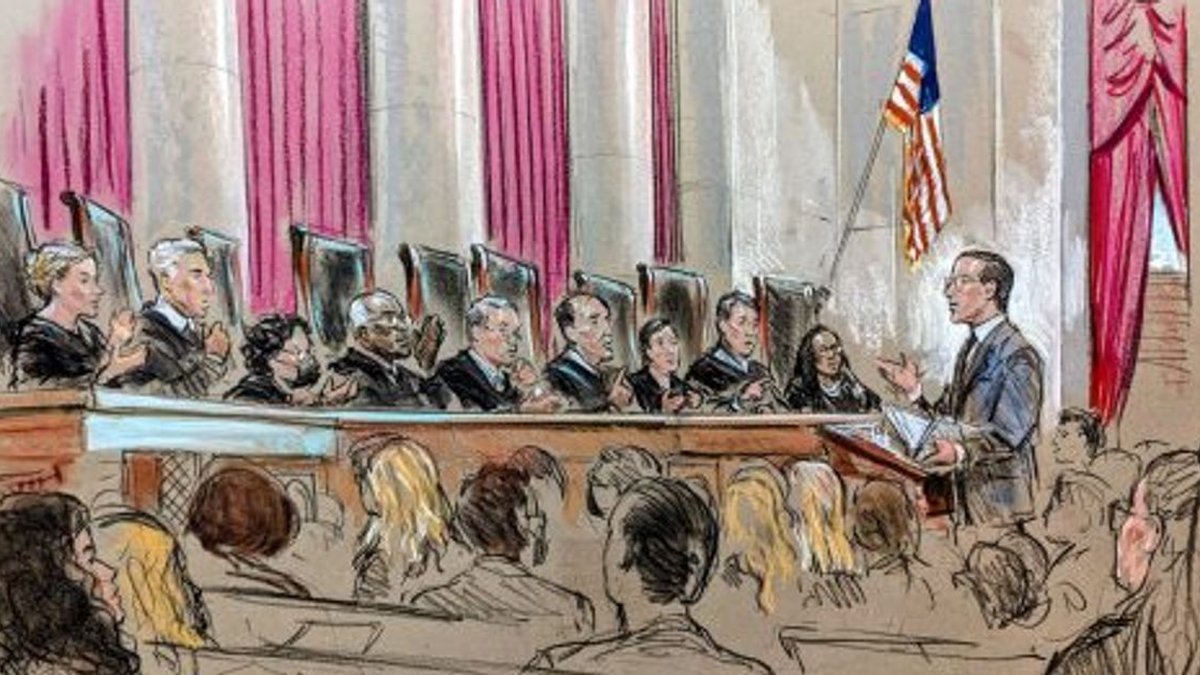
We often describe the court through a familiar shorthand: three Republican-appointed conservatives (Justices Clarence Thomas, Samuel Alito, and Neil Gorsuch) at the far right of the court; three Democratic-appointed liberals (Justices Sonia Sotomayor, Elena Kagan, and Ketanji Brown Jackson) on the other side; and a smaller group of three-Republican appointees (Chief Justice John Roberts and Justices Brett Kavanaugh and Amy Coney Barrett) nearer to its middle. That description captures something real. But it also misses something important: Supreme Court ideology is shaped by issue area, docket, coalition, case selection, and the public visibility of votes.
The final decisions for cases argued during the latest Supreme Court term show why measuring judicial ideology may be useful, but it is also complicated.
In Trump v. Barbara, the court rejected President Donald Trump’s effort to narrow birthright citizenship for children born in the United States to parents who were unlawfully or temporarily present. That outcome is easy to code as liberal. It invalidated a Trump immigration policy and preserved a broad constitutional understanding of citizenship. Yet the lineup was more complicated than a simple liberal-conservative story. Roberts wrote the majority opinion. Barrett joined it, as did Sotomayor, Kagan, and Jackson. And Kavanaugh disagreed with the court’s constitutional holding but still concluded that the executive order violated federal law.
In Chatrie v. United States, the court held that police conducted a Fourth Amendment search when they obtained Google location history data through a geofence warrant. Although the case involved a mix of issues that do not always fall neatly along partisan lines – privacy, technology, criminal procedure, and the reach of police power – it was considered by many a liberal decision because it strengthens privacy protection against government surveillance. But, perhaps because of this confluence of different issues, the majority coalition again defied a simple ideological narrative, as Roberts and Kavanaugh joined Kagan’s majority opinion, and Gorsuch concurred separately in the judgment.
Then there is the emergency docket. In Callais v. Louisiana, the court was asked to accelerate finalizing its decision two weeks earlier limiting the Voting Rights Act and allowing Louisiana to use a redistricting map struck by a lower court as racially discriminatory. Jackson dissented from the court’s decision to issue its judgment, but was not joined (at least publicly) by Sotomayor and Kagan, while Alito, with Thomas and Gorsuch, defended the court’s action. This dispute also shows why emergency applications are harder to measure. In many emergency orders, the public sees named dissents, but not a full vote count or a signed majority opinion.
With these nuances in mind, this project uses the Supreme Court Database’s liberal-conservative coding, beginning when Jackson joined the court at the start of the 2022-23 term, through the 2024-25 term, then extends the same codebook-based approach to the present term. (The vote totals differ slightly per justice because not every justice participated in every coded matter.) Uniquely, it also applies that approach to emergency applications with recorded dissents during that same period.
The measure is distance from ideological “neutrality,” or a 50/50 “conservative-liberal voting” split. A justice who votes “conservative” 50% of the time (and 50% “liberal”) sits at zero. A justice who votes conservative 70% of the time is 20 points to the conservative side. A justice who votes conservative 30% of the time is 20 points to the liberal side. In other words, positive values indicate conservative-leaning distance from 50/50 and negative values indicate liberal-leaning distance.
Some caveats.
First, this methodology treats all votes as equally meaningful, which is a point that is debatable. For instance, votes in Trump v. Barbara could easily be more determinative of ideological predilection than in a decision with more economic than civil liberties implications.
Second, this methodology involves tracing a case’s issue area and then the position of the political parties within that area. For instance, a pro-affirmative action or LGBTQ+ rights outcome will be coded liberal. But a trickier situation involves cases within the wider area of economic activity – here, “anti-business,” for instance, is coded as liberal, which may have traditionally been the case but has lately become somewhat more nuanced. As a starting point, though, it made sense to use this existing framework – flawed as it may be – which has been widely adopted and used throughout the literature on Supreme Court decision-making.
Finally, and in some ways most importantly, a justice’s ideological vote does not necessarily equate to political preferences (which is why I use the phrase “ideological” in this article as opposed to “partisan” or “political,” while recognizing, of course, the baggage carried by the terms liberal and conservative). It is possible that one’s judicial ideology leads them to support positions that lean in a particular direction but which they would not necessarily support at the voting booth. This is, of course, a key distinction for anyone who believes in the difference between politics and law. It also helps to explain how justices nominated based on president’s assessments of their political priors have turned out to be ideologically distant from their appointing president’s views even though they may have politically aligned with that president and the president’s party in the past.
With those important nuances in mind, let’s move on to the data.
The merits docket
On the merits docket, the most distant justices from 50/50 are Sotomayor, Jackson, Kagan, Alito, and Thomas, respectively. The farthest from 50/50 is Sotomayor, at 17.5 points to the liberal side. Jackson is 16.3 points to the liberal side. Kagan is 15.7 points to the liberal side. Alito is nearly identical in the opposite direction, at 15.5 points to the conservative side. Thomas follows at 12.1 points to the conservative side.
The justices closest to “neutrality” on the merits docket are Barrett, Roberts, Kavanaugh, and Gorsuch, in that order. Barrett is only 2.5 points from the 50/50 line. Roberts is 3.4 points away. Kavanaugh is 5.1 points away, and Gorsuch is 6.2 points away.
Of course, that does not mean Barrett, Roberts, Kavanaugh, and Gorsuch are moderate in every meaningful sense. It means instead that, within this set of coded merits votes, their conservative and liberal outcomes are more “balanced” than the outcomes of the court’s other justices.
This is where the case narratives matter. A case like Trump v. Barbara can produce a liberal-coded result with conservative votes. A case like Chatrie can do the same in a different doctrinal setting. Those cases help explain why a vote-direction measure can identify patterns without perfectly capturing every justice’s legal philosophy.
The merits graph also raises a more structural point. The Supreme Court does not decide a random sample of legal disputes. It chooses its docket. In a court with a six-justice conservative majority, the liberal justices may appear especially distant from 50/50 because they are often voting against cases selected and decided in a conservative institutional environment. Their distance from “neutrality” may reflect their own voting patterns, but also the agenda the court has chosen to hear. In other words, if the docket contains many cases asking whether to move doctrine in a conservative direction, liberal votes against that movement will register as consistently liberal – since conservatism is the baseline.
The emergency docket: sharper poles
The emergency docket graph looks different. Thomas and Alito become the clearest right-side poles. Thomas is 33.8 points to the conservative side. Alito is 31.8 points to the conservative side. Sotomayor and Jackson are the clearest left-side poles, at 26.8 and 25.0 points to the liberal side, respectively.
Kagan looks different on the emergency docket. She is 8.6 points to the liberal side on emergency applications, much closer to the 50/50 line than she is on the merits docket. The center-right justices remain closer to the middle than Thomas and Alito: Gorsuch is 7.3 points to the conservative side, Roberts 9.1, Barrett 11.5, and Kavanaugh 12.1.
As described earlier, the emergency docket requires a special explanation. This is because on merits cases, the votes are public, but on emergency applications, the court often does not disclose a full vote count. Rather, what we know with confidence is the identity of named dissenters (or justices who concur in the rarer cases where they choose to openly do so). That means the emergency-docket portion of this project rests on a strong assumption: when a justice does not publicly dissent, that justice is aligned with the court’s decision.
That inference has limits, but it is also sensible. A justice who does not publicly dissent allows the court’s order to issue. Yet, at the same time, non-dissent does not necessarily mean full agreement with the reasoning, especially when the court gives little or no reasoning. Instead, it may reflect agreement with the result, institutional restraint, strategic silence, or reluctance to record one’s dissent on an emergency posture.
Callais illustrates the point. Jackson’s dissent is public. Alito’s concurrence, joined by Thomas and Gorsuch, is public. The court’s order is public. But everyone else’s position – including Sotomayor and Kagan, who may have been somewhat sympathetic to Jackson’s position even though they did not publicly join it – is less visible than it would be in a merits decision. That makes the emergency docket important to analyze separately. But it is now a major part of the modern court’s work, and the public voting signals that do appear are too consequential to ignore.
The combined picture: poles and a center-right middle
The combined graph brings the two dockets together. It identifies the court’s poles and middle more clearly than either docket alone.
Alito is the most distant justice overall from 50/50 “neutrality,” at 22.0 points to the conservative side, followed closely by Sotomayor on the liberal side, at 21.3 points. Thomas is next, at 20.6 on the conservative side, and then Jackson at 19.8 on the liberal side.
Kagan occupies an intermediate position on the liberal side, at 12.9 points from the 50/50 line. Kavanaugh occupies a smaller center-right position, at 7.9 points. Gorsuch, Barrett, and Roberts are closer still, at 6.6, 6.0, and 5.6 points to the conservative side.
This supports a three-band description of the court rather than the simple 6-3 court often described by the mainstream media and court watchers. Roberts, Barrett, and Gorsuch are nearest the middle by this measure, with Kavanaugh just outside the closest band. Kagan is intermediate on the liberal side. Alito, Sotomayor, Thomas, and Jackson form the poles.
The map fits part of the common narrative about the Roberts court. The court’s center of gravity is conservative. Even the justices closest to the middle by this measure are Republican appointees with positive conservative-direction scores. What may also be unsurprising for court watchers is that Thomas and Alito are the strongest right-side poles, and Sotomayor and Jackson are the strongest left-side poles.
But the conservative majority is not a single ideological unit. Roberts, Barrett, Gorsuch, and Kavanaugh are much closer to 50/50 than Thomas and Alito. The liberal justices are not identical either. Sotomayor and Jackson sit near the left pole, while Kagan moves closer to the middle once emergency applications are included.
Gorsuch is also often observed as farther to the right than Kavanaugh, Roberts, and Barrett. In some key civil liberties matters this is often, although not always, the case. When we equally weight all cases though and account for Gorsuch’s frequency of dissenting with the liberal justices, Gorsuch’s overall ideological profile becomes more complicated, and in the end, looks less traditionally conservative.
This also illustrates an important point: a justice can be conservative in religion cases, libertarian in speech cases, pro-defendant in some criminal procedure cases, pro-government in immigration cases, skeptical of agencies, deferential to states, or formalist in statutory interpretation. Those dimensions do not always collapse into a single liberal-conservative line – as tempting as it may be to construct such a simple narrative.
The takeaway
The Roberts court is a conservative court. The data do not disturb that basic fact. What they add is structure. They show poles on both sides, a center-right middle, and a docket effect that changes our understanding of some justices’ behavior.
Perhaps the broader lesson is that the “most ideological justice” is not a self-defining category. If ideology means voting in decisions that have conservative outcomes, Alito and Thomas lead. If ideology means voting in decisions that have liberal outcomes, Sotomayor and Jackson lead. If ideology means distance from a 50/50 conservative-liberal baseline, the answer depends on the docket (which I aim to explore in a future article).
That is a more complicated picture than the usual 6–3 story, but it is also more realistic. Supreme Court ideology is not only about “left” and “right.” It is also about case selection, docket, and visibility. The justices vote in a court that chooses its cases, controls its emergency orders, and often reveals only part of its internal decision-making.
And that is also why cases like Trump v. Barbara, Chatrie, and Callais are so useful. They remind us that ideology is not just an abstract score. It is expressed through actual disputes. The numbers show where the justices sit across many cases. The cases themselves show why those numbers need interpretation.
Ultimately, the point is not to replace legal analysis with data, but to bring the two together: to see how the court’s public voting record maps onto the narratives that lawyers, journalists, scholars, and the public use to understand the justices.
Recommended Citation: Adam Feldman, Who is the Supreme Court’s most “ideological” justice? And does that question even make sense? , SCOTUSblog (Jul. 9, 2026, 9:30 AM), https://www.scotusblog.com/2026/07/who-is-the-supreme-courts-most-ideological-justice-and-does-that-question-even-make-sense-/
Sentinel — Human
This text functions as nuanced legal commentary, employing quantitative methods to analyze Supreme Court behavior while meticulously detailing the methodological limitations inherent in that analysis, resulting in a sophisticated argument rather than a purely objective report.