The Downlink • Jul 10, 2026
Say hello to our little friends
Space Snapshot
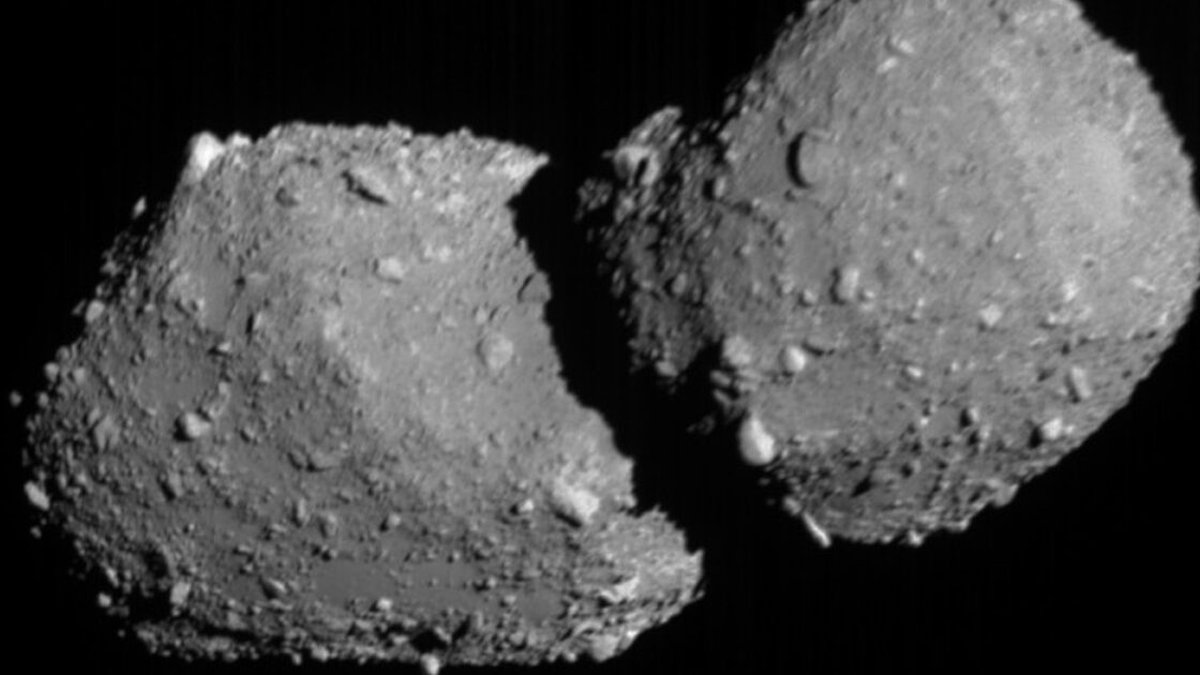
On Sunday, July 5, the Japan Aerospace Exploration Agency (JAXA)'s Hayabusa2 probe performed a close flyby of the asteroid Torifune, capturing this image of the two-lobed near-Earth object.
Hayabusa2 aimed to fly very close past Torifune without colliding, and it came as close as 800 meters (0.5 miles) from the asteroid’s center. JAXA viewed the flyby as an opportunity to test the orbital maneuvering required for a planned collision with an asteroid — a method of asteroid deflection. This added to Hayabusa2’s value to planetary defense efforts, along with the mission’s study of its asteroid targets themselves.
Image credit: JAXA et al.
Fact Worth Sharing
More than 20 asteroids, dwarf planets, and Kuiper belt objects have been visited by spacecraft, starting in 1991 when NASA’s Galileo spacecraft flew past the asteroid 951 Gaspra. Since then, encounters have ranged from high-speed flybys to dedicated sample return missions.
Mission Briefings
Another asteroid got its first close-up. This time, it’s a quasi-moon. Kamoʻoaelwa is a tiny asteroid that orbits the Sun on a path that carries it alongside Earth, making it a quasi-moon of our planet. China’s Tianwen-2 spacecraft reached Kamoʻoaelwa on July 2 and took this picture from a distance of about 20 kilometers (12 miles). Next, Tianwen-2 will study the asteroid and attempt to anchor and attach to it if possible. Image credit: CNSA/Handout via Xinhua.
New Horizons woke up after nearly a year of hibernation. The spacecraft, which achieved the first exploration through the Pluto system in 2015 and the first exploration of another Kuiper belt object, Arrokoth, in 2019, has been offline while cruising through space since August 2025. The mission team sent commands to wake New Horizons up to prepare it to begin conducting a study of hydrogen in the outer heliosphere.
Viking 1 made the first successful Mars landing 50 years ago next week. To celebrate the milestone, The Planetary Society is partnering with the National Air and Space Museum, Johns Hopkins University, and SpaceNews for a special event on July 20 on Capitol Hill. Registration is now open to the public.
From The Planetary Society
Next month, a solar eclipse will pass over western Europe. On Aug. 12, Greenland, Iceland, and Spain will experience a total solar eclipse. Most of Europe will experience a partial eclipse, with most populated areas witnessing 80-90% of the Sun obscured by the Moon. Our extensive collection of resources for making the most of the eclipse is now available in English, Spanish, French, and German. Pictured: Planetary Society member Steve Sheridan captured this sequence of images of the 2017 solar eclipse in Culver, Oregon. Image credit: Steve Sheridan.
Ever wondered what life would be like without cell phones and Wi-Fi? They’re banned in Green Bank, West Virginia, so that its giant radio telescope can listen undisturbed. On this week’s Planetary Radio, hear from director Katie Dellamaggiore and physicist Ellie White about the documentary "Small Town Universe," which documents life in this town and the science enabled by going offline.
Last chance: Speak up for science in the United States. A rule change proposed by the White House's Office of Management and Budget would replace merit-based peer review of science grants with partisan political review. This means political appointees — not scientists — would decide what science gets funded in the United States. We urge anyone living in the United States to share their personal perspective on why this change will harm science. Submissions close on July 13, 2026, at 11:59 p.m. ET.
What's Up
This week, look for Venus shining super-bright in the western evening sky. Yellowish Saturn rises in the east in the middle of the night and is high in the sky before dawn. In the pre-dawn, reddish Mars shines in the east. Learn more in our guide to July’s night skies.
Carl Sagan. Bill Nye. You.
The Planetary Society was co-founded by Carl Sagan to give you an essential role in space exploration. Not already a member? Join today! When you become a member, you join a global community of space advocates who make a critical difference in supporting a future full of space exploration. Join Chief Ambassador Bill Nye and become part of the world's most effective independent space advocacy nonprofit!
Wow of the Week
On cosmic scales, asteroids are small — but some are smaller than others. On the left of this composite image is Ryugu, the asteroid target of Hayabusa2’s primary sample return mission. On the right, the teeny-tiny asteroid 1998 KY26, which is slated for a 2031 rendezvous as the mission’s final objective. At just 11 meters (36 feet) in diameter, 1998 KY26 would be the smallest asteroid visited up close by a spacecraft. Image credit: ESO/M. Kornmesser/T. Santana-Ros, JAXA/University of Aizu/Kobe University.
Send us your artwork!
We love to feature space artwork in the Downlink. If you create any kind of space-related art, we invite you to send it to us by replying to any Downlink email or writing to [email protected]. Please let us know in your email if you’re a Planetary Society member!
Facts Only
* Hayabusa2 performed a close flyby of asteroid Torifune on July 5.
* The flyby was approximately 800 meters (0.5 miles) from Torifune's center.
* JAXA viewed the flyby as testing orbital maneuvering for asteroid deflection.
* The Tianwen-2 spacecraft reached Kamoʻoaelwa on July 2 and took a picture from about 20 kilometers away.
* New Horizons was commanded to wake up in August 2025 to study hydrogen in the outer heliosphere.
* Viking 1 is scheduled for its first successful Mars landing the following week.
* A solar eclipse will pass over western Europe on August 12.
* The Planetary Society is partnering with other organizations for an event on July 20 concerning the eclipse.
* Submissions regarding a proposed rule change in the U.S. concerning science grant review close on July 13, 2026.
* Asteroids and dwarf planets have been visited by spacecraft since 1991.
* The smallest asteroid visited up close was 1998 KY26, with a diameter of 11 meters (36 feet).
Executive Summary
Full Take
The narrative juxtaposes highly specific scientific achievements—like the Hayabusa2 flyby and New Horizons reactivation—with broader calls for public engagement regarding policy and societal values. The pattern observed is the framing of scientific exploration as both a mechanism for planetary defense (asteroid deflection) and a source for public education, balanced against potential political interference in funding decisions. This duality suggests an underlying tension between technical progress and democratic oversight.
The inclusion of news about private space missions and astronomical observations alongside appeals for public input on government science policy creates a framework where scientific endeavor is positioned as a shared public good requiring both expert action and citizen attention. The juxtaposition of near-intimate views of distant objects (like Kamoʻoaelwa) with large, abstract political battles over funding suggests an implicit argument that real-world impact relies not just on technical capability but on the governance structures surrounding that capability.
What assumptions underpin the request for public input regarding science grants? Does prioritizing partisan review over merit in science funding reflect a systemic erosion of trust when confronting complex, long-term challenges like planetary defense or deep space exploration? The focus shifts from *what* is known (the facts of the flyby) to *how* knowledge is authorized and distributed. Where does the responsibility lie when technical experts pursue missions that benefit humanity versus political bodies determining which scientific futures are funded?
Sentinel — Human
The text reads like a curated newsletter blending space news updates with advocacy appeals, demonstrating strong editorial structure typical of human-managed content.