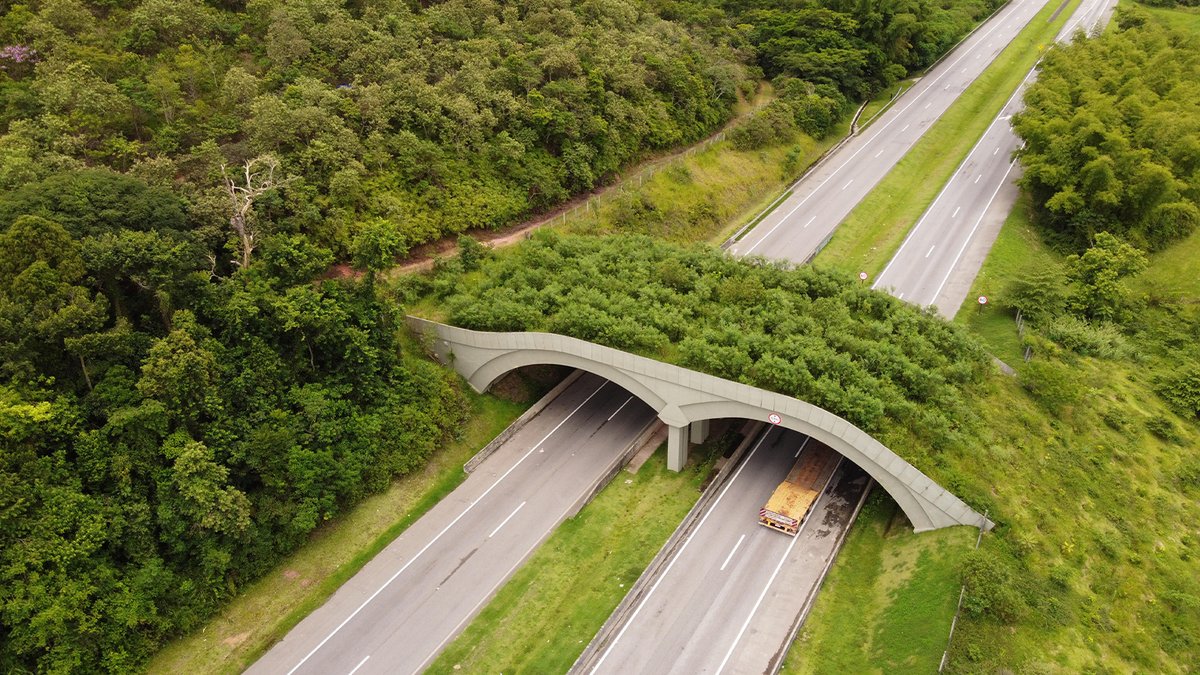
Nearly three years ago, Newscast guest, author and journalist Ben Goldfarb discussed his book Crossings, which is about wildlife crossings and road ecology. Wildlife crossings help reconnect habitats fragmented by road networks, reducing collisions, helping protect threatened wildlife, and improving genetic diversity.
Since that conversation, Goldfarb has documented the growing popularity of wildlife crossings worldwide. He returns to the Newscast to detail how, where, and why wildlife crossings are becoming increasingly funded and built.
“Probably the biggest factor is that at this point, the evidence that wildlife crossing structures are effective is just overwhelming. Maybe 20 years ago, you could’ve theoretically said, ‘Well … we don’t necessarily know that …’ but here in 2026, we just have a lot of scientific research basically showing that animals of all shapes and sizes use wildlife crossings,” Goldfarb says.
He takes us to locations in South America, North America and Europe, where this particular type of infrastructure has rare nonpartisan political support. A bill is currently before the U.S. Congress to make the Wildlife Crossings Pilot Program permanent. Public surveys show overwhelming support for wildlife crossings in the United States. Goldfarb explains that the positive reception may also be due to the visual nature of one iteration of crossings, the highway overpass, which a source of his long ago described as “billboards for connectivity.”
“I love wildlife crossings for … their ability to … just remind us that we’re sort of global citizens of a planet that we share with wildlife.”
Please take a minute to let us know what you think of our podcast here.
Mike DiGirolamo is the host & producer for the Mongabay Newscast based in Sydney. Find him on LinkedIn and Bluesky.
Banner image: The first wildlife bridge in Brazil connects habitat across the coastal four-lane BR-101 highway. Saving Nature’s partners, DOB Ecology and the Golden Lion Tamarin Association, are reforesting a corridor to connect a protected area to the south and forest fragments to the north of the bridge. Image courtesy of Luis Paulo/Saving Nature.
Related podcast:
Transcript
Notice: Transcripts are machine and human generated and lightly edited for accuracy. They may contain errors.Ben Goldfarb: Overpasses are these big, beautiful bridges that are really hard to miss. I forget who it was, but one source years ago described them to me as billboards for connectivity, these giant, striking visual reminders that, as you say, we share the landscape with other animals, and they have to move through our world, and we have to let them do that. And yeah, I love wildlife crossings for exactly as you say, their ability to just remind us that we’re global citizens of a planet that we share with wildlife.
Mike DiGirolamo: Welcome to the Mongabay Newscast. I’m your host, Mike DiGirolamo, bringing you weekly conversations with experts, authors, scientists, and activists working on the front lines of conservation, shining a light on some of the most pressing issues facing our planet, and holding people in power to account. This podcast is edited on Gadigal land. Today on the Newscast, we speak with journalist and author Ben Goldfarb. Three years ago, he appeared on this program to talk about his book, Crossings: How Road Ecology Is Shaping the Future of Our Planet. Since that time, a global movement has emerged to implement a unique piece of infrastructure known as wildlife crossings, which are the centerpiece of his book. These crossings span a range of types, but they are perhaps best known for the versions that span highways, connecting one part of the wilderness to another and giving wildlife a safe passageway. The benefits are myriad, including helping protect endangered species, enhancing genetic diversity, reducing collisions and deaths among both wildlife and humans, and more. Goldfarb details this global movement, which is spurred by decades of research demonstrating the efficacy of wildlife crossings and their many benefits for both wildlife and human safety. He takes us to locations in North America, Europe, and South America where a variety of these crossings are being built, how they are being funded, and the public response to them. It’s important to note that crossings are not a panacea, and he explains how they can sometimes be used as a Band-Aid for road construction through critical habitats. But on the whole, for existing road networks, the evidence, Goldfarb says, speaks for itself. The biggest question I had about wildlife crossings is how they function as a reminder to human society that we are not separate from nature but cohabitants of it, and perhaps they may help shift public sentiment toward acknowledging our responsibility to care for nature. Goldfarb points out in this discussion that this type of conservation measure is unique among political issues. It enjoys bipartisan support in places like the United States, and public polling shows overwhelming support for it. Andy Holland, who is the environmental resources coordinator for Douglas County in Colorado, told Goldfarb, “It’s like the whole world is open to wildlife now.” Hi, Ben. Welcome back to the Mongabay Newscast.
Ben Goldfarb: Thanks. I’m thrilled to be here.
Mike DiGirolamo: Audiences might remember that we spoke almost three years ago now about road ecology and your book, Crossings. We’re going to continue on that subject today because, in the time since we last spoke, there’s been this sort of global movement to implement wildlife crossings. And this is good news in many ways. But why is this happening, from your perspective?
Ben Goldfarb: That’s a great question. I think probably the biggest factor is that, at this point, the evidence that wildlife crossing structures are effective is just overwhelming. Maybe 20 years ago, you could have theoretically said, “We don’t necessarily know that animals use them sufficiently to restore genetic connectivity across highways, and we don’t have a ton of data about their benefits for human safety through the prevention of dangerous, expensive vehicle crashes.” But here in 2026, we just have a lot of scientific research basically showing that animals of all shapes and sizes use wildlife crossings. They mate on either side, so they restore gene flow across these highways that can fragment populations. And we also know that fences and crossings prevent a lot of crashes, and that saves human lives and public money in the long run. So there’s this overwhelming body of evidence, I think, that wildlife crossings are effective. And at this point, it’s impossible for any transportation agency in North America or beyond to deny how important they are.
Mike: Yeah. And given the 20 years of research, in the last three years have you looked at the numbers? Have you crunched the numbers to see how many human lives we’re saving with wildlife crossings and how many nonhuman lives we’re saving?
Ben: Yeah, that’s such a good question, Mike. We don’t really know the answer to the human life question. I think part of the issue there is that a lot of single-car crashes are wildlife-related incidents that don’t get reported as such, right? Somebody swerves to avoid a deer or a black bear and unfortunately hits a tree or a telephone pole and doesn’t survive to tell the tale. That doesn’t get recorded as a wildlife-related incident, but that is, in fact, a wildlife-related human fatality. So we don’t have a great sense of how many people are dying due to wildlife crashes to begin with, which makes it hard to know how many lives are being saved by wildlife crossings. But I would say broadly that we know wildlife crossings and fences reduce collisions with large animals by almost invariably more than 80%, and often by 95% to 100%. So we know that there’s a huge reduction in collisions that adds up to lots and lots of nonhuman lives being saved and certainly a bunch of human ones as well. And I think, in testament to how effective they are at preventing crashes, we know that many wildlife crossings actually pay for themselves very quickly. These are multimillion-dollar pieces of infrastructure that, in many cases, prevent so many expensive crashes that they actually recoup their own construction costs in under a decade. So they’re good investments as well as good conservation and public safety projects.
Mike: Let’s talk about where the investment is being spent. You wrote a pretty substantial piece for us about this, and there were two places you really zeroed in on. One of them is North America, and another is Croatia. But let’s first talk about North America. What’s happening there?
Ben: In North America, we’re seeing this incredible outpouring of new wildlife crossing construction and new funding for wildlife crossings. I live in Colorado, which is where part of the article you’re referencing is set. There we’ve got this giant highway, Interstate 25, that basically runs north to south through the state and effectively prevents the movement of deer, black bears, elk, pronghorn, and all of these critters, cutting off their east-west movements. Over the last decade or so, the Colorado Department of Transportation has been very invested in building wildlife crossings, particularly in the region between Colorado Springs and Denver, this very heavily trafficked, densely populated part of Colorado along the eastern front of the Rocky Mountains. There, the transportation department has put in five underpasses and, starting at the end of last year, one giant overpass, what’s currently the largest wildlife overpass in the country, though it will soon be surpassed by one in California. That’s been incredibly effective in reducing collisions and facilitating animal movements. That overpass just had its first elk on it this past week, actually, which is a big milestone in the history of that project because elk tend to take a while to acclimate to a new crossing structure. Those crossings are really emblematic of this broader interest around North America, and around the U.S. especially, in wildlife crossing construction. Historically, we’ve seen western states taking the lead on this issue, states like Colorado, Wyoming, Utah, and Montana. But increasingly we’re seeing eastern states get very involved as well. States like Vermont, Maine, and Massachusetts, which historically hadn’t been very engaged in wildlife crossing construction, are increasingly dedicating funds toward it. So it’s a pretty exciting time for this particular issue in the United States.
Mike: I found it really inspiring in a way. I’m not a giant fan of car travel by any means, but seeing bipartisan support for these crossings really does stand out. Do you find anything interesting about that?
Ben: Yeah, I think that’s a great point, Mike. The bipartisan support does make wildlife crossings fairly unique among conservation initiatives. That goes back to a couple of things. One is the public safety issue we were talking about earlier. Theoretically, public safety is a nonpartisan issue. But I think it also attests to the influence of the hunting community, frankly. Deer, elk, and antelope hunters don’t want to see animals splattered on the highway any more than members of the Humane Society do. Hunters are, in many cases, strong advocates for keeping herds of deer and elk healthy in the American West, and that means preventing highway collisions. In states like Wyoming especially, which is probably the best example of this, obviously a very deep-red state, the hunting community and conservation-oriented hunters have been really integral in pushing the state to dedicate funds for wildlife crossings. So you have this conservative constituency that is very engaged in habitat connectivity and safe passage. That’s a big part of why this is genuinely a bipartisan issue. Some of the language dedicating funding for wildlife crossings in the 2021 Infrastructure Investment and Jobs Act was initially written by John Barrasso, the Republican senator from Wyoming. And Ryan Zinke, the Republican representative from Montana, is sponsoring legislation right now to allocate more funding for wildlife crossings. So in this hyperpolarized society, this is a truly bipartisan issue, which is pretty exciting.
Mike: There’s a program called the Wildlife Crossings Pilot Program, and there’s currently a bill that would make it permanent. Can you tell our audience what the Wildlife Crossings Pilot Program is? What did it do?
Ben: So that was the 2021 program within the Infrastructure Investment and Jobs Act that I mentioned a moment ago, and that essentially dedicated $350 million over five years to new wildlife crossings. The format of that program was essentially a competitive grant program, so states, Native tribes, and other entities basically submitted applications saying, “Hey, here’s the crossing that we want to build,” or “Here’s the planning study we want to conduct.” Then that money was allocated based on which grants the Federal Highway Administration chose to fund. It was a very successful program. It’s actually still ongoing. There’s still one more round of funding left to give out this year. The problem is that it wasn’t nearly enough money. Three hundred and fifty million dollars sounds like a lot, but in the context of massive federal transportation budgets, it’s literally a drop in the bucket. There’s so much need for these projects that states and tribes applied for many times more funding than was available. So lots of really worthy wildlife crossings went unfunded. Now the issue is whether we can get that program reauthorized in the next big surface transportation bill that Congress is theoretically going to pass this year, if Congress can do anything. Ideally, that would dramatically increase the funding for wildlife crossings. There are a couple of bills that would do that. One would fund it for another five years at $400 million over five years, so a modest increase over the previous funding level. But there’s also talk of funding it at $1 billion over five years, which I think would start to address the scale of the problem. That’s what the Zinke bill would accomplish.
Mike: If this bill was made permanent, does that permanently lock in, theoretically, a billion dollars every five years in perpetuity for building and maintaining this infrastructure? Is that kind of how it would work? Do you know the details on that?
Ben: Yeah. It would do a couple of things. One is building new infrastructure. But just as important is planning future infrastructure, right? The idea is that the western states in particular, like Colorado, Wyoming, Montana, and Utah, have been doing this work for a long time. They’ve got a pretty good sense of where they need wildlife crossings. Here in Colorado, we’ve got many years of research showing that Interstate 70 near the town of Vail is a critical hotspot that desperately needs an overpass. Midwestern and eastern states, as I said before, haven’t done nearly as much of this work. So they still need, in many cases, to conduct the research that pinpoints where the hotspots are and where wildlife crossings are feasible and practical. That’s what this funding has done. It’s provided money not only for those big, flashy, shovel-ready projects, but also for laying the scientific and planning groundwork for states that haven’t been very engaged in this issue to start doing that work in the future.
Mike: What are you going to be looking into next? What’s your next big question or line of inquiry?
Ben: Yeah, that’s a good question, Mike. One of the things that interests me is how we deploy more of these projects on the ground. One of the challenges is that the construction costs of these projects have gone way up in recent years due to inflation and rising costs across the construction industry. We’re seeing wildlife crossings that used to cost $5 million to $10 million now costing more like $20 million in some cases. That big overpass on Interstate 25 received $22 million in federal funding. It didn’t actually use all of it, but that gives you a sense of the scale of these projects now. So what does it mean to deploy them more cost-effectively? Can we find ways to make dollars go further? Maybe that means different methods of construction, or maybe it means different construction materials. There are researchers at the Western Transportation Institute in Montana who have been conducting research for a very long time into building wildlife crossings out of recycled materials, fiber-reinforced polymers, essentially plastics. Maybe that’s an avenue to getting these projects on the ground in a more cost-effective fashion because, even if we get more funding for wildlife crossings, it’s still not going to provide every dollar that we require to mitigate all of those hotspots out there.
Mike: I want to introduce a bit of nuance here because I don’t want to make it seem like we’re painting wildlife crossings as a panacea. You highlighted this nuance in your piece, and you write that sometimes crossings themselves can become a form of “malicious restoration.” What is malicious restoration?
Ben: I think this broadens our geographic scope a little bit. We see this outside of North America in countries like Myanmar, Kenya, and Nepal, countries that are building out infrastructure right now. Here in the U.S., we’re mostly retrofitting our existing highways rather than building new major ones, whereas countries in the developing world are building their highway systems now. I think there’s a tendency, or at least the possibility, to say, “If we build a new highway through an intact chunk of wildlife habitat but add wildlife crossings, then we’ve essentially solved the ecological problem of the new highway.” That’s a concern that I have, and it’s one I’ve heard other road ecologists express as well. Wildlife crossings are a great technology, but they’re really good at solving a couple of specific problems. Crossings and fences are excellent at preventing roadkill and allowing animals to move around the landscape and reconnect habitat. That’s great, but roads cause all kinds of other problems too. They create significant noise pollution, which is hugely disruptive to migratory birds, for example. They bring in cars, which shed tire particles, and we’re learning more all the time about how toxic tire particles are for many fish species and other aquatic life. Roads completely change land-use patterns. A road goes in and suddenly clear-cutting, mining, and all kinds of potentially destructive activities become much more feasible. Wildlife crossings can’t prevent any of those problems. So the issue I want to see avoided worldwide is allowing wildlife crossings, as effective as they are at solving a couple of discrete problems, to justify potentially devastating new infrastructure development.
Mike: There’s another term you use, “bridge to nowhere.” There’s a risk of wildlife crossings becoming a bridge to nowhere. What does that mean exactly, and how does it happen?
Ben: The idea is that wildlife crossings connect habitats fragmented by roads. But if those habitats are turned into subdivisions, farms, or strip malls, then the wildlife crossing is no longer effective. That’s not just a theoretical concern. It’s actually happening in Colorado. One of my sources in this article told me about a deer underpass near the town of Durango that is currently very effective at getting deer safely under a highway. But the land surrounding that highway is expected to be developed into a high-density housing development. The habitat the deer are moving into is essentially going to disappear. I think that’s a really important point about wildlife crossings. It’s not enough simply to build the structures. We also have to conserve the land on either side of the crossing in perpetuity so that animals actually have habitat to move between. Investment in crossings has to be matched by investment in land conservation.
Mike: Hello, listeners, and thank you for tuning in. As I always like to mention, Mongabay is a nonprofit news organization. We rely on the support of listeners like you. So if you’d like to support the podcast, go to patreon.com/mongabay to become a monthly sponsor of the show. If you’d like to read Goldfarb’s reporting or find a copy of his book Crossings, you can find links in the show notes.
So let’s switch gears now to Europe because Croatia is an interesting example. As you note in the piece, much of the highway construction there didn’t really begin until the late 1990s. That created a different opportunity for infrastructure planning. What’s happening in Croatia in terms of wildlife crossings?
Ben: Yeah, this is a really neat story that I learned about while I was working on my book. Unfortunately, I didn’t have space to include it there, so I was excited to work it into this article. That story was told to me by a wildlife biologist named Josip Kusak, who studies wolves and other large carnivores in Croatia. At some point in the 1990s, he was out in a remote valley surveying wolves when he noticed survey stakes in the ground and realized they marked the route of a proposed highway that was going to run through the middle of this incredible valley. He knew it was going to be harmful, but he also knew there wasn’t much he could do to stop it. So he went to the highway authority and basically said, “Can I consult on this new highway?” Incredibly, they said, “Sure, we’d love to hear your ideas.” He proposed all of these underpasses, bridges, and animal-friendly infrastructure, and the highway authority essentially adopted all of it, resulting in one of the most permeable highways in the world. Road ecologists often talk about roads being permeable or impermeable. Can animals move across them or not? What you want is a permeable highway where animals can move over and under with relative ease. This Croatian highway is one of the most ecologically permeable roads anywhere. It doesn’t receive nearly as much attention as the famous crossings in Banff National Park, but it’s one of the most wildlife-friendly highways on Earth. A big part of that is timing. It was built later, when we already understood how devastating highways could be for wildlife. Kusak had studied in the United States and learned wolf-tracking techniques in Minnesota. He was able to point to the U.S. and say, “We don’t want to end up with giant, impermeable interstate highways like those. We want highways that animals can actually cross.”
Mike: There’s another layer to this that I want to ask about because it’s not talked about in your piece, but my research tells me that crossings are also being increasingly implemented for train infrastructure, which I think is obviously a very good thing because we need more public transportation as well. What can you tell me about that situation? Have you looked into that at all?
Ben: A bit, yeah. There are overpasses being built for bighorn sheep, for example, in the Mojave Desert, where there’s a new high-speed rail line going in. I think those are among the first overpasses in the U.S. for a train line that have ever been built. Look, I think that obviously, broadly, anything we can do to get people out of cars is fantastic, and I’m all in favor of expanded rail. But rail also creates a lot of the same ecological problems that highways do. Rail lines can be really significant barriers to animal movement. Trains can’t brake unlike cars, which leads to some really high collision rates on certain rail lines. So trains are wonderful, but they require some of the same mitigation that highways do. I know that in India and Bangladesh, there are really high rates of train collisions with Asian elephants. That’s actually a bigger mortality source, I believe, than car and truck collisions are because cars and trucks can see an elephant in the road and brake. Elephants are pretty conspicuous. Whereas trains require about half a mile to brake, essentially, and so they really can’t stop for an elephant on the tracks. There are very high elephant collision rates with train lines in South Asia, and I know there have been some underpasses and fences installed along train lines in Asia for elephant passage.
Mike: There are some other forms of crossings that you highlight in the piece, specifically in tropical forested nations, and one of them is canopy bridges. Can you talk about these? Because it’s obviously a different kind of infrastructure than a highway overpass. What do canopy bridges provide? What are the advantages or disadvantages there?
Ben: The primary advantage is that in tropical countries especially, you have all of these arboreal animals that live up in the treetops and move between areas of forest without descending to the forest floor. A sloth, a gibbon, or a howler monkey is very unlikely ever to encounter a conventional wildlife underpass. These are animals that really have to move between forest fragments at the level of the treetops. Unfortunately, those forests are often fragmented by roads, and for those arboreal critters, canopy crossings are really the best mitigation that we have. They’re really simple structures, just sort of a rope ladder, like Indiana Jones would cross in Temple of Doom, from one forest fragment to another over the road. The design varies a little depending on the primate or other animal you’re trying to help because they have different mechanics in the way they swing from vine to vine or branch to branch, so you have to think about that a little bit. But the principle is generally the same. They’re incredibly effective. They’ve been shown to work for all kinds of species, from squirrel gliders in Australia to orangutans. There was just the first documented instance of an orangutan using a canopy crossing recently, which is very exciting. There’s a road ecologist named Fernanda Abra in Brazil who I spent a bunch of time with down there a few years ago, and she’s installed dozens of these things and has this big project to build many more in the Amazon, where new highways are being built or existing ones are being paved. And yeah, they’re extremely effective for those arboreal animals and really cost-effective too. They often cost hundreds of dollars rather than millions, as many wildlife crossings do.
Mike: Was there anything, or any location or place, that you wanted to look more into or did look more into that you didn’t get to write about in the piece?
Ben: I’m always fascinated by some of the stuff happening in India. There are some really innovative wildlife mitigation solutions being tried there. For example, elevated highways that are built on concrete pillars so that, instead of having isolated underpasses, the entire forest floor is wide open for many miles, allowing animals to move back and forth seamlessly. I’ve always wanted to see one of those stretches of road and report on that. India also just opened its first section of what they call Red Road, which is basically a section of road where the pavement is striped in red and black. The idea is that by creating that kind of unusual visual pattern, it induces drivers to drive more slowly than they would on a conventional road. I’ve always been fascinated by that concept of essentially getting drivers to slow down by changing the design speed of the highway. We know that changing the posted speed limit along a road doesn’t actually influence driver speed very much. If you’re on a big, straight, wide-open highway, you’re going to go 70 miles an hour even if the posted limit is 55. But by changing the design speed of the road, by adding more sinuosity, bends and curves, by narrowing the lanes potentially, or by changing the pattern of the pavement itself, we can theoretically slow drivers down for the sake of wildlife. India is trying some of that, which I think is pretty interesting.
Mike: You’ve been on this subject for, I think it’s fair to say, many years now, and you’ve talked to a lot of people. You’ve talked to engineers and just regular old citizens around these projects. So I’d love to hear your thoughts on the evolution of public sentiment toward this kind of infrastructure. How would you describe the trajectory of it over the course of your reporting?
Ben: Yeah, it’s a great question. I would say that the sentiment these days is incredibly positive. I think it’s generally been positive for a while. Here in Colorado, there’s been public polling showing that 85% of residents support more wildlife crossings. You couldn’t get 85% of people to agree that the sky is blue, right? So that’s just an amazing indication of how popular these things are. I think that’s a testament to a few different factors. There’s been a lot of media coverage around the efficacy of wildlife crossings, not least by Mongabay. You guys have covered this topic as well as anybody over the years, which I really appreciate, and it’s one of the reasons I was excited to do a piece about the subject for Mongabay. Part of it is just how visual a subject it is. I remember talking once to Patty Cramer, who’s famous, or famous in the road ecology world. Shout out to Patty, who’s just been a fantastic source for me over the years on this subject. The point she made is that one of the things that totally changed public sentiment was the advent of the camera trap. Starting in the early 2000s, there were these increasingly cheap motion-activated cameras that road ecologists could deploy on wildlife overpasses and underpasses and get these spectacular images and videos of mountain lions and bears and bobcats and all kinds of critters. That became an amazing public outreach tool that I think really moved sentiment in favor of these structures. People could literally see animals using them. It’s hard to refute that they work when you can actually lay your own eyes on the evidence. And then I think they are just the proverbial win-win-win-win. They help public safety. They save the public money. Maybe most important, they conserve threatened and endangered wildlife populations. They keep herds of huntable game on the landscape if you’re a hunter. So they just do all of this great stuff. Whatever your political alignment or your values, there’s some reason that you theoretically care about getting animals safely across highways.
Mike: The thing I’m interested in asking about, and I don’t know if you’ll have a response to this or not, is that when I look at wildlife crossings, they evoke this almost, and I want to be careful about how I say this, almost utopian-type ethos, where we no longer consider ourselves separate from nature and actually acknowledge the truth, which is that we are part of it. And I’m an environmental journalist, so if I’m thinking that, surely when people look at these, they think, “Oh, wow. I didn’t consider that, but that’s really cool. Yeah, we are all really kind of responsible for protecting wildlife and, hence, ourselves.” I’m curious if you feel these kinds of structures help shift an Overton window of public sentiment, as it were, toward acknowledging our inherent connection with nature.
Ben: Yeah, that’s a really beautiful idea, Mike, and I think it’s spot on. I think that’s especially true of wildlife overpasses, right? Because underpasses are… you could drive over a wildlife underpass beneath the highway and not know it was there, whereas overpasses are these big, beautiful bridges that are really hard to miss. I forget who it was, but one source years ago described them to me as billboards for connectivity, these giant, striking visual reminders that, as you say, we share the landscape with other animals, and they have to move through our world, and we have to let them do that. That’s one of the reasons I’m so excited about the overpass being built just outside of Los Angeles, the Wallis Annenberg Wildlife Crossing over the 101. That’s literally one of the most densely trafficked freeways on Earth, with hundreds of thousands of cars per day, and here’s this giant, spectacular crossing for mountain lions, coyotes, bobcats, deer, lizards, and all kinds of other critters. It’s under construction now, will be open in December of this year, and basically advertises to the world that, yes, even in a really urban place like the Los Angeles suburbs, there are these large carnivores out there that we cohabitate with, and we have to be respectful of them and share space with them. And yeah, I love wildlife crossings for exactly as you say, their ability to remind us that we’re global citizens of a planet that we share with wildlife.
Mike: Ben, do you have anything that you’re working on, maybe a new book or a piece, that you want to share with us, that you want to plug?
Ben: Thanks. Yeah, Mike, I’d love to come back on the pod in a couple of years and talk about this, but I’m working on a book now about fish. What about them? I don’t know. They’re awesome. They’re beautiful. I love them. The tagline that I keep repeating to myself is that fish are the new birds. Birds are, of course, these beautiful migratory animals whose journeys we admire, and they visit the feeders in our backyards. They’re the consummate mobile wildlife. Fish are also undertaking these spectacular adventures of their own, but they’re invisible to us. And we treat them as commodities and quarry. When we encounter fish, it’s at the end of a line or on a plate. The ethos of this book is having encounters with fish in their own milieu, respecting them as spectacular migratory wildlife the way that we respect our avian brethren.
Mike: I am both a bird fan and a fish fan, so when you are ready for galley copies, send me one, and I will give it a read.
Ben: I know people on the internet are always like team bird or team fish, but at the end of the day, we’re actually all fish, right? So it’s a false dichotomy.
Mike: All right, Ben, thank you so much for joining me. Have a great day.
Ben: All right. Thanks a lot, Mike.
Mike: As always, if you’re enjoying the Mongabay Newscast or any of our podcast content and you want to help us out, we encourage you to spread the word about the show and leave a review. Word of mouth is among the best ways to help expand our reach. You can also support us by becoming a monthly sponsor at our Patreon page at patreon.com/mongabay. We’re a nonprofit news outlet, so even pledging a dollar per month makes a very big difference and helps us offset production costs. So if you’re a fan of our audio reports from Nature’s Frontline, go to patreon.com/mongabay to learn more and support the Mongabay Newscast. You can also read our news and inspiration from Nature’s Frontline at mongabay.com or follow us on social media. Find Mongabay on LinkedIn at Mongabay News, and on Instagram, Threads, Bluesky, Mastodon, Facebook, and TikTok, where our handle is @mongabay, or on YouTube at Mongabay TV. Thank you, as always, for listening.