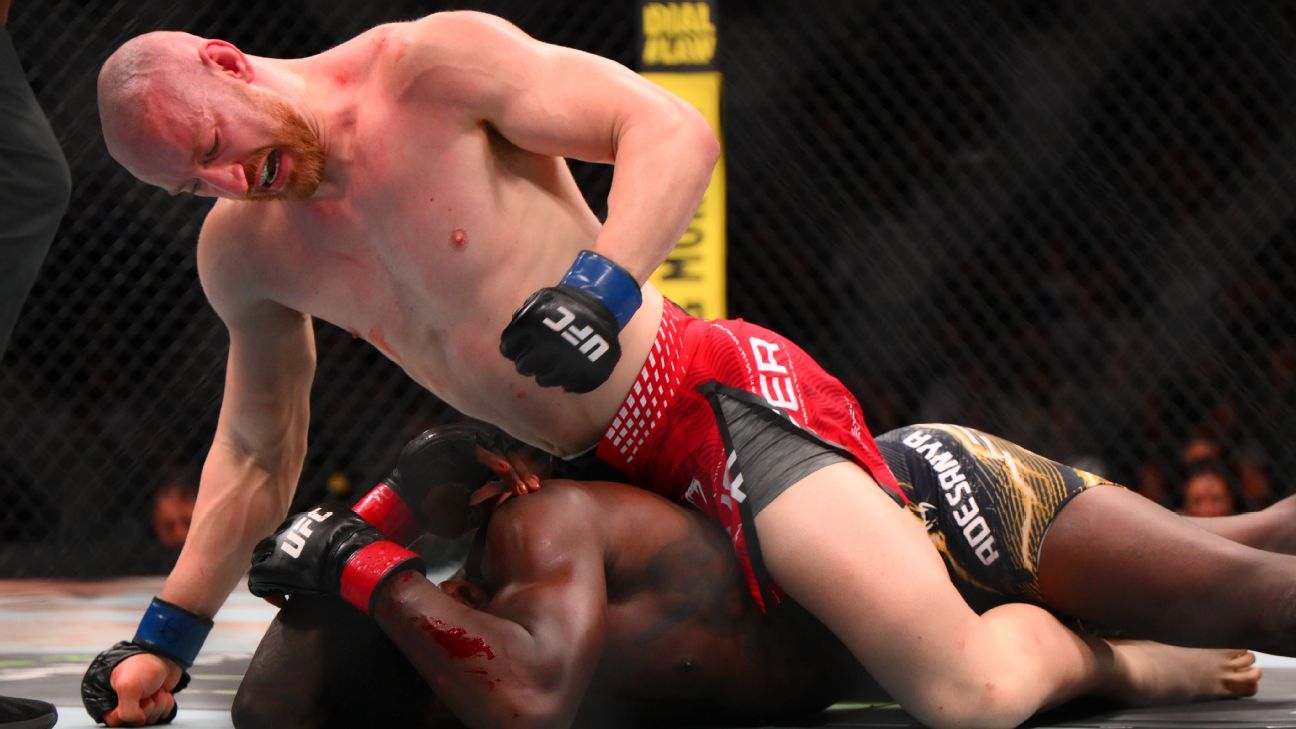
All week, Joe Pyfer said his recent spiritual transformation would not change his performances inside the Octagon -- he proved that Saturday night against two-time UFC champion Israel Adesanya.
Pyfer (16-3) scored the biggest win of his career at UFC Fight Night in Seattle, finishing Adesanya (24-6) via TKO at the 4:18 mark of the second round. The finish came after Pyfer hurt Adesanya with strikes, threw him to the canvas and forced the referee to intervene with vicious ground strikes from the back.
It was Pyfer's first appearance since he committed himself to Christianity earlier this year, and he revealed his personal life had been even more dire than he'd previously let on.
"I almost took my own life a couple weeks ago, but I found God," Pyfer said. "I don't like crying, so I'm going to keep it together. God restored me, that's the only reason I'm here."
Before this year, Pyfer had developed the reputation of something of an antagonist in MMA. Several of his previous fights have involved public animosity with his opponent, and he had been known to sling insults on social media. The buildup to Saturday's main event was completely different, with Pyfer showing nothing but respect for Adesanya, whom he repeatedly referred to as the greatest middleweight of all time.
Adesanya, 36, looked good in the opening seven minutes, defending several Pyfer takedown attempts and even appearing to have him hurt in the second round. Adesanya put Pyfer on his back foot with forward pressure and leg kicks but was eventually forced to back off after Pyfer hit him with a counter left hook. Pyfer followed with a good body shot moments later, and then a flush right hand that visibly had Adesanya rocked.
Pyfer eventually wrestled Adesanya down with a body lock and quickly moved to his back. Adesanya defended a rear-naked choke attempt but had no answer for Pyfer's ground-and-pound from the back.
Adesanya suffered his fourth consecutive loss dating back to September 2023. He has been finished in his past three appearances but was defiant about his UFC future immediately after the bout.
"You keep going -- again and again and again and again," Adesanya said. "I'm not f---ing leaving. You'll never stop me. I might get beat, but I'll always remain undefeated."
For Pyfer, who fights out of Pennsylvania, it's a massive win that should catapult him up the rankings. He went into Saturday's contest ranked No. 14 in the division. Adesanya was ranked No. 4.
"Izzy is not the most powerful guy in the world, we know that, but he's one of the highest fight IQ champions of all time," Pyfer said. "There's nobody better. In my book, he's the best middleweight of all time. I love you as a champion, love you as a person. Congratulations to Israel. My man was [ranked] No. 4, I'm in the top five [now]. As Izzy said, 'They need me and here I am.' I'm 16-3, 29 years old."
In the co-main event, former UFC flyweight champion Alexa Grasso (17-5-1) picked up her first win since March 2023 with a highlight-reel knockout over Maycee Barber (15-3). Grasso rocked Barber with a left hand at 2:42 of the opening round. Barber spun around from the shot and Grasso jumped on her back and applied a rear-naked choke, but Barber was already out from the initial punch. The loss snapped a seven-fight winning streak for Barber.
Facts Only
Joe Pyfer defeated Israel Adesanya via TKO at 4:18 of the second round at UFC Fight Night in Seattle.
Pyfer improved his record to 16-3, while Adesanya fell to 24-6.
Pyfer revealed he had considered suicide weeks before the fight but credited his newfound Christian faith for his recovery.
Adesanya suffered his fourth consecutive loss, with his last three defeats coming by finish.
Pyfer, ranked No. 14, was respectful toward Adesanya, calling him the greatest middleweight of all time.
Adesanya, ranked No. 4, stated he would continue fighting despite the loss.
In the co-main event, Alexa Grasso knocked out Maycee Barber at 2:42 of the first round.
Grasso’s victory ended Barber’s seven-fight winning streak.
Executive Summary
Full Take
This fight narrative presents a compelling intersection of personal redemption and athletic triumph, but it also invites scrutiny of how such stories are framed. The strongest version of this narrative highlights Pyfer’s resilience—his spiritual transformation and victory over a former champion—while acknowledging Adesanya’s defiance in the face of repeated losses. The emotional weight of Pyfer’s revelation about suicidal thoughts adds a humanizing layer, but it also risks being exploited for dramatic effect, particularly if future coverage leans into a "redemption arc" without nuance.
Pattern-wise, the framing of Adesanya’s post-fight defiance ("I might get beat, but I'll always remain undefeated") could be interpreted as a form of emotional resilience or, more cynically, as a way to soften the blow of a declining career. The contrast between Pyfer’s humility and Adesanya’s bravado might be used to create a binary of "old guard vs. new blood," though the article itself avoids overt manipulation. The mention of Pyfer’s past as an "antagonist" in MMA, juxtaposed with his current respectful demeanor, could be framed as growth—or as a strategic rebranding.
Root cause: The narrative taps into the archetype of the underdog’s rise, reinforced by Pyfer’s personal struggles and Adesanya’s fall from dominance. The unstated assumption is that spiritual transformation directly correlates with athletic success, which may oversimplify the complexities of mental health and performance. Historically, this echoes the trope of the "redeemed warrior," a powerful story but one that can gloss over systemic issues in combat sports, such as the pressure on fighters to perform despite personal crises.
Implications: For human agency, Pyfer’s story could inspire others facing similar struggles, but it also risks setting an unrealistic expectation that faith alone can resolve deep-seated issues. Adesanya’s defiance, while admirable, may delay necessary reflections on his career trajectory. The UFC benefits from dramatic storylines, but fighters bear the physical and emotional costs.
Bridge questions: How might the UFC’s promotion of personal redemption narratives affect fighters’ mental health disclosures? Could Adesanya’s repeated losses signal a need for structural support for aging champions? What perspectives are missing from the discussion of fighter well-being beyond individual resilience?
Counterstrike scan: If this were part of a coordinated influence campaign, the playbook would emphasize Pyfer’s redemption to create an emotional hook while downplaying Adesanya’s decline to avoid undermining the UFC’s brand. The actual content doesn’t fully align with this—Pyfer’s vulnerability feels genuine, and Adesanya’s defiance is presented neutrally. No overt manipulation is detected, but the framing still serves the UFC’s interest in compelling storytelling.
Patterns detected: none