What Is World Leaks?
World Leaks is a cyber extortion operation that steals sensitive data from organizations and threatens to leak it via the dark web if a ransom is not paid.
Hang on - Isn't That Just Ransomware by Another Name?
Well, you can think of it like that if you want - but traditional ransomware attacks involve two things: stealing and encrypting your data, followed by demands for payments to be made to prevent the publication of the stolen information.
World Leaks, however, focuses exclusively on the theft and threat to expose sensitive data - without the use of encryption. It appears that the group has decided that pure extortion is more profitable (and less risky) than deploying traditional file-encrypting ransomware.
But Won't There be Less Incentive for Hacked Companies to Pay if They Can Still Access Their Data?
For some companies, it is undoubtedly the case that the pressure to pay is greater if their files are encrypted and their business is paralyzed.
If your systems are still running and your data remains accessible, the question really becomes just how damaging would publication actually be? The answer to that varies enormously, depending on what was stolen.
For healthcare providers, law firms, and financial institutions who may have had highly sensitive customer data stolen the consequences of a leak could be huge - especially when you consider the possible regulatory consequences and damage to reputation.
So How Long Has World Leaks Been Around, and How Does It Operate?
The group officially emerged in January 2025, reportedly splintering from the Hunters international ransomware operation after it declared the ransomware business "too risky and unprofitable".
World Leaks offers an "Extortion-as-a-Service" (EaaS) platform to its so-called "affiliates" who use a custom-built data exfiltration tool to steal from networks.
Data thefts are announced on a dark web leak site, while a negotiation portal for victims offers live chat facilities.
Meanwhile, World Leaks even appears to offer journalists their own "insider" platform for breaking news of hacks.
An "Insider" Platform for Journalists?
Yes, World Leaks seems to offer reporters early access to stolen data before victims have even had a chance to respond publicly to extortion demands.
It seems World Leaks views the threat of media coverage as a way of applying significantly more pressure on its victims during ransom negotiations.
Sheesh. So How Does World Leaks Break Into Corporate Networks?
The most commonly-observed method involves accessing VPN infrastructure via valid credentials - often when organizations have not enforced or not properly configured multi-factor authentication (MFA). The group has also exploited known vulnerabilities and used targeted phishing to gain initial access to corporate systems.
So How Big a Threat Is World Leaks? Who Has been Hit?
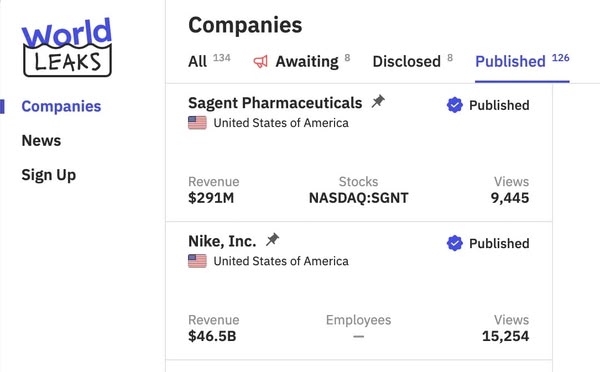
Since January 2025, World Leaks has claimed over 130 victims. These include Nike, UBS, and Dell. Most recently, World Leaks listed the City of Los Angeles as a victim, claiming it stole 160GB of data, including police interview transcripts and records.
What Should My Business Do to Protect Itself?
Here are some tips on what you can do to protect your organization from groups like World Leaks:
- Make sure you enforce MFA on all VPNs and remote access systems. You should use phishing-resistant MFA where possible (for instance FIDO2, passkeys)
- Keep all internet-facing systems fully patched, especially VPNs and remote access tools, and replace any out-of-date or no-longer-supported devices that could be exploited.
- Data loss prevention tools can spot unusually large data transfers.
- Segment your network so that if attackers do manage to get in, they will find it difficult to move around.
- Train staff to recognize and report suspicious communications and phishing emails
Editor’s Note: The opinions expressed in this and other guest author articles are solely those of the contributor and do not necessarily reflect those of Fortra.
Cybercrime Intelligence Shouldn't Be Siloed
Fortra® experts are dedicated to protecting organizations and the public by delivering the latest insights, data, and defenses to strengthen security against emerging cyber threats.
Facts Only
World Leaks is a cyber extortion operation that steals data and threatens to leak it unless a ransom is paid.
The group emerged in January 2025, reportedly splitting from the Hunters International ransomware operation.
World Leaks does not encrypt data; it focuses exclusively on theft and exposure threats.
The operation uses an "Extortion-as-a-Service" (EaaS) model, providing affiliates with custom data exfiltration tools.
Victims are listed on a dark web leak site, and negotiations occur via a live chat portal.
World Leaks offers journalists early access to stolen data before victims respond publicly.
The group has claimed over 130 victims since January 2025, including Nike, UBS, Dell, and the City of Los Angeles.
The City of Los Angeles breach allegedly involved 160GB of data, including police records.
Common attack vectors include compromised VPN credentials, unpatched vulnerabilities, and phishing.
Multi-factor authentication (MFA) is frequently bypassed due to poor enforcement or configuration.
Recommended defenses include phishing-resistant MFA, system patching, network segmentation, and employee training.
Executive Summary
World Leaks is a cyber extortion operation that emerged in January 2025, splintering from the Hunters International ransomware group. Unlike traditional ransomware, it focuses solely on data theft and threats of exposure rather than encryption, operating as an "Extortion-as-a-Service" (EaaS) platform. The group uses affiliates to deploy custom data exfiltration tools, announcing breaches on a dark web leak site and negotiating ransoms via a live chat portal. It has claimed over 130 victims, including major corporations like Nike, UBS, and Dell, as well as the City of Los Angeles, from which it allegedly stole 160GB of sensitive data. World Leaks gains access through compromised VPN credentials, unpatched vulnerabilities, and phishing attacks, often exploiting weak multi-factor authentication (MFA) implementations. The group also offers journalists early access to stolen data, leveraging media pressure to coerce victims into paying. While some organizations may resist paying if their data remains accessible, sectors like healthcare and finance face severe reputational and regulatory risks from leaks. Mitigation strategies include enforcing phishing-resistant MFA, patching systems, network segmentation, and employee training.
The shift from ransomware to pure extortion reflects a calculated risk assessment by cybercriminals, prioritizing profitability and lower operational risk. However, the long-term effectiveness of this model depends on victims' perceived consequences of non-payment, which vary by industry and data sensitivity.
Full Take
**STEELMAN:** The strongest version of this narrative highlights a strategic evolution in cybercrime, where threat actors prioritize extortion over encryption to reduce risk while maintaining profitability. The article effectively outlines the operational mechanics of World Leaks, its rapid growth, and the tangible risks to organizations, particularly in high-stakes sectors. By emphasizing real-world victims and specific attack vectors, it grounds the threat in verifiable reality rather than speculation. The inclusion of mitigation strategies also provides actionable value, avoiding alarmism.
**PATTERN SCAN:** The article avoids overt manipulation, but subtle framing choices warrant attention. The focus on high-profile victims (Nike, UBS, Dell) and the City of Los Angeles could amplify perceived urgency, a mild form of fear appeal (ARC-0012). The description of World Leaks' "insider platform" for journalists might inadvertently normalize the group's tactics, risking a form of sanewashing (ARC-0031) by presenting their media strategy as sophisticated rather than unethical. However, these are minor and likely unintentional.
**ROOT CAUSE:** The paradigm here is the industrialization of cybercrime, where groups optimize for efficiency and scalability. The shift from ransomware to pure extortion reflects a cost-benefit analysis: encryption is resource-intensive and may trigger more aggressive law enforcement responses, while data theft alone can yield similar payouts with lower risk. This mirrors broader trends in criminal enterprises favoring "service-based" models (e.g., RaaS, EaaS) that lower barriers to entry for affiliates.
**IMPLICATIONS:** For human agency, this model shifts power dynamics. Organizations with robust data protection may resist, but those in regulated industries face coercive pressure due to reputational and legal risks. The journalist "insider" platform weaponizes transparency, turning media into an unwilling accomplice in extortion. Second-order consequences include potential erosion of trust in digital systems and increased surveillance of employee behavior to prevent leaks.
**BRIDGE QUESTIONS:**
How might the profitability of pure extortion models influence the broader cybercrime ecosystem? Could this lead to a decline in ransomware or hybridize with other attack vectors?
What ethical obligations do journalists have when offered early access to stolen data? Does reporting on such leaks inadvertently incentivize further attacks?
If regulatory penalties for data breaches increase, could this paradoxically empower extortion groups by raising the stakes for victims?
**COUNTERSTRIKE SCAN:** A coordinated influence campaign pushing this narrative might aim to destabilize trust in corporate and governmental cybersecurity, framing extortion as an inevitable and unstoppable threat. The attack playbook would emphasize high-profile victims, downplay defensive measures, and amplify fear of reputational damage. However, the actual content does not match this pattern. It provides balanced context, mitigation strategies, and avoids hyperbolic language, suggesting it is a straightforward threat assessment rather than a manipulative effort.
Sentinel — Human
This article appears to be written by a human journalist with a strong understanding of the subject matter. The text shows signs of individuality, conversational style, and unique insights, indicating it is unlikely synthetic or AI-assisted in nature.