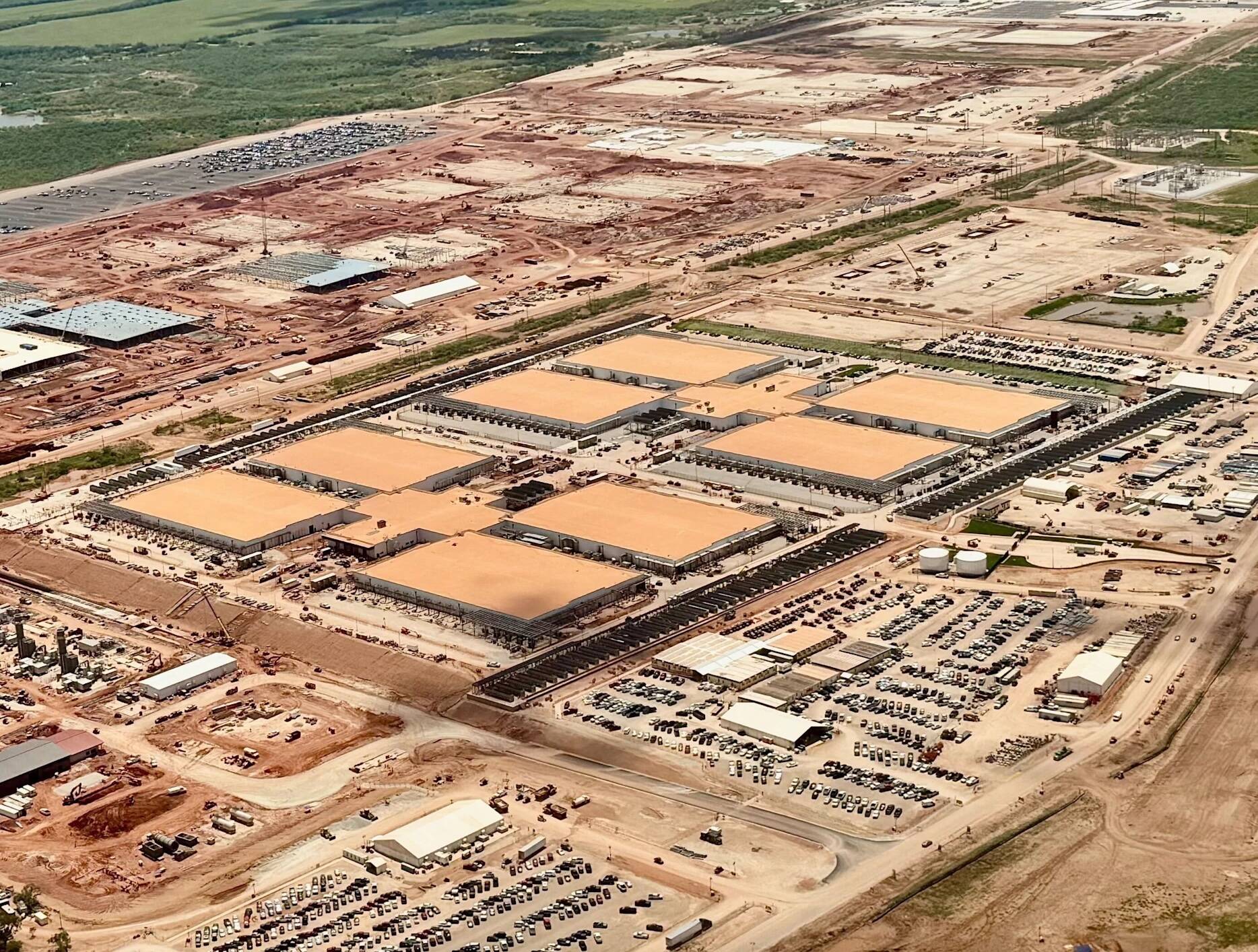
New campus to include on-site power generation
Bitcoin farmer turned bit barn builder Crusoe revealed plans to add 900 megawatts of capacity to its Abilene Texas datacenter campus on Friday to support Microsoft's AI ambitions.
The new campus will be located alongside the 1.2 gigawatt facility Crusoe is building for Oracle and OpenAI as part of its $500 billion Stargate initiative, announced early last year.
Oracle and OpenAI had reportedly planned to lease the additional capacity until negotiations and financing fell through.
Meta was expected to lay claim to the unbuilt and yet untapped datacenter expansion, but it seems Microsoft will now take up residence at the site instead. While Microsoft's relationship with OpenAI has certainly changed in recent years, its possible that Redmond could end up using the site to serve the model dev.
The new campus will feature two new data halls along with an on-site power plant capable of delivering 900 MW of behind-the-meter energy to the facilities. The bit barns themselves will each support 336 megawatts of critical IT load.
"By integrating 900 megawatts of new on-site power generation, we will continue building the industrial foundation for American AI – at a velocity the industry has never seen," Chase Lochmiller, Crusoe CEO said in a canned statement.
- Senators want datacenters to come clean on power consumption
- Microsoft and Nvidia claim AI can speed approval of new atomic plants
- OpenAI now gets to decide which type of product assassin it will become
- Arm rolls its own 136-core AGI CPU to chase AI hype train
According to Crusoe, this expansion will bring the site's capacity to 2.1 gigawatts, though "capacity" seems to be doing a lot of the heavy lifting here. Only about 200 megawatts of existing 1.2 gigawatt projects have actually been powered on.
Crusoe says that the remaining gigawatt should come online throughout 2026. Work on the second campus, which Microsoft's AI models and services will call home, is currently in the "land-clearing and site preparation" phase. Crusoe doesn't anticipate the facilities will be operational until the middle of next year.
Crusoe didn't elaborate on how its on-site power plants generate their power, but given the timeline, natural gas generators or fuel cells are the most likely candidates. We've reached out to Crusoe for comment; we'll let you know if we hear anything back. ®
Facts Only
Crusoe is expanding its Abilene, Texas datacenter campus with an additional 900 MW of capacity.
The expansion will support Microsoft’s AI ambitions and include two new data halls and an on-site power plant.
The new campus will bring the site’s total capacity to 2.1 GW, though only 200 MW of the existing 1.2 GW is currently operational.
The project is part of Crusoe’s $500 billion Stargate initiative, initially involving Oracle and OpenAI.
Oracle and OpenAI’s plans to lease additional capacity reportedly fell through due to financing issues.
Meta was previously expected to claim the expansion but will not be involved.
Microsoft’s relationship with OpenAI has evolved, but it may use the site for AI model development.
Construction is in the land-clearing and site preparation phase, with operations expected by mid-2025.
Crusoe has not disclosed the power generation methods for the on-site plant.
The remaining 1 GW of the initial 1.2 GW facility is expected to come online throughout 2026.
Executive Summary
Crusoe, a company transitioning from Bitcoin mining to datacenter development, is expanding its Abilene, Texas campus with an additional 900 MW of capacity to support Microsoft’s AI infrastructure. This new campus will include two data halls and an on-site power plant, bringing the site’s total capacity to 2.1 GW, though only 200 MW of the existing 1.2 GW is currently operational. The expansion is part of Crusoe’s broader $500 billion Stargate initiative, which initially involved Oracle and OpenAI, though their plans to lease additional capacity reportedly fell through. Microsoft’s involvement suggests it may use the site for AI model development, despite its evolving relationship with OpenAI. Construction is in early phases, with operations expected by mid-2025. Crusoe’s power generation methods remain undisclosed, but natural gas is a likely candidate given the timeline.
The project highlights the rapid scaling of AI infrastructure and the competitive dynamics among tech giants like Microsoft, Oracle, and Meta. However, the gap between announced capacity and operational reality raises questions about execution risks. The focus on on-site power generation also underscores the energy demands of AI, though specifics about sustainability or efficiency are absent.
Full Take
**STEELMAN:** This narrative effectively highlights the breakneck pace of AI infrastructure expansion, with Crusoe positioning itself as a critical player in meeting the energy demands of tech giants. The focus on on-site power generation underscores the urgency of scaling AI capacity, while the shifting alliances (Oracle/OpenAI to Microsoft) reflect the fluid dynamics of the AI arms race. The article also subtly critiques the gap between announced projects and operational reality, a common issue in tech infrastructure.
**PATTERN SCAN:** The piece leans into the "AI hype train" (ARC-0024 Ambiguity) by framing the expansion as a race for dominance without interrogating the feasibility of such rapid scaling. The lack of detail on power generation methods—despite energy being a central theme—creates a blind spot that could obscure environmental or logistical trade-offs. The mention of Meta’s potential involvement, only to pivot to Microsoft, hints at a "forced binary" (ARC-0043 Motte-and-Bailey) where the narrative implies a zero-sum competition without evidence.
**ROOT CAUSE:** The paradigm here is the tech industry’s "build first, ask questions later" ethos, driven by the assumption that AI’s exponential growth justifies unprecedented energy and capital expenditure. The unstated assumption is that these datacenters will deliver proportional value—a claim that remains unproven. Historically, this echoes the dot-com bubble’s infrastructure overbuild, where capacity outpaced demand.
**IMPLICATIONS:** Human agency is secondary to corporate and technological momentum. Local communities near Abilene may bear costs (noise, pollution, resource strain) while benefits accrue to shareholders and AI developers. Second-order consequences include potential energy market distortions if gas-powered plants proliferate, and the risk of stranded assets if AI demand doesn’t materialize as projected.
**BRIDGE QUESTIONS:**
If only 17% of the initial 1.2 GW is operational, what guarantees exist that the 2.1 GW target won’t face similar delays?
How does Crusoe’s on-site power generation align with broader climate goals, and what trade-offs are being made?
What would it look like for this expansion to prioritize community benefits (e.g., grid stability, local jobs) over pure AI scalability?
**COUNTERSTRIKE SCAN:** A coordinated influence campaign would amplify the "AI race" framing to pressure regulators into fast-tracking permits and subsidies, while downplaying environmental or feasibility concerns. The actual content aligns partially—it emphasizes speed and scale but doesn’t outright dismiss risks. No overt manipulation detected, but the lack of critical scrutiny on energy sources or local impacts leaves room for exploitation.
Patterns detected: ARC-0024 Ambiguity, ARC-0043 Motte-and-Bailey