The outpouring is, as always, sort of astonishing.
Even as nearly two dozen brutal, wind-whipped fires continue, as of this writing, to ravage NorCal’s stunning Wine Country, to the tune of tens of thousands of acres burned, unimaginable loss and indescribable devastation — all told, the most destructive inferno of its kind in California history — amidst it all, something sort of magical is occurring.
People rally. People offer support. By which I mean, armies of people, massive outpourings of support and kindness and help of every shape imaginable; communities, individuals, local governments, the National Guard, online fundraising campaigns supporting suddenly out-of-work laborers, hotel staffs, needful families; local charities, urban businesses, endless donations of food and clothing, money and refuge, love and support both big and small, personal and financial, emotional and psychological and everything in between, from places you expect, but many you don't.
The Sonoma County Fairgrounds, an enormous swath of land that’s become a small, functioning city/evacuation center unto itself, is the site of a rather staggering scene, comprising medical care, meal areas to serve hundreds, huge tents full of well-kept cots, a rest area for exhausted firefighters, play areas for children, for nursing mothers, the elderly, support for farm animals both large and small, you name it.
It’s positive. Helpful. Kind. Endlessly kind and generous, even with displaced families crammed together in cots, even with all the commiseration and sadness, even with so many thousands having no idea if their homes still stand or where they might go next. There is laughter, there is sharing, there is the unending flow of gratitude to be alive and safe, connected, even now and perhaps more than ever, to the community.
Advertisement
Article continues below this ad
It’s sort of astonishing, but also completely normal. Which is to say, this is always the universal truth: As tragedy escalates, empathy only increases. We are, by default, a generous and hopeful species, and when devastation strikes, our shared humanity only becomes more palpable; sympathy and compassion shine through the toxic smoke like beacons.
This is extremely important to note right now, simply because it’s become all too easy, in the bleak age of Trump, to believe that the default state of the modern human animal is actually one of suspicion, of violence and corruption, shameless sexism and racism and outright detestation for all you hold dear.
It’s worth remembering that, for eight solid years, acts of compassion and overt kindness of the type we're seeing right now in NorCal were hallmarks of the Obama era. No one ever doubted the federal government would be there to help, or that the president would offer genuinely heartfelt words of support in times of need, and follow through immediately.
These traits have, of course, all but completely vanished from the GOP-led federal government, replaced by nothing but callousness and cruelty, dumb tweets and snarling rhetoric.
This is, after all, a president who threatens to withdraw all aid from Puerto Rico, simply because they’re too poor and have lousy infrastructure and therefore don’t, in his shriveled mind, deserve the help after a devastating hurricane left millions without clean water, electricity, food.
Advertisement
Article continues below this ad
This is an administration that gleefully destroys health care for millions, guts women’s rights, wipes away health care for children, rolls back Obama-era air quality protections regarding coal pollutants — protections that, by every estimate, saves thousands of lives, prevents asthma, protects children.
This is a Republican-led government that, in the face of the most savage gun massacre at the hand of a white American male terrorist, does … well, absolutely nothing at all.
We are not them. Trump is not us. And, perhaps most importantly, the humanity we share cannot, no matter how hard they try, ever be corrupted.
Make no mistake. This is not to say there is nothing to worry about regarding NorCal's devastating fires. This is not to say “it’s all good” or that we in the Bay Area should be “looking on the bright side” or “see it as a blessing.” This is nonsense. Of course most of what has been lost can, eventually, be rebuilt. Of course the land will recover and regrow. This is not the point.
Let’s be clear: This is a terrible, catastrophic event, more than 30 people dead so far, entire communities destroyed and entire towns under threat, the near-complete annihilation of some of the most gorgeous landscape in the country. The heartbreak is immeasurable.
Advertisement
Article continues below this ad
It’s a region noted not just for stunning vineyards, but countless historic sites and multi-generational family homesteads, gentle retreat centers and childhood campgrounds, historical taverns and deep-woods cabins, hundreds of family-run businesses, enormous redwoods and world-famous natural hot springs, high-end resorts and funky backwoods inns, hostels, national parks, antiques dealers and artists, hot-air balloon rides and antique airplanes, stunning homes, world-famous architecture to make you swoon. On and on.
About Opinion
Guest opinions in Open Forum and Insight are produced by writers with expertise, personal experience or original insights on a subject of interest to our readers. Their views do not necessarily reflect the opinion of The Chronicle editorial board, which is committed to providing a diversity of ideas to our readership.
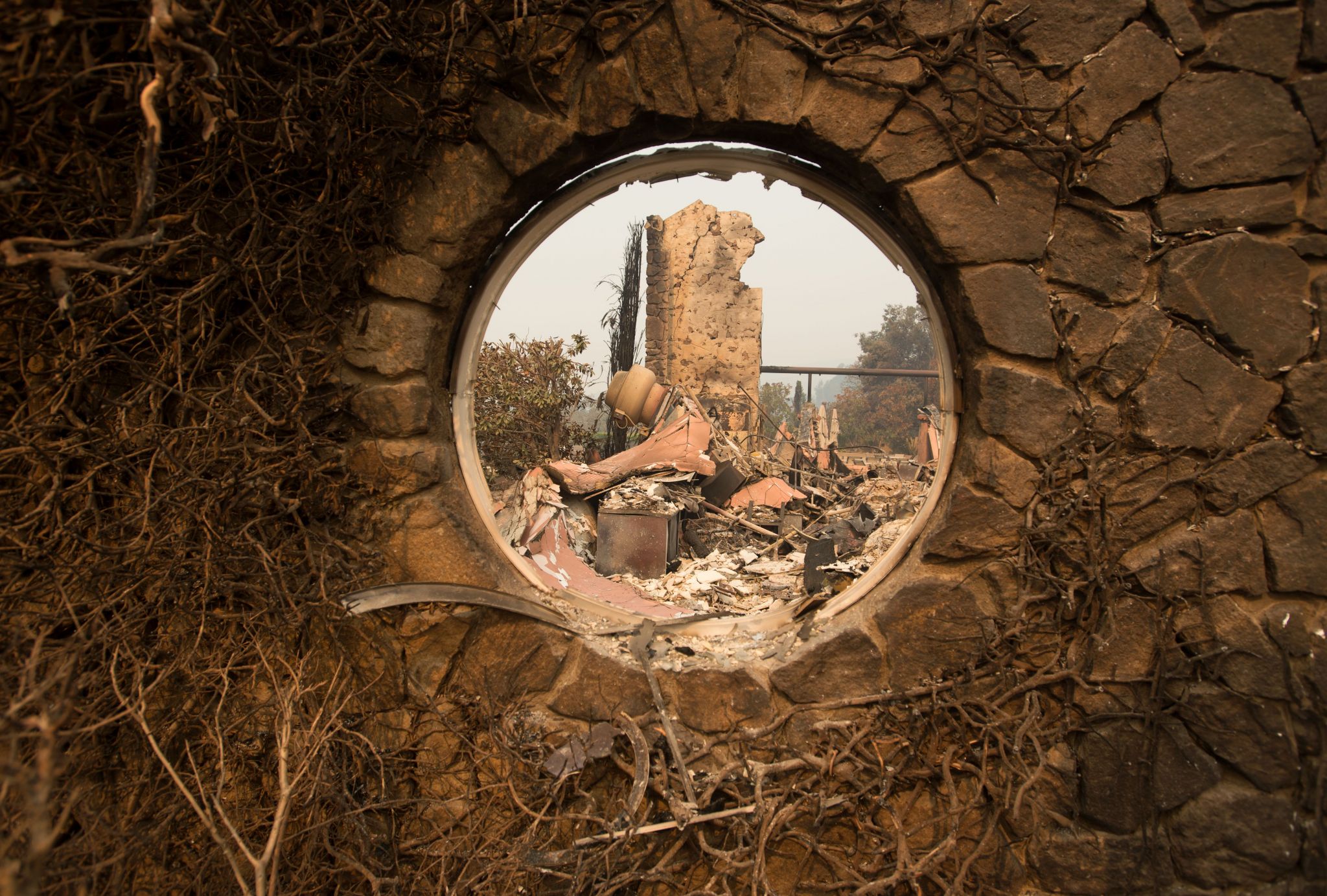
Translation: This is no typical region, no typical wildfire, no typical loss of near-empty forestland and a handful of remote buildings. This is more than 3,500 structures lost (so far). This is toxic air quality worse than Beijing. This is entire neighborhoods, street after street and block after block, burned to the ground, leaving nothing but a lone chimney and the blackened steel carcass of a car.
This is simply to say, the devastation might be staggering and the loss heartbreaking, but the outpouring of love and community support — occurring, as it is, smack in the face of every nasty Trump tweet, every hateful GOP agenda item, every bit of racist Breitbart propaganda, et al — is unutterably marvelous and radiantly humane. And for this, we can only bow in gratitude.
Mark Morford has been providing hyper-literate, award-winning commentary and cultural criticism to SFGATE since 1998, which probably astounds him more than it does you. He’s also one of the Bay Area’s premier yoga instructors, leading classes, workshops and retreats in SF and around the world since 2001. Read his latest stories, follow him on Twitter, Facebook and Instagram, or just visit markmorford.com for the whole of it. Email him here.
Facts Only
Wildfires in Northern California's Wine Country have burned tens of thousands of acres.
Over 30 people have died in the fires.
More than 3,500 structures have been destroyed.
The Sonoma County Fairgrounds is serving as a major evacuation center with medical care, shelter, and support services.
Communities, individuals, and organizations have provided donations, fundraising, and volunteer efforts.
The federal government's response to disasters under the current administration has been criticized.
The Trump administration has been accused of callousness, including threats to withdraw aid from Puerto Rico.
The fires have caused toxic air quality worse than Beijing.
Historic sites, businesses, and natural landscapes have been devastated.
The fires are described as the most destructive in California history.
The Obama administration was noted for its compassionate disaster response.
The current administration has rolled back environmental and healthcare protections.
Executive Summary
Full Take
The strongest version of this narrative highlights the resilience and compassion of communities in the face of unprecedented disaster, contrasting it with the perceived callousness of the federal government. The article effectively underscores the human capacity for empathy and collective action, even amid tragedy, while critiquing political leadership that appears indifferent to suffering. This framing serves as a beacon of hope, reinforcing the idea that shared humanity transcends political divisions.
However, the piece also employs emotional exploitation (ARC-0012) by amplifying the contrast between local compassion and federal indifference, potentially oversimplifying complex policy challenges. The critique of the Trump administration, while valid, risks reinforcing partisan divides rather than fostering constructive dialogue. The narrative echoes historical patterns of disaster response, where local solidarity often outpaces federal action, but it also risks conflating policy disagreements with moral failings.
The root cause of this narrative is a paradigm of political polarization, where disaster response becomes a proxy for broader ideological battles. The unstated assumption is that federal leadership should embody moral clarity, yet the piece does not fully explore the structural constraints or alternative perspectives on disaster governance.
Implications for human agency are profound: the article celebrates grassroots solidarity but risks undermining trust in institutions. The second-order consequence may be further entrenchment of partisan narratives, where disaster response is weaponized for political gain.
Bridge questions: How might federal disaster response be improved without deepening political divisions? What role do local communities play in bridging gaps left by federal policy? How can narratives of resilience avoid reinforcing "us vs. them" dynamics?
Counterstrike scan: A coordinated influence campaign would amplify the emotional contrast between local heroism and federal failure to stoke outrage and deepen divisions. The actual content aligns with this pattern but does not appear to be part of a deliberate manipulation effort. The critique is earnest, though it risks oversimplification.
Patterns detected: ARC-0012 Emotional Exploitation