Tenzin Nyidon
DHARAMSHALA, July 7: The final rites of Tibetan independence activist Lobga Rangzen, also known as Lobsang Palden, who died after self-immolating outside the United Nations headquarters in New York, was held on Monday as condolences and statements of solidarity poured in from the United Nations and several US political leaders.
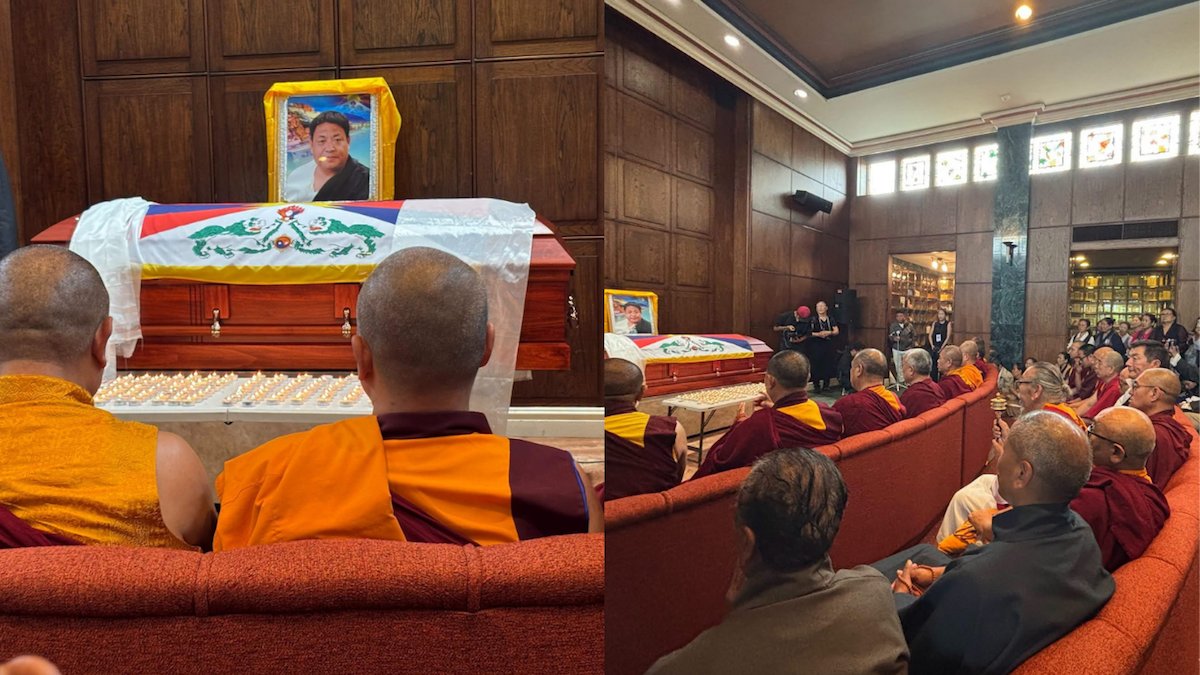
A memorial service for Lobga Rangzen was held in New York City on July 6, coinciding with the 91st birthday of His Holiness the Dalai Lama. His body was received at the Phuntsok Deshi Community Hall, where hundreds of Tibetans gathered to offer prayers, present khatas, and pay their final respects to an activist remembered for his lifelong commitment to the Tibetan cause.
Following the prayer ceremony and final farewell, Lobga Rangzen’s body was taken to Brooklyn for cremation, marking the end of the final journey of an activist whose last public act was a call for Tibetan independence and unity.
The United Nations also responded publicly to the incident. During a press briefing on July 6, UN spokesperson Stéphane Dujarric described the self-immolation outside the UN headquarters as “absolutely tragic.” He said two UN security officers were the first to respond, using fire extinguishers before New York emergency services arrived. Dujarric conveyed condolences on behalf of the UN Secretary-General to Lobga Rangzen’s family.
When asked about the political issues behind the protest, Dujarric said it was difficult to understand what would drive someone to such an act. He added that the Secretary-General has consistently emphasized the importance of protecting minority rights and ensuring minorities feel included in society.
“We are saddened by this tragic and horrific incident, and offer our condolences to his family,” a spokesperson for UN Secretary-General António Guterres told AFP.
New York City Mayor Zohran Kwame Mamdani also expressed condolences, saying he was “heartbroken” over the activist’s death. “No one should feel that such a desperate act is the only way to make the world listen,” Mamdani said, extending his sympathies to Lobga Rangzen’s family and reaffirming New York City’s solidarity with the Tibetan community.
The New York City Mayor’s Office of Immigrant Affairs issued a separate statement, describing Lobga Rangzen, as a lifelong advocate who dedicated himself to amplifying Tibetan voices and defending fundamental human rights. “We are deeply saddened by the death of Tibetan activist Lobsang Palden (Lobga Rangzen), following his act of political protest outside the United Nations,” the statement read.
It added that moments such as these serve as reminders of “the continued suffering that can accompany displacement, persecution, and the enduring struggle for identity, culture, and belonging.” The office further noted that New York City is home to generations of immigrants, including members of the Tibetan community who sought political asylum, freedom, dignity, and the opportunity to live without fear.
US Congresswoman Alexandria Ocasio-Cortez also paid tribute, describing Lobga Rangzen as a “Tibetan freedom activist.” “I am devastated by the death of Tibetan freedom activist Lobga Rangzen. As we mourn his loss, we continue to fight for human rights in Tibet and across the globe. My heart is with his loved ones and our entire Tibetan community in NY-14,” she said.
Cincinnati Mayor Aftab Pureval issued one of the most extensive responses, expressing grief with Lobga Rangzen’s family and Tibetan communities around the world. “It is tragic that a man so devoted to his cause, his identity, and his nation felt that he had to die to be heard,” Pureval said.
He linked the activist’s death to what he described as the ongoing erosion of Tibetan identity under Chinese rule, noting that China’s new Ethnic Unity and Progress Law had come into effect one day before Lobga Rangzen died. Pureval argued that the legislation forms part of broader efforts to assimilate Tibetans, Uyghurs, and Mongolians into a state-defined national identity.
The mayor also pointed to decades of policies affecting Tibetan language, religion, and education, referencing the state boarding school system and religious restrictions. He noted that more than 170 Tibetans have self-immolated since 2009 in protest against Chinese rule, adding that many of their names have gone largely unnoticed internationally.
Calling Tibet’s movement “nonviolent, democratic, and more than 70 years old,” Pureval urged political leaders and international institutions to speak more openly about the situation in Tibet.
Sentinel — Human
The text functions as a report aggregating statements from various political bodies regarding the death of an activist, relying on established public discourse rather than presenting novel information.